

























































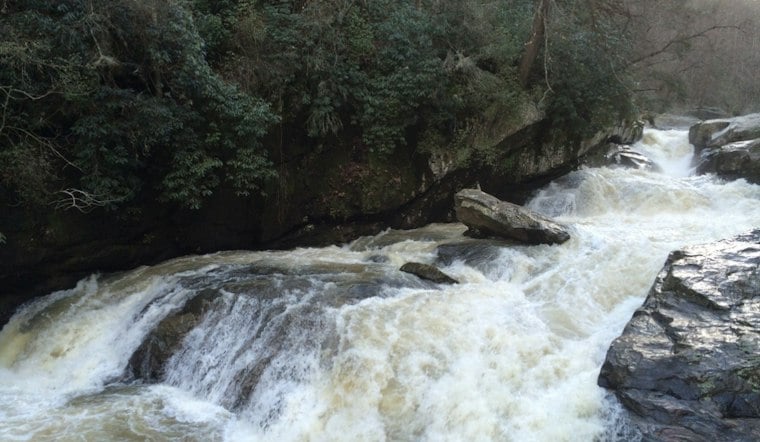
Along the Green River near the Henderson-Polk county line, the water still doesn't move the way it used to. Two years after Tropical Storm Helene tore through the Tuxedo Hydroelectric Station in a landslide, the plant that regulated this river's flow for more than 100 years remains broken, leaving the Green with what locals describe as an uncertain future.
Before Helene, the Tuxedo station's turbines ran six hours a day, releasing 200 cubic feet of water per second from 7 a.m. until 1 p.m., according to the Raleigh News & Observer. That controlled daily pulse has been replaced by water simply overflowing the dam continuously instead of in a concentrated release, the paper reports. Northbrook Power Management, which owns the dam, has confirmed separately that the facility is no longer able to manipulate either the natural lake levels upstream or the water flows downstream, according to Hendersonville Lightning.
The scale of the disruption is stark for paddlers. Shane Benedict told the News & Observer that if the hydro station operated normally, the Green would run roughly 300 days a year — compare that to the Linville River, which runs only about 50 to 70 days annually. Benedict ranks the Green River Narrows among the top five best-known rivers in the country among serious paddlers, a reputation built on its three miles of Class 5 rapids, part of a river system that also includes four miles of Class 2 and 3 water upstream and gentler Class 1 and 2 stretches below suited to tubing, using the standard 1-to-6 whitewater grading scale.
Tubing Company Swept Away, Now Rebuilt on Rain
Wendell Gillespie, 60, owns Green River Cove Tubing Company, a business his father opened in 1982. The outfit was swept away during Helene and stayed closed through 2024, reopening only this past May, per the News & Observer's reporting. Gillespie said the business now depends on rain for customers, since the Tuxedo plant's power releases used to reliably raise the river by as much as a foot on a predictable schedule.
The numbers tell the story of a shrunken season: where the tubing company once served 600 to 800 customers per weekend before the storm, it now draws just 300 to 400. Making matters worse, the Green River Cove switchbacks remain closed to through traffic because of landslides, adding about 20 minutes to the drive from Asheville or Hendersonville for anyone trying to reach the river. The region's tubing outfitters elsewhere have had mixed fortunes — 828newsnow.com reports that Green River Cove Tubing Co. is raising prices to $15 per person this summer to cover higher permit, fuel and equipment costs, even as demand across western North Carolina's outfitters has stayed strong despite shifting river conditions.
A Dam Caught Between Repair and Sale
Henderson County official Chris Todd said Northbrook Tuxedo is weighing both rehabilitating the dam and discussing potential buyers, according to the News & Observer. Todd said the county is working to help facilitate a sale and identify funding sources. John Mitchell, also quoted in that reporting, said the county hopes to influence repairs so water can eventually flow through the gorge again.
Money is part of the equation. The North Carolina General Assembly allocated $20 million for repairs to a dozen dams damaged by Helene, including Lake Summit Dam, though the News & Observer notes the dam's actual share of that funding has not been determined. In a company release from March 2025, Northbrook Tuxedo said it remained committed to assessing the situation and considering sensible repairs or modifications, and separately stated the dam itself was structurally sound while it continues exploring funding sources and partnerships for a long-term solution. Reached for comment on October 6, Northbrook Tuxedo and New Energy Capital did not respond to phone messages and emails, the paper reports.
The dam's uncertain path isn't without precedent. A flume failure in June 1987 sent 15,000 cubic yards of dirt into the Green River and shut the generating plant down for four and a half years, according to Hendersonville Lightning. Debris from that decades-old accident, including large steel hoops embedded in the channel, reportedly still lingers in the river today, with local paddlers beginning efforts to remove some hazards.
One Outfitter's Frustration, And a New Stretch of River
Tim Bell, who owns Saluda-based kayak rental and guide company Green River Adventures, has watched the slowdown up close. Bell, who began whitewater kayaking at age 11 and moved to western North Carolina from Florida in the early 2000s, opened his business in 2007; he told the News & Observer his business is down about one-third since Helene and that the local economy has been stunted.
Speaking on a bridge over the Green River on October 5, Bell discussed a company proposal for a temporary siphon system meant to control water flow over the dam, though he said he prefers a long-term fix instead. He also said he's frustrated that restoration efforts have been limited and suspects finding a buyer for the dam has been prioritized over repairs. Lake Summit Dam, Bell noted, once supplied water through pipelines carrying it a mile overland before Helene hit.
Not every change has been bad news for paddlers. The Green River Dries, a stretch with Class 4 rapids, is running for the first time in decades now that the station is out of commission, and Bell said recreation is developing around this newly accessible section. Hendersonville Lightning separately reports that with its challenging Class III-IV+ rapids, that same stretch could become a valuable addition to the region's recreational economy if reliable flows are eventually restored — though Lake Summit itself remains about three feet higher than normal, with water still flowing over the dam and creating ongoing problems for property owners whose docks and boathouses have been submerged.
A Regional Economy Still Finding Its Footing
The stakes extend well beyond one river. NPR has reported that outdoor recreation across western North Carolina carries an annual economic impact of nearly $5 billion, and that in the weeks after Helene, businesses along the French Broad, the Nolichucky and the Pigeon rivers were closed indefinitely, uncertain whether normal operations could resume. NPR also noted that the flooding altered the Green's rapids so dramatically that existing whitewater guidebooks became obsolete, leaving the river littered with debris, washed-up logs and fallen trees.
North Carolina's Dam Safety Law requires that before any new construction, modification, repair or removal begins on a dam, the person or company seeking a permit must receive state approval of engineering plans and specifications, according to the North Carolina Department of Environmental Quality. That same agency's secretary, Reid Wilson, traveled to Turner Shoals Dam in Polk County to announce a second round of state grants for high-hazard dams damaged by Helene, underscoring that the Tuxedo situation is part of a broader statewide recovery effort still playing out two years after the storm.





