

























































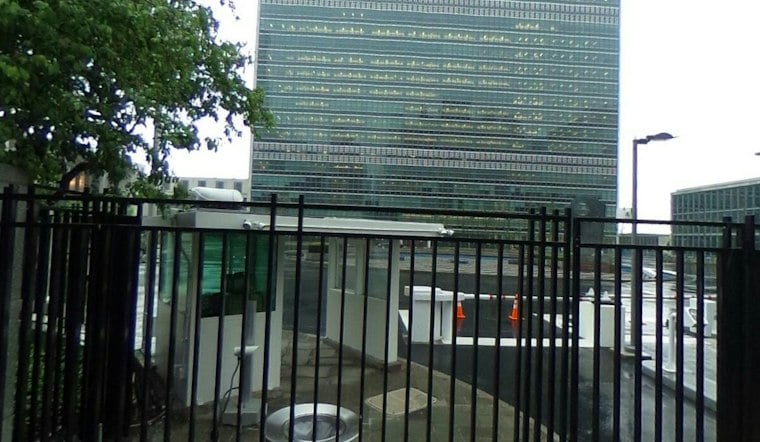
A panel of former Cuban political prisoners took the microphone at United Nations headquarters on Monday, accusing Havana of corruption and repression just a week before the General Assembly is set to vote on Cuba's annual resolution condemning the U.S. embargo. The event, titled “Cuba Libre: The Oppression Havana Hides,” was organized by the U.S. Mission to the U.N. and quickly drew a furious response from Cuban diplomats, who called it a politically motivated stunt designed to sway the vote.
Cuba's ambassador to the United Nations, Ernesto Soberón Guzmán, denounced the panel shortly before it began, branding it “a puppet show,” according to the Miami Herald. Members of the Cuban diplomatic mission reportedly protested during the event itself, yelling and calling the panelists terrorists, per the same report. The panel was organized by the U.S. Mission to the U.N. and included former political prisoners José Daniel Ferrer and Luis Manuel Otero Alcántara, GAESA finance researcher Emilio Morales, Cuba Archive executive director María Werlau, Republican Rep. Nicole Malliotakis of New York, and Ukraine's deputy permanent representative to the U.N.
A Push to Isolate Havana at the U.N.
The Trump administration is expanding its efforts to reduce Cuba's diplomatic influence at the United Nations, the Herald reports, and U.S. Ambassador to the U.N. Mike Waltz used the panel to argue that Cuba has misled the world for decades. Waltz said the Castro regime has sold the world a myth for 67 years, and added that Cuba's government lacks sufficient electricity for hospitals, schools and homes but somehow keeps the lights on in its prisons. He also pushed back on the premise of the resolution itself, saying it describes a blockade that does not exist and that no U.S. Navy ships surround the island.
Malliotakis, whose mother fled Cuba in 1959, joined Waltz on the panel alongside the former prisoners. Otero Alcántara, released into exile three months before the panel after five years behind bars, said he had been arrested several times before his imprisonment in 2021, and told the gathering that more than 31 artists remain jailed in Cuba for their work. Ferrer, meanwhile, said he spent more than 12 years in Cuban prisons, including more than nine years in solitary confinement — and said Cuban officials had offered to suspend his sentence if he spoke publicly in the government's favor. He refused, and both he and Waltz urged diplomats to vote against Cuba's resolution or abstain when the General Assembly takes it up.
Money, Doctors and GAESA's Hidden Assets
Much of the panel's firepower centered on GAESA, the military-run conglomerate that controls much of Cuba's economy. A Miami Herald investigation found GAESA held $18 billion in current assets in 2024, a figure Morales called the tip of the iceberg of hidden money as he described Cuba as a mafia state. Werlau, for her part, said an average Cuban doctor earns less than $10 a month, even as the government profits from exporting medical labor — Cuban law requires doctors who abandon overseas missions to wait at least eight years before returning home.
Those claims echo figures Cuba's own National Office of Statistics has published: the government obtained $34.7 billion from exports of social and health services between 2018 and 2024, but reinvested only 0.96% of that total back into those services, according to the Herald's reporting. Separately, Ukraine's deputy permanent representative to the U.N. told the panel that more than 1,000 Cuban nationals signed contracts with the Russian army between 2023 and 2025, lured in part by monthly payments of about $2,000.
Cuba Fires Back Over Invitations and Pressure Tactics
Soberón had criticized the event days earlier, on October 16, for being invitation-only and for not identifying its panelists in advance, accusing Washington of using U.N. premises to promote a hostile political agenda against Cuba. Waltz responded on X three days later, saying Cuba's ambassador had actually objected to invitations being extended to former political prisoners and independent experts. Cuba's Foreign Minister, Bruno Rodríguez, went further, calling the panel a deceitful spectacle and accusing Waltz of violating U.N. conference rules. Rodríguez also accused the United States of committing what he called a genocidal crime against Cuba through an energy blockade, economic aggression and other punitive measures — language Cuba has used to describe Washington's fuel-related policy, which it says amounts to an energy blockade imposed since January.
Both Soberón and Rodríguez separately accused Secretary of State Marco Rubio of directly pressuring heads of state and government to flip their votes, with Rodríguez describing it as extraordinary pressure and intimidation on other member states. Rubio spoke by phone with Salvadoran President Nayib Bukele on October 13, with Cuba coming up in the conversation; according to a State Department readout, Rubio urged El Salvador to join the United States and like-minded partners in advancing shared U.N. priorities, and said the Cuban regime will not make reforms the Cuban people deserve while it believes the international community is on its side. El Salvador has historically backed the anti-embargo resolution but did not cast a vote last year. Juan Pablo Segura, the State Department's top official for the Western Hemisphere, wrote separately that supporting Cuba's resolution delays needed reforms and lets Havana argue it need not change, urging countries to reject the measure as a reward for a regime he said endangers the United States and the hemisphere.
A Resolution With No Binding Power — and Fading Support
The General Assembly is scheduled to take up the embargo resolution on October 27 and 28, continuing a demand it has made annually since 1992 against an embargo first imposed by the United States in 1960, according to UN News. The vote is symbolic: the resolution is not binding, and only the U.S. Congress can lift the embargo. Still, the trend line has shifted sharply against Cuba in recent cycles. The 2024 resolution passed with 187 votes in favor, with only the United States and Israel voting against it and Moldova abstaining, per UN News. By 2025, support had fallen to 165 votes in favor, seven against and 12 abstentions, with Argentina, Paraguay, Hungary, Ukraine and North Macedonia joining the U.S. and Israel in opposition, according to Martí Noticias.
The slide continued at a special July 2026 session, where the General Assembly voted 136-9 with 30 abstentions on Cuba's request for an extra debate on U.S. sanctions — a request the United States had objected to. The vote drew 30 abstentions, and Waltz told the Cuban delegation during the July debate, this is not Havana. Germany, which has voted for the resolution every year since 2002, had not yet decided its position for this year's vote as of October, German Ambassador Géza Andreas von Geyr said. Soberón has maintained that the vast majority of the U.N. will still support Cuba on October 27 and 28, and Cuba has said it expects overwhelming backing for its annual resolution.
Dueling Numbers on the Embargo's Cost
Rodríguez presented Cuba's annual embargo report at a press conference in Havana in September, reporting that the embargo cost the country $8.08 billion between March 1, 2025, and February 28, 2026 — a record high and 7% above the previous year, according to UPI. Havana separately pegs the embargo's accumulated damage at $178.7 billion at current prices, though economists have questioned that figure because Cuba has not disclosed its methodology, the Miami Herald notes.
Cuba's human rights record also loomed over the week's exchanges. Freedom House has rated Cuba “not free” in every edition of its Freedom in the World report for 53 years, giving the country a score of 9 out of 100 overall and zero on political rights — the lowest ranking of any country in the Western Hemisphere. Prisoners Defenders counts more than 1,300 political prisoners still behind bars in Cuba, a tally that includes Maykel Castillo Pérez, one of the authors of the protest anthem “Patria y Vida,” who is serving a nine-year sentence despite the song winning two Latin Grammys.




