

























































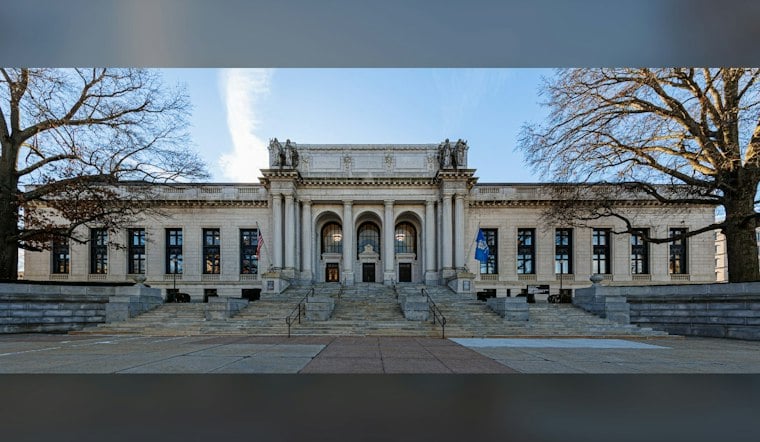
After completing her final exams this past spring, Catherine Cheek stood before Connecticut's highest court and argued a murder appeal. The case was Rashad Tee Sellers', a man sentenced to 50 years in prison, and the stakes could not have been higher for a student still finishing her degree.
Cheek, who graduated from UConn School of Law with her JD in 2026, worked on State v. Sellers alongside fellow clinic student Justin Taverna through the law school's Criminal Defense Appellate Clinic, according to UConn Today. The clinic, run in partnership with the Connecticut Division of Public Defender Services, lets students work on real criminal appeals under the supervision of experienced appellate attorneys. Cheek and Taverna were supervised by Connecticut public defenders and UConn Law adjunct professors Erica Barber and Jennifer Bourn.
On Aug. 25, the Connecticut Supreme Court reversed Sellers' murder conviction and ordered a new trial, a decision that landed squarely on the work the clinic had helped build. The appeal challenged scientific evidence the state used to tie Sellers to the crime, including lead particles found on his clothing that were described as associated with gunshot residue. The court found that the trial court should have more carefully evaluated the reliability of that evidence before admitting it, and it overturned the conviction because that review never happened. According to UConn Today, the gunshot residue evidence was the only link between Sellers and the firearm used in the homicide.
A Separate Account of the Same Reversal
The Hartford Courant likewise identifies the defendant as Rashad Tee Sellers and says the new trial followed the trial court's inadequate evaluation of the scientific evidence's reliability.
Before the ruling came down, the students did the unglamorous work of appellate litigation. They reviewed the trial court's record, researched the relevant scientific and legal issues, and helped develop the defense's arguments, per UConn Today's account of the clinic's process. Cheek ultimately stayed with the clinic for an additional year to prepare a reply brief and argue part of the case, presenting the opening portion of oral argument before the Connecticut Supreme Court herself.
Moot Courts and a Client Who Made It Real
Barber organized about five practice moot courts to help Cheek prepare for the real thing, the kind of repetition that turns nerves into readiness. Cheek has said that meeting the client made her feel the weight and importance of the appeal — a reminder that behind the legal briefs was a man who had already spent years under a 50-year sentence.
Bourn has said students like Cheek and Taverna contribute extensive time and review of case materials. Barber has said the clinic lets students see injustices that experienced attorneys may have become accustomed to, a kind of fresh-eyed scrutiny that can catch what years of practice sometimes smooth over.
A Clinic With a Track Record
The Criminal Defense Appellate Clinic typically enrolls five or six students and handles about three cases a year, taking on murder appeals, Fourth Amendment issues, search-and-seizure questions and motor vehicle stop cases. Since its launch, four clinic cases have reached final disposition, with victories in three, including two murder appeals.
Jessica Rubin, UConn's associate dean for experiential education, has said clinical legal education lets students handle complex matters under expert supervision while serving clients and communities. Both Barber and Bourn participated in UConn Law's appellate and trial clinics as students themselves, during the period associated with instructors Tim Everett and Todd Fernow. Barber has credited the clinic with leading to her first judicial clerkship and her first law firm job, and Fernow has returned as a guest lecturer, with Barber still seeking his advice on challenging legal issues.
Bourn has said the clinic confirmed her decision to pursue public defense work, and both she and Barber say they hope their former students stay connected to one another as they build careers in criminal defense, appellate advocacy and public service.





