

























































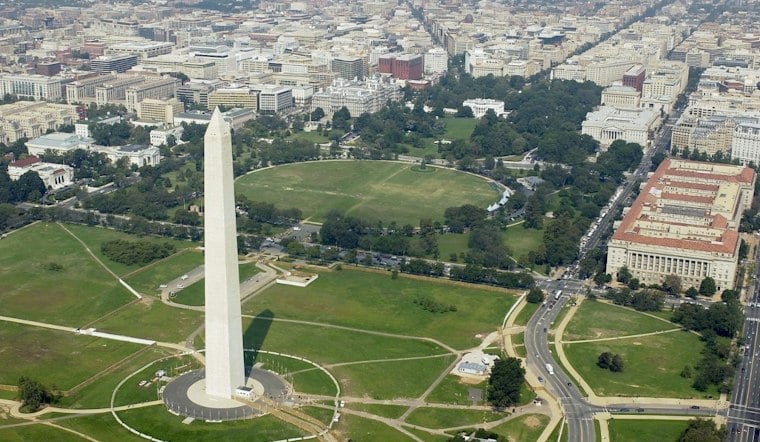
Americans and Britons gathered at the Washington Monument to bury a joint time capsule that will not be opened for another 250 years, sealed with letters from a king, a president and a vice president inside. The ceremony marked the latest milestone in a transatlantic collaboration tied to the United States’ 250th-anniversary celebrations, and it capped a project whose history stretched back several years, beginning with efforts to repair the George Washington statue in Trafalgar Square. A public presentation ceremony for the capsule took place in January.
A Shared Monument to Two Nations' History
United States and United Kingdom leaders buried the capsule under the Washington Monument, with officials from both countries holding a joint ceremony to mark the occasion, according to The Washington Post. Per the same report, the burial took place in Washington, D.C. The capsule itself was designed by British architect Lord Norman Foster, as WSLS reported, and it is inscribed with an instruction that leaves little room for ambiguity: do not open until July 4, 2276.
That date is etched into the project's purpose. The capsule is set to be reopened on July 4, 2276, the station notes, a full quarter-millennium after it was sealed. The presentation ceremony for the capsule took place on January 7, 2026, at George Washington's Mount Vernon estate, according to the same report, before the vessel eventually made its way to its permanent resting place beneath the monument that bears the first president's name.
Letters From Leaders on Both Sides of the Atlantic
Inside the capsule sits a stack of correspondence from some of the highest offices in both countries. The joint time capsule included a letter from King Charles III, a letter from President Donald Trump, and a letter from Vice President JD Vance, according to WJLA. Letters from students were also included alongside the dignitaries' contributions, the station reported.
The capsule contains winning entries from Virginia's Expressions of Freedom student competition, along with proclamations and letters from senior U.S. and U.K. officials, per WSLS's earlier account of the project. Students at the Washington Academy in Sunderland separately contributed poems, letters and even a rap inspired by George Washington, according to the Belfast Telegraph.
Soil, a Royal Coin and a Virginia Seal
Beyond the letters, the capsule carries physical artifacts meant to tie the two nations' histories together. It holds soil from Sulgrave Manor, George Washington's ancestral home in England, a detail the Belfast Telegraph described as soil from the ancestral Northamptonshire home of George Washington. The capsule also contains a Royal Mint coin dedicated by King Charles III, which the Belfast Telegraph reported was a commemorative coin struck to mark the semiquincentennial milestone and presented as a gift by Charles and Queen Camilla during their state visit back in April.
The vessel itself bears its own symbolism. It was inscribed with the seal of the Commonwealth of Virginia, and according to Spectrum News, it was etched with 13 stars at its base and topped with a lid incorporating that seal and motto. Virginia's Glenn Youngkin and Suzanne Youngkin helped organize the time capsule event, WJLA reported.
A Sister Capsule Across the Ocean
The Washington Monument capsule is not a solitary artifact. It matches one placed beneath the restored George Washington statue in London's Trafalgar Square, per National Park Service and British Embassy attribution cited by WJLA, with that installation dated to 2025. Architecturally, the project was designed as a sister time capsule to the one at Trafalgar Square, according to Dezeen.
The London counterpart carries its own historical weight. A time capsule sealed with George Washington's wax seal was placed beneath that statue and will be opened on America's 500th birthday in 2276, WJLA reported. WSLS similarly noted that the U.S. capsule matches one placed under the restored statue in Trafalgar Square in June 2025, linking the two ceremonies across the Atlantic as parallel acts of commemoration meant to be reopened together in the 23rd century.





