

























































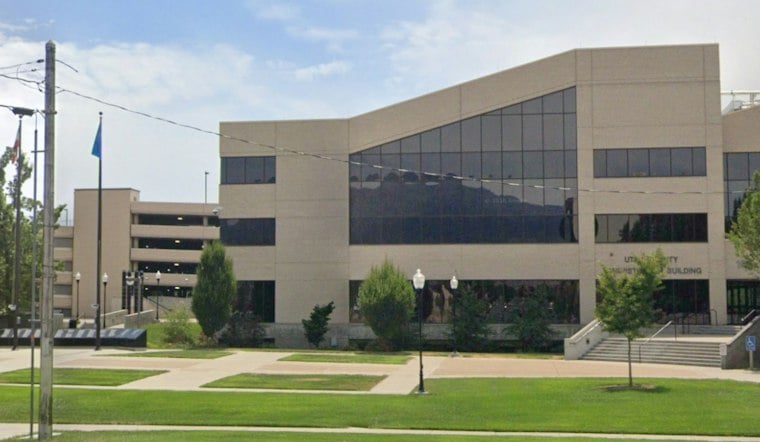
The Utah County Planning Commission voted unanimously Tuesday night to recommend that the county commission approve a new data-center ordinance. As the meeting ended, deputies removed Utah artist and activist Aspen Azalea from the chamber; she was booked into the Utah County Jail after a confrontation outside the room, while two other people were cited and released.
Videos reviewed by The Salt Lake Tribune show deputies leading Azalea out before she fell to the ground, where an officer pressed a hand against the back of her neck and handcuffed another person lying nearby. The Party for Socialism and Liberation Salt Lake City provided the footage to the Tribune and is organizing a rally at the Utah State Capitol at 6 p.m. Wednesday. Organizers are calling for “justice for Aspen” and the arrest of the officer who restrained her.
As public comment grew heated, commission chair Shayne Pierce directed deputies to remove someone from the audience, the Tribune reported. Residents and protesters urged commissioners to impose stricter limits on data centers, with some calling for an outright ban rather than the proposed ordinance.
What the Proposed Ordinance Would Actually Do
The proposed measure, Application #2026-09, would revise Chapters 2, 8, 10 and 12 of the county’s land-use code. The Utah County Planning Commission staff report says data centers would be permitted in M&G-1 (Mining and Grazing) and I-1 (Industrial) zones, with a new Data Center Overlay Zone available as an alternative for proposals that do not meet the location requirements within those zones. The Tribune reported that the largest projects would be limited to 500 megawatts and 1 million square feet, and that county commissioners could decide whether to require development agreements for individual projects.
The proposal would cap cooling-water consumption at 300,000 gallons per year, require studies of nearby wells and call for water-impact monitoring every six months during the first two years. The Tribune noted that the cap is slightly more than the annual water use of two Utah County households. The measure would also expand public notice and comment opportunities before future approvals.
During the meeting, commission board member Seth Cox compared data centers to landfills: facilities people may not want to live near but rely on every day. He said anyone who uses a cellphone is, in effect, a data-center customer, and that the rules are intended to protect county residents rather than simply approve projects, the Tribune reported. The recommendation now goes to the full Utah County Commission, which will make the final decision at a later meeting.
Part of a Statewide Reckoning Over Server Farms
Utah County's proposed restrictions arrive amid a wave of local pushback against data centers statewide. Clearfield City Council adopted an ordinance in September temporarily restricting development activity for up to 180 days, following similar pauses by Salt Lake County in August and earlier temporary freezes in Logan, Iron County and Grand County, according to the Standard-Examiner. Hoodline reported that 38 randomly selected Utahns developed recommendations at a two-day forum, including recusal for officials with conflicts in AI decisions. The group voted against the final draft and planned to share its proposals with officials in November.
A May State Capitol rally opposed the proposed Stratos data center campus in Box Elder County, as reported by the Daily Utah Chronicle.
Big Tech Investment Fuels the Tension
The debate unfolds against the backdrop of massive tech investment already underway in the county. Meta announced an expansion of its Eagle Mountain data center campus involving more than $3 billion in investment; the site broke ground in 2018, according to Meta Data Centers. Over the past five years, facilities operated by Meta and QTS along the Wasatch Front have received environmental permits for hundreds of backup diesel generators meant to maintain power during grid outages, the American Fork Citizen has reported, a detail that has fed local air-quality concerns alongside worries over water use.
Statewide, the stakes are even larger. The Kem C. Gardner Policy Institute's public finance brief found that while new data center construction can provide short-term property tax relief under Utah's Truth in Taxation framework, the rapid depreciation of computer equipment creates long-term tax rate volatility for local taxpayers once those initial benefits fade.
What remains uncertain about water and tax impacts
On water, the Utah Division of Water Resources reports that agricultural and municipal-and-industrial water-depletion trends vary across river basins; statewide patterns alone do not describe conditions near a particular project. On property taxes, Deseret News reports that a University of Utah study modeled equipment valued at $1 billion declining to $620 million after one year and $70 million after five years. That is an illustrative scenario, not a forecast for a specific Utah County project.
This remains a developing story, and the Utah County Commission will make the final decision at a later meeting.





