

























































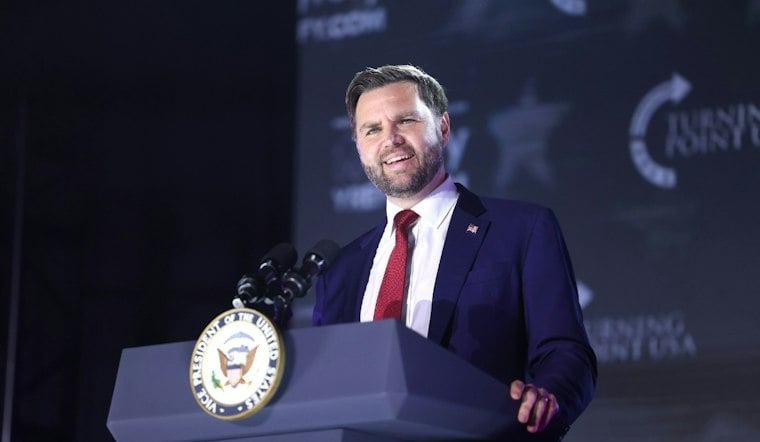
Vice President JD Vance sat down for an exclusive interview at Fairbanks International Airport on Monday, mixing campaign talk for Republican Sen. Dan Sullivan with pointed comments on Iran's nuclear ambitions and a reported Iranian-linked security scare at a British air base. Vance told the interviewer that Iran is trying to terrorize the world economy by shooting at commercial shipping, even as he insisted the attacks have not stopped the flow of oil and gas.
The interview, conducted by Reuters reporter Jacob Bogage and published by the Raleigh News & Observer, came as Vance campaigned in Alaska, a state both parties see as pivotal to controlling Congress after the November elections. Vance said the United States destroyed Iran's nuclear program, telling the outlet that Iran's nuclear facilities and enrichment facilities have been destroyed and that Washington will ensure Tehran cannot rebuild its nuclear facilities or capacity. He framed the goal as twofold: preventing Iran from obtaining a nuclear weapon and heading off broader regional proliferation, warning that an Iranian bomb could push other countries to seek their own.
Tracing the Strikes and the Uranium Stockpile
Vance's claim about destroyed enrichment sites traces back to Operation Midnight Hammer, the June 2025 mission in which the U.S. military deployed B-2 stealth bombers armed with GBU-57 bunker-buster bombs against underground Iranian facilities at Fordow, Natanz, and Isfahan, according to background compiled by The Washington Post. Ahead of those strikes, International Atomic Energy Agency reporting from September 2025 estimated Iran held 440.9 kilograms of 60 percent enriched uranium, an amount the Institute for the Study of War notes would be technically sufficient for ten weapons if further enriched to 90 percent — though IAEA inspectors have reported a lack of physical access to verify the current state of any buried stockpiles since mid-2025.
Vance argued that 60 percent enriched uranium is not needed for energy production and said Iran must take meaningful action on its enrichment capacity to demonstrate it will not build a weapon. He called Iran the world's largest state sponsor of terrorism and said President Trump opposes mass proliferation of nuclear weapons, adding that Trump and Chinese President Xi Jinping have discussed the issue directly. Vance said he himself is involved in the talks with Iran, while stressing that Trump is driving U.S. policy and that Washington will not trade words for actions — it wants Iranian actions in exchange for its own.
A Shaky Diplomatic Trail
Those talks have a documented, uneven history. U.S. and Iranian officials held three major rounds of negotiations between April 2025 and April 2026, concluding in an Islamabad Memorandum of Understanding in June 2026 that addressed enrichment limits and maritime security in the Strait of Hormuz, according to a timeline compiled on Wikipedia. Vance said the U.S. and Iran struck an original agreement to open the Strait of Hormuz, lift the U.S. blockade, and discuss Iran's nuclear program — but that Iran failed to keep its agreement not to shoot at commercial shipping. He noted Iran has said it does not want a nuclear weapon, attributing that stance to a 1979 position, even as he said Tehran is trying to conduct strikes against American assets around the world.
Vance Downplays Fairford Concerns Amid Active Investigation
Pressed on reports of an Iranian operation targeting RAF Fairford in the United Kingdom, Vance said nothing has happened regarding the matter. His comment landed in the middle of an active British investigation: Counter Terrorism Policing announced the arrest of a 22-year-old British national in London on Monday, the seventh arrest in the probe into a suspected Iranian-backed plot targeting the Gloucestershire base. Separately, the Pentagon evacuated a fleet of 12 long-range B-1 Lancer bombers from RAF Fairford back to U.S. bases over the weekend following intelligence warnings of a potential Iranian-backed attack, the Post reported.
Vance said the United States has capable military and intelligence personnel and argued that warfare has changed through new uses of drones and asymmetric capabilities. An October Business Insider headline addressed whether Iran could strike California with a nuclear weapon.
Back Home, a Senate Race and an Energy Push
Politics was never far from the conversation. Vance said he plans to help win the midterm elections and specifically to help get Sullivan elected, campaigning in Alaska, where the Senate race took center stage, according to CNN-News18. Sullivan faces Democratic former Rep. Mary Peltola, as Hoodline reported in its earlier coverage of the primary. Adding to the race's oddity, Alaska's general election ballot features two candidates named Dan Sullivan after a retired teacher by that name won a legal challenge before the Alaska Supreme Court to remain on the ballot alongside the incumbent senator, according to a video posted by CBS News on Facebook.
Vance's Fairbanks stop also coincided with a major federal announcement: the U.S. Department of Energy said it would provide $150 million in federal funding for a 223-mile electrical transmission project connecting Beluga to Healy in Alaska's Railbelt corridor, whose overall cost is about $418 million, according to coverage from Moneycontrol and Must Read Alaska. Asked about his own political future, Vance said he has not thought much about running for president and that he will decide after the midterm elections.





