

























































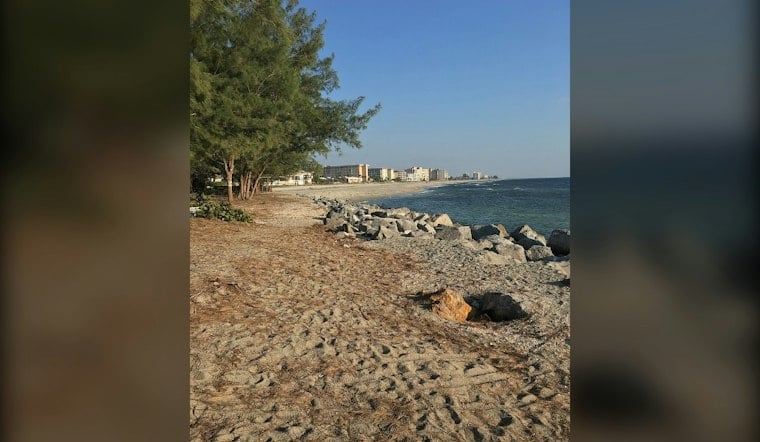
Venice Beach has new sand stretching 3.2 miles along the Gulf, the product of a $27.5 million restoration that wrapped up this fall without costing local taxpayers anything. The project deposited roughly 620,000 cubic yards of sand from just south of the Venice Inlet to just south of the Venice Fishing Pier, widening the shoreline by 50 to 100 feet in a city that has leaned on the U.S. Army Corps of Engineers for coastal protection for more than three decades.
According to Classic Country 104.5, the sand replaces material lost to gradual erosion and major storms since the last renourishment cycle in 2015. This regularly scheduled round was planned years in advance and was 100% federally funded through the Army Corps' Flood Control and Coastal Emergencies program. Hurricanes Helene and Milton inflicted severe erosion on the coastline in 2024, as reported by WGCU.
The City of Venice and the Army Corps marked the project's completion with a celebration in Venice, Florida, according to WFLA. The newly widened beach now serves as a sacrificial buffer between Gulf wave energy and the roads, homes, businesses, and infrastructure behind it, the station notes, per FOX 13 Tampa Bay.
A Year-Long Hunt for the Right Sand
The project didn't arrive on schedule. The same WGCU report notes the renourishment was delayed a full year because the Army Corps needed to find a specific match of smooth, white quartz sand. That sand was eventually located 11 nautical miles offshore, southwest of Englewood, after decades of dredging left nearshore deposits along Florida's Gulf coast increasingly depleted, the outlet reports.
The Army Corps' Jacksonville District awarded the construction contract for this third periodic renourishment cycle to Weeks Marine, Inc. on April 13, 2026, per the agency's own announcement. Weeks Marine carried out the dredging in rolling work zones of 1,000 to 1,500 feet, spending five to seven days on each section so most of the public beach stayed open to visitors through the summer peak, FOX 13 Tampa Bay reports.
Protecting Sea Turtles During Construction
Because federal funding timelines required construction to happen during the summer, the work overlapped directly with sea turtle nesting season. Mote Marine Laboratory and Aquarium conducted daily wildlife monitoring throughout the construction window and relocated 524 sea turtle nests, the same WGCU account states. WFLA reports those relocated nests went on to produce more than 50,000 eggs, and Kathryn Gentile said the relocation effort was very successful, according to the station.
Beyond the sand itself, subcontractors extended five existing municipal stormwater outfall pipes across the widened beach to maintain proper city drainage into the Gulf, with the final pipe work wrapping up this month, the City of Venice says. The extensions were intended to maintain drainage into the Gulf.
A Multi-Decade Partnership With Deep Roots
This is not Venice's first rodeo with renourishment. The federal Venice Beach Hurricane and Storm Damage Reduction Project operates under a long-standing agreement dating to the 1990s. Venice began renourishing in 1995, followed by maintenance cycles in 2005, 2015, and now 2026, according to the City of Venice. WFLA reports that City Manager James Clinch and his daughter Clara participated in both the 2015 ribbon-cutting and this year's celebration, a detail Clinch himself leaned into, describing the beach restoration as a generational project, per the station.
Nick Pachota told WFLA the restoration allows people to keep enjoying Venice, framing the newly widened beach as protection for both the coastline and the community's way of life.
The South Jetty Remains a Sore Spot
Not every piece of Venice's coastal infrastructure is fixed. The South Jetty at Humphris Park remains closed due to catastrophic damage from the 2024 hurricanes, with a major Army Corps maintenance report expected in November, the City of Venice says. Some residents have questioned why sand placement moved forward before the jetty's structural repairs.





