

























































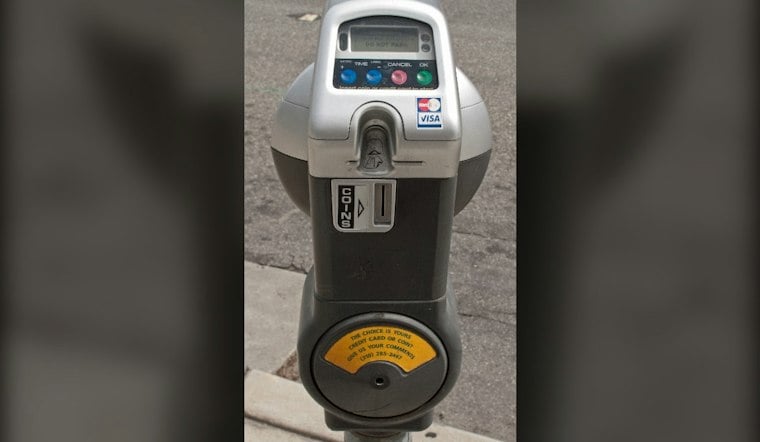
Free parking near Abbot Kinney Boulevard may soon be a thing of the past. The Los Angeles Department of Transportation is pushing to expand its demand-based LA Express Park system into Venice, a move that would convert roughly 300 currently unmetered spaces into paid parking and raise hourly rates at six existing city lots in the neighborhood.
The proposal, detailed by the Westside Current, calls for metering approximately 200 unmetered street spaces along Abbot Kinney Boulevard and converting about 100 more spaces across three unmetered city lots into paid parking. The city also plans to raise base hourly rates across six existing Venice lots that together hold roughly 500 spaces, according to the LA Bureau of Engineering.
Because the changes touch so many spaces, the Bureau of Engineering is reviewing a Coastal Development Permit application for the project and has scheduled a virtual public hearing for October 27 at 6 p.m. via Zoom to receive public comment on the proposal. Residents can submit comments or join the hearing directly, per the same agency's project documentation.
New Tech, New Signs Across the Neighborhood
The upgrade goes beyond simply adding meters. The project would install updated pay stations featuring color LED screens, vehicle-occupancy sensors, and mobile payment options including pay-by-cell, text-to-pay, and tap-to-pay, the Bureau of Engineering's project page notes. The three newly metered lots would also get new hourly rates and multi-space pay stations, while the city rolls out up to 30 pedestrian wayfinding signs and 20 vehicular wayfinding signs throughout Venice to help drivers find open spots.
That sensor-and-signage combination is central to how LA Express Park operates elsewhere in the city. Dynamic parking systems built on this model use real-time occupancy data to target a sweet spot of roughly 70% to 90% block occupancy, raising rates during peak demand and lowering them in off-peak hours, according to research compiled by Reinventing Parking. The goal is to keep at least a space or two open on every block so drivers stop circling in search of parking.
Why Venice, and Why Now
The push into Venice follows a decade of expansion for LA Express Park, which has expanded from Downtown Los Angeles to Westwood Village and Hollywood, according to Trellint. Venice now represents the next frontier for the city's curb-management strategy.
Local data suggests the congestion problem is real. A Venice parking utilization evaluation found that occupancy exceeds 90% in zones closest to Abbot Kinney Boulevard and the beach, with unrestricted free street parking prompting visitors to continuously circle surrounding residential blocks, according to a report reviewed by the Venice Neighborhood Council. The pressure on Abbot Kinney Boulevard has only intensified amid a wave of commercial activity along the corridor, including the return of the 40th Abbot Kinney Festival in September and an Arc’teryx opening reported by Hoodline.
Coastal Access Rules Add Scrutiny
Venice sits within the California Coastal Zone, and the proposal's Coastal Development Permit application is under review. Coastal permit review also brings public beach access into focus. At the October 27 hearing, residents and coastal advocates can weigh in before any permit is granted.
The plan raises a key question: whether demand-based pricing in Venice functions as a tool that improves access by reducing traffic, or as a financial barrier to the beach.
The Venice plan arrives alongside several other shifts in how the city manages its coastal parking and land. Hoodline has reported on a Venice parking lot owned by an entity affiliated with Mission Investors Corp. that is proposed for housing redevelopment. For now, the fate of the Abbot Kinney parking overhaul rests on public testimony still to come, with residents able to weigh in during the October 27 virtual hearing or by submitting public comments.





