

























































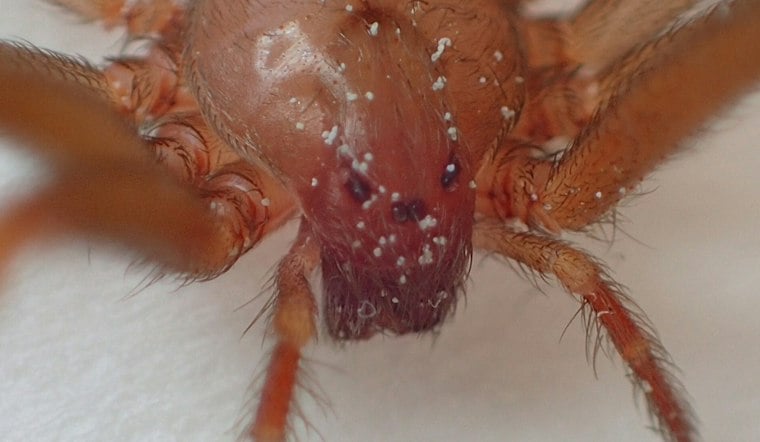
A pest control company's routine call to Connecticut state officials turned into a milestone discovery in 2025, after entomologists confirmed the first known Mediterranean recluse spider ever found in the state inside a Wallingford apartment building. The venomous arachnid, native to the warm Mediterranean region of Greece and Italy, had likely been living undetected in the building for years before anyone noticed.
The find was verified by the Connecticut Agricultural Experiment Station, which confirmed the species after entomologist Gale Ridge collected a sample and brought it to her laboratory for imaging, according to the Hartford Courant. Ridge then worked with a leading arachnid expert to confirm the identification, per the same account. The station's Insect Inquiry Office in New Haven serves as the state's primary biosurveillance responder for exactly this kind of discovery, processing public and commercial insect submissions to track non-native, invasive, and medically significant pests entering Connecticut, according to CT.gov.
Ridge, who confirmed the spider for the first time in Connecticut, said it likely lived in the apartment building for many years before being spotted, and that it is probably more common throughout the state than this single sighting suggests, per the Courant's reporting. She believes the spider may also be present in Bridgeport, New Haven, and Hartford.
Why the Spider Can't Survive Connecticut Winters Outdoors
Despite the alarming discovery, the Mediterranean recluse poses little threat to the broader outdoor ecosystem because it simply cannot survive Connecticut's cold. The spider is not adapted to the state's weather, and winters here would kill it if it tried to live outside, according to the Courant's report. That forces the species into a strictly indoor existence in Connecticut, confined to lower-level utility rooms, cellars, basements, and steam tunnels.
This synanthropic dependence on climate-controlled indoor spaces is well documented beyond Connecticut. Research compiled by the National Center for Biotechnology Information shows that Mediterranean recluse spiders rely entirely on basements, electrical meter boxes, and underground utility tunnels to survive winter freezing in cold northern climates, since the species originates in much warmer southern European and North African environments. Established colonies have reportedly persisted for decades in similar indoor infrastructure elsewhere in the Northeast, including the subterranean steam tunnels at Pennsylvania State University, where they have lived without biting students or employees, according to Penn State Extension.
The spider likely arrived at the Wallingford complex the way it often spreads to new locations: hidden in someone's furniture, per the Courant. The species is found throughout much of the world and has an established population in Washington, D.C., arriving at new sites primarily through furniture and bedding rather than by crawling outdoors on its own.
What the Venom Actually Does and How Risky It Is
The Mediterranean recluse does carry venom, and Ridge said it can bite humans in self-defense, potentially causing a painful bite, skin necrosis, and severe swelling, per the Courant. However, she also noted that bites are medically insignificant in most cases, with hospitalization required in only a handful of instances. Ridge put the risk in context by stating that ticks pose a greater threat to humans than most arachnid species in Connecticut.
The biochemistry behind the bite involves an enzyme called sphingomyelinase D, which breaks down cell membranes to cause localized tissue damage, though research published in MDPI Toxins notes the Mediterranean recluse's envenomation severity is generally milder than that of the native North American brown recluse. Toxicological data cited by the Illinois Department of Public Health also notes that brown recluse bites are uncommon and generally occur in self-defense.
The spider itself is described as non-aggressive, docile, and shy, using its venom to hunt prey rather than threaten people, according to the Courant. It is most active at night, hunting cockroaches and termites, which makes it beneficial as a source of natural pest control. Ridge noted it has no real impact on humans or native species, and the Courant reports it poses no ecological threat in Connecticut.
Why Spider Bite Diagnoses Are Often Wrong
Part of what makes the Wallingford case notable is how rare a confirmed recluse identification actually is. Connecticut has more than 600 native spider species, and the Agricultural Experiment Station identifies about 99% of submitted photos easily as native insects, according to the Courant. Entomological research published in the Journal of Medical Entomology backs that pattern up on a national scale, finding that in states outside the brown recluse's natural territory, more than 90% of spider specimens submitted by the public suspecting recluses turn out to be misidentified native or common indoor species.
That misidentification problem extends into medical settings as well. Research compiled by the National Academies Press indicates that medical diagnoses of recluse spider bites in non-endemic northern states far outnumber actual spiders, with doctors frequently mistaking bacterial skin infections like MRSA or tick-borne lesions for spider envenomation. Part of the confusion comes down to appearance: Mediterranean recluses and North American brown recluses look nearly identical to the naked eye, both with six eyes arranged in three pairs and a violin-shaped pattern on the cephalothorax, according to Indiana State University, meaning microscopic analysis or DNA sequencing is often needed to tell the species apart.
The scale of the Mediterranean recluse's spread globally underscores why a single Wallingford apartment matters to entomologists. The citizen-science platform iNaturalist calls the species one of the most invasive spiders worldwide and has recorded thousands of sightings, noting it can survive in many different environments even though it is restricted to indoor habitats in Connecticut specifically. Beyond Pennsylvania and Connecticut, the species has also been reported in Washington, D.C., where spiders live in basements and foundations as part of the city's deep infrastructure.
What Residents Should Do If They Spot One
For Connecticut residents worried they might have spotted a recluse, the Agricultural Experiment Station accepts photos of unidentified insects for expert identification. Anyone who finds a suspicious specimen should keep it in case laboratory testing is requested, since Ridge collected and imaged the Wallingford sample and sent images to an expert.



