

























































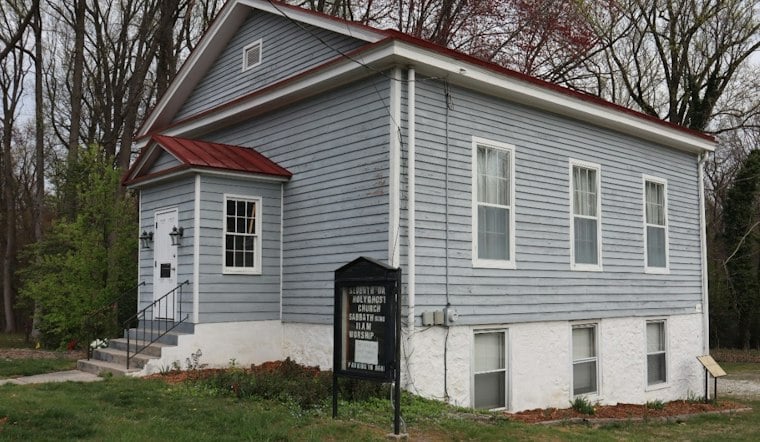
A 171-year-old church in Voorhees that once sheltered abolitionist meetings and gave Walt Whitman a place to recover from a stroke is now on the market for $455,000 — and the people who know it best say there is nothing stopping a buyer from tearing it down.
The Glendale Methodist Episcopal Church, sitting at the corner of Haddonfield-Berlin and White Horse roads, is the only surviving building from the old settlement of Glendale, according to The Philadelphia Inquirer. Keller Williams Realty has the 1,800-square-foot property listed, which includes a sanctuary, basement and kitchenette, built in 1855 on land that Quaker Alexander Cooper donated to three church trustees that same year. Glendale residents helped build the structure on the condition that its lower level double as a schoolroom and meeting place, and that schoolroom went on to host abolitionist meetings before the Civil War — making it one of Camden County's oldest standing public school buildings as well.
Walt Whitman spent months recovering from a paralytic stroke inside the church, writing poetry and bathing in a creek behind it, per the same Inquirer report. The building is listed on both the New Jersey and National Registers of Historic Places, a distinction architect Margaret Westfield herself nominated it for back in 1995. But that status, as the article notes, offers protection mainly from federally funded projects — it does not stop a private buyer from altering or even demolishing a 19th-century landmark.
A Preservationist's Warning
Westfield, a Woodbury-based preservation architect who has overseen grants and crafted a preservation plan for the building, did not mince words. “Honestly, this building is one of the most significant buildings in South Jersey,” she said, according to the same report. “It needs somebody to come in and save it.”
Westfield said the property's slope makes the land largely unusable without the church itself still standing on it, and she believes the most realistic future is as a private residence unless a new congregation steps in. She envisions the first floor and former schoolroom becoming living space and a kitchen, with the upstairs sanctuary converted into bedrooms. Her hope, as relayed in the report, is that any new owner preserves the historic exterior and keeps Glendale's story alive.
The asking price marks a striking jump from recent history. The church was listed for $264,000 in December 2021, according to 70and73.com, after the church closed in June 2020 following a meeting with the United Methodists group. It last sold in 2022, when the Neptune-based United Methodists of Greater New Jersey sold the building to Seventh Day Holy Ghost Church for $245,000.
A Congregation Ready to Move On
Chocolate Obasoanya, founder of Seventh Day Holy Ghost Church — described in IRS filings as a Protestant place of worship — said the building is in good condition but that the congregation is ready for something smaller. “We just want to downgrade,” Obasoanya said.
The deed carries its own quirk dating back to 1855: it requires a church meeting lasting at least one hour every year, or the property could revert to the Cooper Estate. A 2004 Garden State Historic Preservation Trust Fund grant, awarded through the New Jersey Historic Trust, helped stabilize the structure and restore its exterior to resemble its 1930s appearance; county and state grants have helped restore the church in recent decades as well.
Trees, Traffic and a Contested Entrance
The site has also seen physical changes that complicate its historic character. PSEG cut down two tulip poplar trees by the church entrance in 2022 — trees that dated to 1855 — even though the New Jersey Historic Sites Council had found in 1997 that removing them would adversely affect the property's historic preservation, per Westfield. Camden County separately widened the intersection and added a turning lane. Westfield said the combination of tree removal and road widening has made the church's main entrance unsafe to use. A Seventh Day elder emailed Westfield for help in 2023 as workers dug out the tree stumps, writing that the trees had shielded worshippers from the road on their way to the church's front door.
Camden County Historical Society president Zed Fox said the organization has no official position on what should happen to the property, while Voorhees Township has no current plans to acquire the building, according to township administrator Stephen Steglik. For now, the fate of one of South Jersey's most storied buildings rests with whoever decides to write the next chapter — or close the book entirely.





