

























































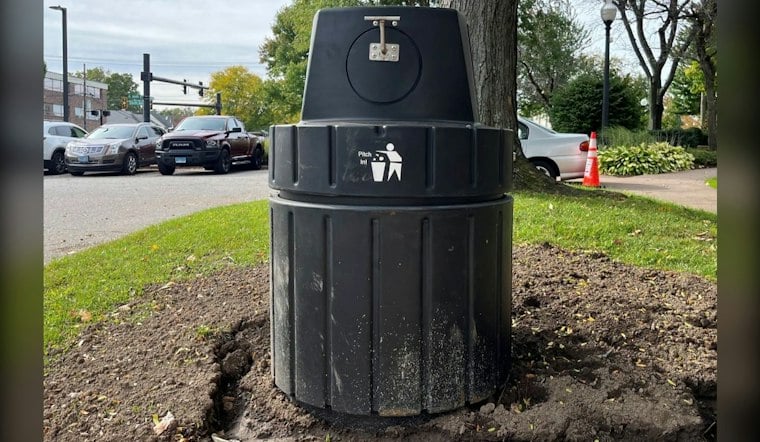
West Hartford has started putting its trash underground, literally. The town has installed 22 new sub-terrain receptacles in parks, trailheads, and other public spots, part of a push to cut down on litter, animal scavenging, and the labor it takes to keep public spaces clean.
According to we-ha News, most of the storage capacity in the new receptacles sits below ground, with only a small opening visible at the surface. A flap covering that opening is designed to keep animals, insects, and other scavengers out while trapping trash odors inside, and the containers themselves are notably larger than the traditional cans they're replacing.
Why Fewer Pickups Could Mean Fewer Messes
That added capacity changes the math for crews who service the bins. Instead of emptying traditional cans three or four times a week, the new receptacles need attention at most once a week, a shift the town's report notes saves on labor costs. Removal is also different: rather than a worker manually hauling out bags, a small crane extracts the entire waste container.
Public Works Director John Phillips told we-ha News the sub-terrain waste receptacles are great, adding that they look nice and respect their purpose, and said the technology could be a game changer. Phillips also said he believes West Hartford is among the first towns in Connecticut to introduce this kind of receptacle, according to the same report.
Targeting the Real Source of Park Litter
Town officials are framing the upgrade as an animal-control measure as much as a tidiness one. The article notes that raccoons, squirrels, and birds — not people — are responsible for most of the litter found close to trash cans, and officials expect the animal-resistant design of the new bins to cut down on that mess in public spaces. The flap's airtight seal is also meant to slow the breakdown of trash and the odors that come with it.
The receptacles were manufactured by Canadian-based Sybertech Waste Reduction Ltd., whose own materials describe units that can hold up to 3 to 4 cubic yards of self-compacting trash, with underground cooling and a self-closing lid designed to help mitigate odors. The manufacturer also advertises operational cost savings of up to 72 percent, though that figure has not been independently verified for West Hartford's installation.
Where the Bins Are Going
Most of the new receptacles have gone into popular parks, with some placed at trailheads along the Trout Brook Trail, including at Norfeldt Field and Duffield Road. Three more are planned for the baseball fields on the former UConn property at 1700 Asylum Avenue, and Public Works intends to add another 20 receptacles townwide in spring 2027.
The underground bins won't be replacing the Big Belly trash cans already in place at Blue Back Square, which were installed there several years ago to address overflowing cans on busy weekends. A similar in-ground system appeared in three parks in Milton, Ontario — Campbellville Ball Park, Rotary Park, and Bronte Meadows Park — in 2018, according to halton.insauga.com, which described a comparable setup of underground plastic cylinders holding a bag on a lifting harness, with the same 3-to-4 cubic yard capacity that allows for less frequent emptying.




