

























































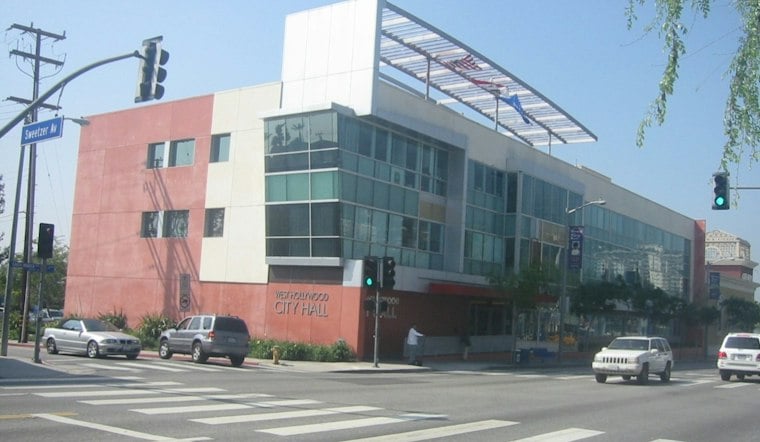
West Hollywood City Hall at 8300 Santa Monica Boulevard is an office and public-service location, but it is not where the City Council holds its regular meetings. The council meets in chambers at the West Hollywood Library, 625 N. San Vicente Boulevard; commissions, advisory boards and subcommittees also use City Hall’s first-floor community meeting room. WEHOonline reports that the council began using the library chambers on October 3, 2011, after meeting at the old West Hollywood Park auditorium.
Work at the offices
Exterior maintenance is underway at the City Hall building, which is to remain open during the work. WEHOonline reports that city public information officer Sheri Lunn identified painting and window sealing as the project’s scope. The outlet also reported scaffolding activity on October 13 and expected brief sidewalk and lane closures on Santa Monica Boulevard and Sweetzer Avenue from October 12–16, 2026, and again from November 9–13, 2026. WEHOonline’s report is the source for these current-project details.
The building has undergone other work since the city moved in. In 2012, the city announced waterproofing, crack repairs, replacement of window gaskets, painting and repairs to exterior stairwell landings. A lobby and waiting-area renovation started in 2018 and was recorded as complete in fiscal 2019.
Facilities shaped for public use
West Hollywood agreed in 1994 to buy the building from Petersen Publishing Company after improvements, completed the purchase in 1995 using certificates of participation, and finished the renovation and move that May. As recounted in WEHOonline’s records-based history, architect Mehrdad Yazdani and firm Ellerbe Becket adapted the structure with a new façade, seismic upgrades and interior remodeling. The redesign included an angled blue-green glass section, a curved steel canopy and copper panels.
A city expansion completed in May 2016 added an automated parking structure and a public plaza behind City Hall. The project includes a 200-space garage and a 7,000-square-foot plaza. The city says rooftop solar panels and the automated retrieval system produce an emissions reduction equivalent to taking 92 cars off the road each year. The four entry and exit bays have hand-painted murals by artists including MONCHO1929 and Art of Chase, part of the city’s Art on the Outside program. City Hall’s second floor also contains the Green Building Resource Center, with public displays and guidance on energy and water conservation related to the city’s Green Building Ordinance.
The city’s search for a permanent home
After West Hollywood incorporated in November 1984, staff worked from temporary offices called Hall B at Plummer Park, while council meetings took place at Fiesta Hall. The city moved its offices to 8611 Santa Monica Boulevard in June 1985; that site is now occupied by a Trader Joe’s near Westmount Drive. Regular evening meetings had shifted to the old West Hollywood Park auditorium by February 1985.
In 1987, the city held a competition for a civic center at West Hollywood Park, with plans for City Hall, a county library, a fire station and public space. Zaha Hadid’s unbuilt proposal treated the site as a geometric landscape, according to the Zaha Hadid Foundation. The park proposal did not become the city’s civic center, and the former Specialty Records building became the site of City Hall instead.
Earlier tenants at 8300 Santa Monica Boulevard
City records cited in WEHOonline’s report date the three-story, roughly 35,600-square-foot building to 1962. Before its civic use, it housed the office of Specialty Records, the label founded by Art Rupe. Its roster included Little Richard, Lloyd Price, Percy Mayfield and Sam Cooke with the Soul Stirrers. The Rock & Roll Hall of Fame credits Rupe with helping bring R&B and soul into the mainstream and launching Little Richard’s career.
WEHOonline’s account cites a 1968 firsthand description of a visit to Specialty Records’ office at the address and a 1969 Billboard directory listing the label, Rupe and product development employee Barret Hansen there. Hansen later became known as Dr. Demento and recalled working on reissues for Specialty. These records place the label’s office at the building; they do not establish that its artists recorded there. The same account notes that a 1989 recycling industry directory listed Berg Mill Supply Co. in suite 209.
What the records establish
A separate local precedent is Plummer Park, not City Hall. A January 21, 2014, City of West Hollywood report outlined a plan that included removing Great Hall and Long Hall and pursuing a strategy to renovate Fiesta Hall’s interior. It does not describe repairs to Great Hall or Long Hall; the Fiesta Hall work was a distinct park project, unlike the current City Hall painting and window sealing. The sources also draw a boundary around the building’s music history: the Rock & Roll Hall of Fame credits Rupe with helping bring R&B and soul into the mainstream and launching Little Richard’s career, while the cited directory and firsthand account place Specialty Records’ office at 8300 Santa Monica Boulevard. The address evidence establishes an office location, not that artists recorded there.





