

























































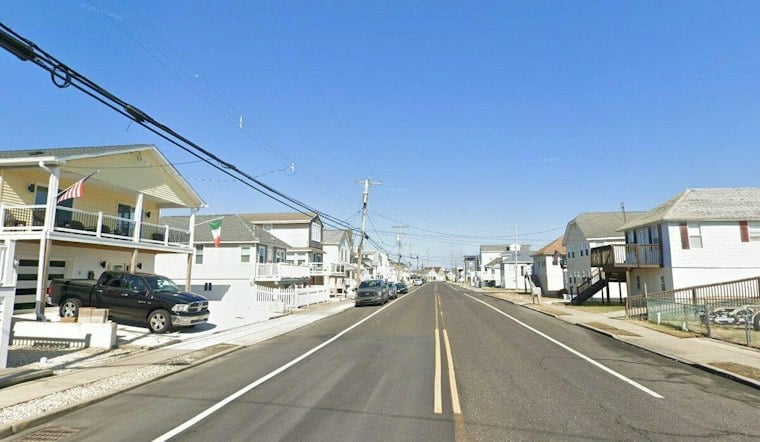
A fire tore through all three floors of a West Wildwood home Thursday morning, trapping a dog on the top floor before firefighters managed to revive it with oxygen and get it to a veterinarian. Investigators believe the blaze may have started in a golf cart that had sat submerged in floodwater from the nor'easter that swamped the back-bay borough just days earlier.
The fire was reported around 9 a.m. on the 600 block of West Maple Avenue, according to 6abc Philadelphia. The Wildwood Fire Department said flames had already engulfed all three floors of the structure by the time crews arrived. A father and son entered the residence to check whether anyone was trapped inside, and officials said no occupants were ultimately found in the home.
Firefighters did discover an unresponsive dog on the third floor. Emergency responders administered oxygen and successfully revived the animal before it was transported to a local veterinarian for further treatment; the dog's condition afterward was not reported. Crews brought the fire under control roughly 26 minutes after arriving on scene, per officials, though the home itself sustained significant damage and neighboring houses suffered damage to their siding. No injuries to people were reported.
A Nor'easter's Delayed Aftermath
Investigators believe the fire may have originated from a golf cart that had been submerged during the previous weekend's nor'easter flooding. That storm battered coastal New Jersey between September 25 and September 27, prompting Cape May County Emergency Management to issue flood warnings as tidal surge inundated back-bay municipalities including West Wildwood, according to FOX 29 Philadelphia. West Wildwood sits on a low-lying back-bay peninsula that state flood planning records describe as uniquely susceptible to recurring tidal inundation and storm-surge flooding, per New Jersey Department of Environmental Protection records from earlier this year.
The delay between the flooding and the fire is not unusual for saltwater-damaged batteries. A 2023 U.S. Coast Guard safety alert warned that saltwater submersion leaves conductive salt deposits on battery contacts, which can cause delayed internal short circuits and thermal runaway in electric vehicles and battery-powered equipment days or even weeks after flooding. That mechanism helps explain why a golf cart battery that survived a storm intact could still ignite a residential fire well after the floodwaters had receded.
Fire Department Issues New Warning
In the fire's wake, the Wildwood Fire Department warned residents not to use or charge flood-exposed golf carts, e-bikes, e-scooters, or other battery-powered devices. The department also urged residents to move any flood-exposed equipment away from structures entirely. Similar guidance has circulated in other coastal communities; Pinellas Suncoast Fire & Rescue District in Florida advised in 2024 that coastal residents park all flood-exposed golf carts, e-bikes, and electric vehicles at least 50 feet from homes due to the risk of delayed ignition.
The hazard extends beyond fire risk alone. A 2024 U.S. Fire Administration report found that lithium-ion battery fires entering thermal runaway can produce extreme temperatures and release hazardous gases such as hydrogen fluoride, while remaining vulnerable to sudden reignition hours after initial suppression. Federal regulations enforced by the U.S. Department of Transportation's Pipeline and Hazardous Materials Safety Administration also classify flood-damaged or compromised lithium batteries as hazardous materials, meaning they cannot be placed in standard household trash or municipal recycling bins.
Part of a Troubling Pattern
The West Wildwood fire adds to a string of recent battery-related blazes tied to golf carts and personal transportation devices nationwide. Hoodline reported that a fire involving lithium-ion-powered golf carts at Teal Bend Golf Club in Sacramento destroyed a storage barn housing 50 to 60 carts and triggered a hazardous materials response on September 28. Days earlier, a golf cart fire in Martin County, Florida, spread to a home's garage and porch, prompting local fire officials there to warn that smart chargers can fail to shut off.
New Jersey has its own grim history with battery-related residential fires. In February, a fire attributed to lithium-ion battery failure in Stafford Township, Ocean County, resulted in the death of a 92-year-old resident and injured two others. As coastal storm seasons continue to batter low-lying Jersey Shore communities, fire officials across the region are increasingly treating flood-soaked batteries as a lingering, unpredictable threat rather than a problem that ends once the water recedes.




