

























































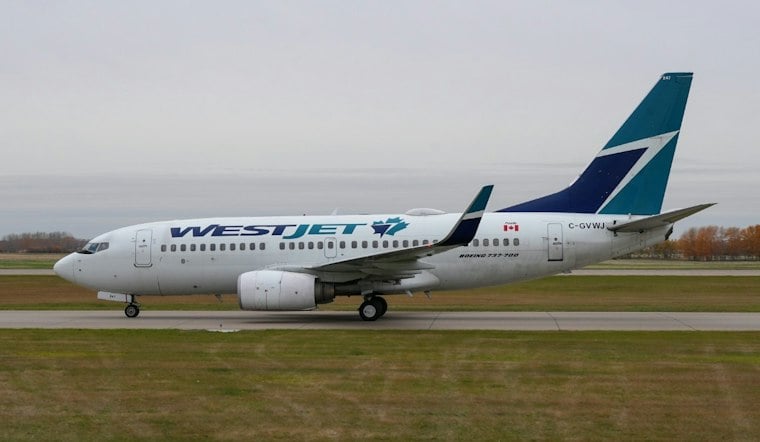
WestJet has quietly cut 10 routes to the United States throughout 2026, with Edmonton International Airport absorbing the heaviest blow at five lost connections. The carrier has pointed to weaker American travel demand driven by geopolitical tension, trade-war effects and rising jet fuel costs, according to Cirium data cited in the reporting.
The cuts, first detailed by Simple Flying, show Edmonton losing its Nashville route in January, followed by Seattle and San Francisco service both ending in April, Atlanta in June, and Chicago O'Hare in October. Alaska Airlines remains the sole year-round operator on the Edmonton–Seattle corridor, while Air Canada now runs seasonal flights to San Francisco and United Airlines offers seasonal service to Chicago from Edmonton, per the same account.
Vancouver International Airport lost three U.S. routes of its own in 2026: Lihue in April, with no airline currently flying that route at all; Boston, also in April, now served seasonally by JetBlue; and Nashville in May, picked up seasonally by Air Canada. The pullback from Vancouver fits a broader pattern documented separately, as Aviation Shop reported that WestJet's summer 2026 U.S. departures from Vancouver dropped 46.6% year-over-year, concentrating the brunt of the transborder pullback on the Canadian West Coast.
Toronto and Winnipeg Feel the Squeeze Too
Toronto lost its Los Angeles route in April, though both Air Canada and Porter Airlines continue to fly nonstop between the two cities, the Simple Flying report notes. Winnipeg saw its Nashville service end in May, leaving the city with five remaining U.S. destinations: year-round links to Chicago, Denver and Minneapolis, plus seasonal service to Fort Lauderdale and Las Vegas.
WestJet, Canada's second-largest airline by fleet size and passenger numbers, was founded in 1994 and competes directly with Air Canada. Even as it trims transborder capacity, the carrier maintains what the outlet describes as a growing European route map from Halifax, Toronto and Calgary.
A Strategic Pullback, Not a Market Collapse
The Edmonton and Vancouver cuts are part of a far larger contraction. TheStreet reported that WestJet permanently removed 13 international destinations from its schedule during 2026, including seven cities in Cuba and three European routes alongside the ten U.S. routes, citing surging jet fuel costs and low passenger uptake. Separately, Simple Flying found that WestJet reduced its scheduled Canada–U.S. flights for Q3 2026 by 14.1% year-over-year, cutting 1,260 flights compared to Q3 2025.
WestJet's pullback includes Toronto–Los Angeles, where Porter Airlines continues to operate nonstop flights.
Behind the Numbers: A Fortress Hub Strategy
Calgary International Airport is a focus for WestJet’s long-haul growth, while many of its U.S. cuts affect point-to-point and gateway flying. That restructuring followed Onex Partners' October 2025 closing of a 25% minority equity stake sale in WestJet to Delta Air Lines, Korean Air and Air France-KLM, with Onex retaining a 75% majority stake, per Onex's own announcement.
WestJet has also been converting narrowbody orders into widebody capacity. Aviation A2Z reported that WestJet converted six Boeing 737 MAX 10 orders into two Boeing 787-9 Dreamliners in February 2026, shifting capacity toward long-haul international routes from Calgary rather than regional narrowbody operations. That move builds on Boeing's September 2025 announcement of WestJet's largest-ever order for 67 aircraft, including 60 737 MAX 10 jets and seven 787-9 Dreamliners, expanding its total firm order book to 123 planes.
Weaker demand for U.S. travel among Canadians has shown up in national data too. Global News reported that Canadian domestic travel increased 3.3% year-over-year in July 2026 while transborder passenger traffic to the U.S. dropped 8.7%, reflecting Canadians redirecting leisure spending closer to home. Canadians have also responded to trade tensions by traveling domestically or to other international destinations and buying locally made goods, per the Simple Flying report.
Hoodline previously reported that Canadian visits to Arizona plunged 22% as WestJet airport traffic in Phoenix fell 40% amid airlines redirecting winter capacity toward Mexico and the Caribbean. That followed an earlier expansion, with direct Vancouver-to-Austin service set to begin May 11, 2025, as part of the same transborder network the carrier is now rationalizing.
For Canadian travelers still flying the routes that remain, the mechanics haven't changed: passengers clear U.S. border formalities before boarding through U.S. Customs and Border Preclearance and arrive in the United States as domestic passengers, according to the Simple Flying report.





