

























































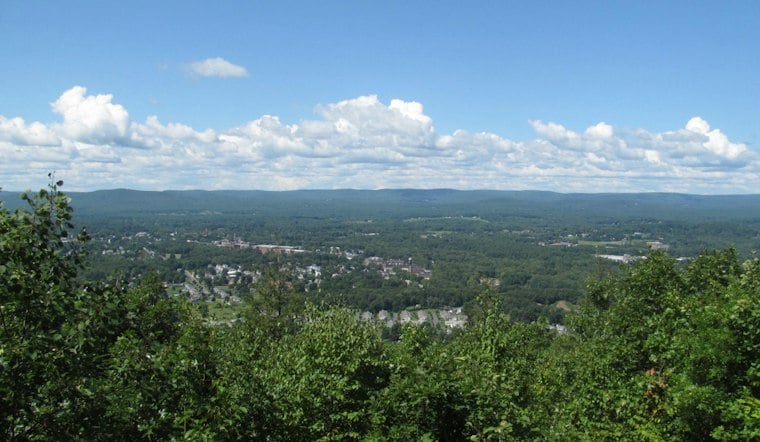
Hawks migrate through the Mount Tom area, where thermals rise off the mountain's basalt cliffs. For 13 years, Holyoke veterinarian Linda Henderson has led the Hawks at Mount Tom project and spoken publicly about hawks.
Henderson, who works as a veterinarian at Holyoke Animal Hospital, started the Hawks at Mount Tom project after speaking publicly about hawks in response to a 2009 proposal from Holyoke Gas & Electric to build five wind turbines on the mountain's peak, according to MassLive. The project has since grown into an annual event, typically held the third Sunday of September.
Why Mount Tom Pulls In So Many Raptors
The science behind the spectacle comes down to geology and wind. Thermals — pockets of hot air that rise off Mount Tom's basalt cliffs — allow hawks to gain altitude until that hot air dissipates, the outlet reports. Wind currents can also create updrafts along the mountain.
That combination has made Mount Tom part of something much bigger than a local curiosity. The Mount Holyoke/Mount Tom/East Mountain Range is formally designated an Important Bird Area, classified by Mass Audubon as a migration corridor for more than 5,000 migratory raptors during a single season. The organization notes the range sits close to the Connecticut River, a geographic feature that helps make the entire corridor a prime bird migration route. Large concentrations of Broad-winged, Sharp-shinned and Cooper's Hawks pass through, and the group points out that Peregrine Falcons once nested on Mount Tom's rocky cliffs and could do so again someday.
A Flyway for More Than Just Hawks
Raptors aren't the only draw. Mount Tom's flyway also draws other birds, including warblers, scarlet tanagers and hummingbirds.
Vince Yurkunas, president of the Allen Bird Club and a birdwatcher with 50 years of experience, is part of the birding community. The Allen Bird Club notes that the optimal stretch for observing the greatest number and variety of migrating raptors across Western Massachusetts runs from the second week of September through the third week of October, and that its fall counts now feed into a hawk-watch network stretching from Quebec all the way to Central America.
Decades of Hawk-Watching on the Same Ridge
Mount Tom's reputation as a raptor stopover isn't new. Hawk watchers there once witnessed 1,700 migrating Broad-winged Hawks pass near the observation tower in a single sighting back in 1974, according to massbird.org. The same basalt cliffs and their orientation toward the sun that generate those thermals also draw paragliders, as GBH News has reported, making the ridge a magnet for anything capable of riding rising air.
Henderson's program has leaned into that legacy, pairing live birds with discussions of migratory threats so attendees leave understanding not just what they're watching but why it's worth defending. On Monday at 7 p.m., she's scheduled to speak at the Allen Bird Club of Springfield's annual event, where her talk will cover both her Hawks at Mount Tom project and her past efforts opposing the wind turbines once proposed for the peak. The free talk is open to the public and will be held in the Tolman Auditorium of the Springfield Science Museum, located at 21 Edwards St. in Springfield.




