

























































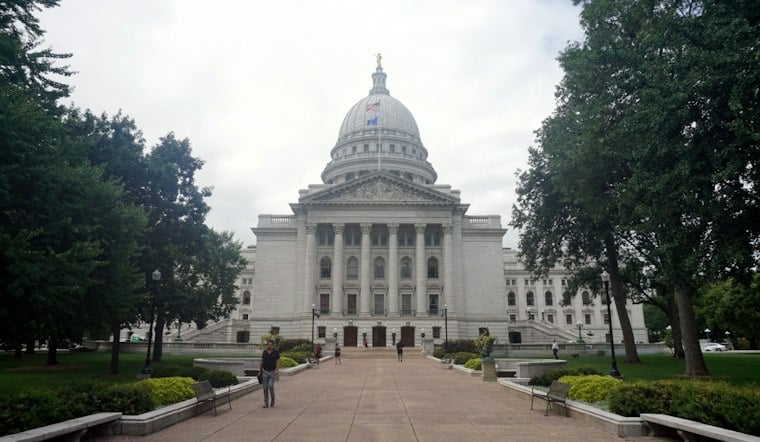
The immediate question in Wisconsin’s Act 10 dispute is whether the state Supreme Court will review a July appeals court decision upholding the law. The legal challenge is unfolding alongside the Nov. 3 election, which could also affect whether lawmakers have the power to change the law.
Act 10, Wisconsin's 2011 law restricting public employee unions, was signed by then-Gov. Scott Walker and largely eliminated collective bargaining for most public workers, according to Urban Milwaukee. The law took full effect that June, limiting covered unions to negotiating only over wages and capping any raises at the rate of inflation, as reported by WPR. It also banned unions from deducting dues directly from employees' paychecks and required public workers to contribute more toward their pensions and health insurance.
The law imposed stricter certification requirements too, forcing unions to hold recertification elections every year and clear a majority vote of all members — not just those who showed up to vote — to keep representing workers. Police and firefighter unions were carved out of those changes entirely. The upheaval triggered massive backlash at the time, with Act 10 drawing as many as 100,000 protesters to the Capitol in 2011.
Appeals Court Reverses 2024 Ruling That Struck Down Key Provisions
A Dane County Circuit Court judge ruled in 2024 that major portions of Act 10 were unconstitutional, finding that the law's differing treatment of general public employees and public safety employees violated the Wisconsin Constitution's equal protection clause, according to WPR. The lawsuit behind that ruling specifically argued that treating public safety unions differently from other public employees was unlawful. The circuit court stayed its own ruling pending appeal, which kept Act 10 in place as the law of the land, per Quarles.
On July 29, 2026, the Wisconsin Court of Appeals, District 2, overturned the circuit court decision and upheld Act 10, according to the law firm’s analysis. The Wisconsin Supreme Court had upheld the law in 2014, but the current dispute concerns the equal-protection challenge brought in state court. The case may now go to the state’s highest court; the available evidence does not establish whether the justices will take it up or how they might rule.
An Earlier Federal Ruling
The state-court history is not the only earlier precedent: a separate federal case, Wisconsin Education Association Council v. Walker, upheld Act 10 in 2013, according to The Daily Cardinal.
Political Stakes Rise Ahead Of November Vote
The law's fate is tangled up with Wisconsin politics in more ways than one. Five of the seven justices on the state Supreme Court were elected with help from Democrats, and the court could overturn some of Act 10's restrictions if it ultimately sides with the 2024 circuit court decision, Urban Milwaukee reports. But a governor cannot repeal Act 10 alone — undoing it legislatively would likely require Democrats to control the Assembly, Senate and governor's office simultaneously, since legislature party control determines whether the law's restrictions are rolled back.
That makes the Nov. 3 election pivotal to Act 10's political future. U.S. Rep. Tom Tiffany, who voted for Act 10 originally, has defended the law and warned that repeal would place more of a burden on taxpayers, saying local governments and school districts would face devastating cuts or higher taxes. Tiffany has been endorsed by three public safety unions. His opponent, Milwaukee County Executive David Crowley, has called for a full repeal of Act 10 and disputed the idea that restoring bargaining rights would create an immediate cost to taxpayers, arguing that employee retirement and healthcare contributions would ultimately depend on negotiated agreements. Crowley has been endorsed by more than a dozen unions, while labor groups including SEIU Wisconsin and AFT-Wisconsin back a full repeal and full bargaining rights for public employees, respectively.
Public opinion is split along familiar lines. A Marquette Law School poll found 54% of Wisconsin registered voters favored restoring collective bargaining, while 43% favored keeping Act 10 unchanged. The partisan divide was stark: 84% of Democrats favored restoring bargaining, compared with 65% of Republicans opposed to repeal. Independents were nearly evenly split, with 50% supporting keeping Act 10 and 46% favoring repeal.
What Repeal Would — and Wouldn't — Change Overnight
Even if Act 10 were repealed or overturned, the shift wouldn't be instant. Unions and employers would need to reorganize, recertify, and negotiate new agreements, and a repeal would not immediately result in higher pay or benefits for public employees, according to Wisconsin Watch. University of Wisconsin labor expert Michael Childers has noted that already certified unions would be able to bargain immediately while other unions would need to reorganize first. Established unions would eventually regain the ability to bargain over contracts and agreements, potentially increasing public employees' ability to negotiate compensation and working conditions over time — though not right away.
Despite the law's restrictions, some school district unions have continued bargaining after successfully recertifying year after year. Wisconsin was once a labor-rights pioneer, becoming the first state to formally authorize public-sector collective bargaining back in 1959 — a legacy that makes Act 10's impact on union membership all the more striking. The state's public-sector union membership rate fell from 46.6% in 2010 to 18.5% in 2025, a decline of nearly 29 percentage points since 1985, per the same Wisconsin Watch account. WPR separately reported that Wisconsin's long-term union membership decline between 1985 and 2025 was the steepest of any state in the country, and that the drop was roughly 20 times the national average, concentrated around 2011. Private-sector union membership fell too, from more than 17% in 1985 to under 5% by 2025.
Dueling Estimates On The Cost Of Repeal
Act 10 shifted pension and health care costs onto public employees, and before the law passed, Wisconsin Retirement System employers covered more than 99% of pension contributions — a share that fell to about half by 2020, according to Wisconsin Watch's reporting. The Wisconsin Policy Forum estimated that increased employee pension contributions reduced state and local government costs by nearly $5.2 billion between 2011 and 2017, a figure cited by PolitiFact. School districts alone reduced benefit costs by $451.5 million in 2012. The MacIver Institute has put total Act 10 savings even higher, estimating they topped $16.8 billion by 2023 — though PolitiFact notes those figures reflect a transfer of costs from taxpayers onto public employees rather than a pure savings.
Looking ahead, Tiffany has estimated that a full repeal could increase taxes by $2 billion annually for local governments and school districts, a figure echoed by the Wisconsin Institute for Law & Liberty, which projects repeal could cost taxpayers more than $2 billion a year, including $1.788 billion for school districts and $480 million for local governments. WILL calculates that a $300,000 home could see property taxes rise by $624 or more annually if those costs were passed on to taxpayers. Those projections remain estimates from advocacy and political sources rather than confirmed fiscal outcomes, and whether they materialize will hinge on how the courts — and voters — ultimately settle Act 10's fate.
State Sen. Dianne Hesselbein has said Senate Democrats support restoring collective bargaining rights, arguing that collective bargaining works for Wisconsin. She has said her caucus is actively discussing how public employee health insurance and pension contributions might be structured going forward, even as the legal and electoral paths toward any such change remain unresolved.



