

























































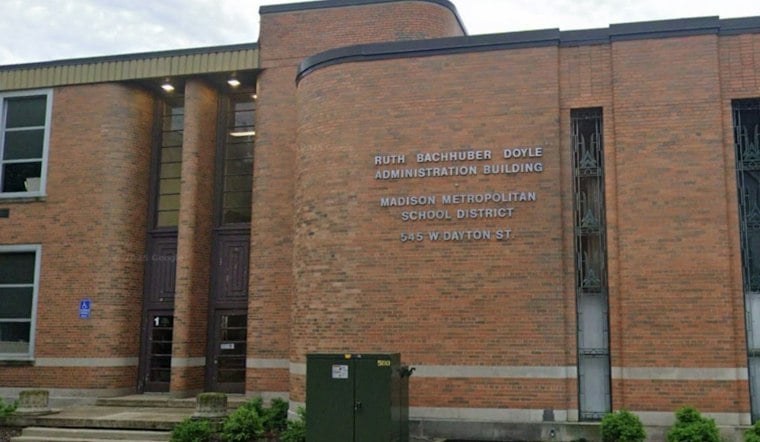
Madison Metropolitan School District is weighing new attendance boundaries that could place a middle school on the west side and an elementary school on the east side. The second draft comes amid uneven capacity pressures: growth is expected in some areas even as district planning documents project an overall enrollment decline.
The proposal, detailed by The Capital Times, would put the middle school on district-owned land near Acacia Ridge, close to Olson, Stephens and Anana elementary schools. The proposed east-side elementary school would be on district land off Sprecher Road, near Kennedy and Ada Deer elementary schools. Single-family housing is planned near Olson and Anana, and an external consultant estimated that Madison schools can expect about 20 new students for every 100 detached homes built, according to the report. District projections cited by the Cap Times indicate that a west-side school could serve some of the area’s growth and ease pressure elsewhere.
Projected Enrollment Numbers Driving the Plan
District projections cited by the Cap Times put the proposed west-side middle school at about 66% utilization roughly a decade after opening, compared with about 59% at nearby Gillespie Middle. Without a new school, Toki Middle is projected to reach full utilization during that period. By 2035, Cherokee, Gillespie and Hamilton middle schools would be within the district’s recommended utilization range of 75% to 85% with the proposed school in place.
The proposed east-side elementary school would draw students from Kennedy, Lori Mann Carey and Schenk, which are near or above full capacity today, according to the Cap Times. Without another school, Ada Deer, Lori Mann Carey and Schenk are projected to be near or above capacity within roughly a decade. Other schools face the opposite concern: district projections cited by the outlet put several elementary and middle schools below 65% utilization within 10 years.
A Decades-Overdue Overhaul
MMSD’s last comprehensive districtwide attendance-boundary review was in the early 2000s. Since then, the share of students of color has risen from 10% to roughly 60%, a change the district says makes redrawing boundaries more complex, according to Madison365. Separately, City of Madison planning projections call for about 100,000 more residents and 15,000 additional housing units by 2050, with growth expected to affect neighborhood schools unevenly.
MMSD already owns two undeveloped parcels earmarked for potential expansion: an eight-acre plot at Acacia Ridge on the west side and a 20-acre plot off Sprecher Road on the east side, which the district has held for decades without development. The district, which serves more than 25,000 students across a 74-square-mile area spanning Madison, Fitchburg, Maple Bluff, Shorewood Hills and surrounding towns, is the second-largest public school district in Wisconsin.
Enrollment Trends Are More Complicated Than Growth Alone
MMSD’s 2024 Long Range Facilities Plan projected districtwide enrollment would decrease by 1,395 students over the following three years, mostly in elementary grades. The district also reported a 482-student decline in 4K-12 enrollment from 2020-21 to 2021-22; that one-year comparison does not establish a continuing trend. Together, the figures show why districtwide projections and neighborhood-level capacity pressures can point in different directions, according to the 2024 Long Range Facilities Plan and MMSD’s fall 2021 enrollment report.
Community Feedback and What Comes Next
MMSD began holding community input sessions the week before the Cap Times report was published and plans to make an interactive map of the draft boundaries and proposed changes available by the following Monday. Assistant Superintendent of Innovation and Strategy Cindy Green told the outlet the second-round maps are designed to prompt feedback; they leave more schools above or below preferred utilization levels than within the target range. A third draft is expected to give more attention to programming, including possible uses for under-capacity schools.
A consultant’s survey received more than 900 responses. Respondents supported a range of options, including new schools, boundary changes, building renovations or expansions, and specialized programming at underused schools, the Cap Times reported. MMSD says it aims to provide all-day, five-day 4-year-old kindergarten at every elementary school and expand STEM, dual-language immersion and arts programming districtwide. Nuestro Mundo, a dual-language immersion charter school, has no set attendance area and is not included in the boundary changes.
The district will host additional community input sessions in December, followed by a districtwide town hall in January. The school board is expected to vote on adopting new maps in February, with changes beginning to take effect for the 2028-29 school year and continuing to roll out through the 2030-31 school year, according to the Cap Times timeline.
The Referendum Question Looming Over the Plan
New schools on the Acacia Ridge and Sprecher Road sites would likely require another property-tax referendum, district officials have acknowledged. Voters approved a $607 million MMSD referendum package in November 2024: $507 million for capital debt and $100 million for operations. The vote was the largest school referendum package in Wisconsin history, according to the Daily Cardinal. A Wisconsin Policy Forum analysis says the package raised MMSD’s local property-tax levy by 20.4%, adding an estimated $1,376 to the average Madison homeowner’s bill.
What the 2024 Referendum Covered
The 2024 facilities measure was not authorization to build the two new schools now being considered. MMSD said the $507 million facilities funding would transform 10 schools, alongside a separate $100 million operational measure, according to the district’s statement on the referendum results.
Superintendent Joe Gothard, who grew up on Madison’s east side and attended MMSD’s Elvehjem Elementary, Sennett Middle and La Follette High schools before leading St. Paul Public Schools in Minnesota, would like to see changes to state funding before recommending new construction to the school board, the Cap Times reported. State revenue caps on Wisconsin school districts have lagged inflation for 18 consecutive years through the current school year, according to the Wisconsin Association of School Business Officials. The Associated Press reported that Wisconsin districts sought $5.9 billion through a record 241 referendums in 2024; voters approved 169 measures worth $4.4 billion.
MMSD selected construction managers J.H. Findorff & Son Inc. and Vogel Bros. Building Co. in late 2024 to oversee capital projects funded by the $507 million facilities referendum, work that includes modernizing middle and high school facilities across the city. Whether that construction expands to entirely new buildings on the district's long-held west and east side parcels will hinge on the boundary review's final maps and, ultimately, on another trip to Madison voters.



