

























































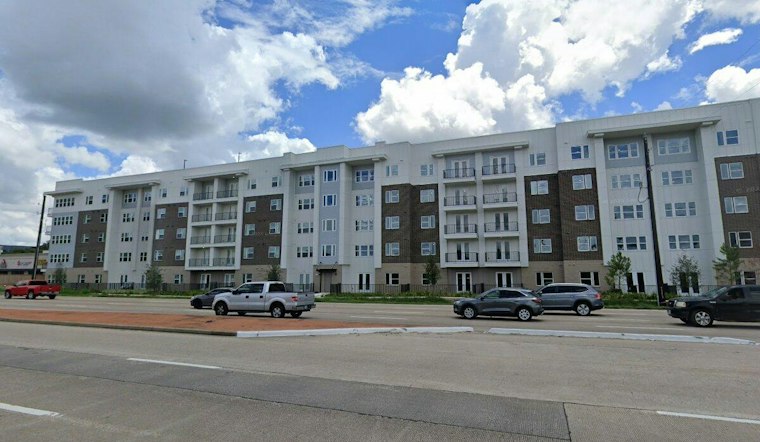
A four-story apartment complex with 101 units just opened at 800 Highway 6 South in Houston's Energy Corridor, just south of Memorial Drive, bringing dozens of income-restricted homes to a part of the city where affordable options have been scarce. The Rushmore includes 85 apartments reserved for income-qualifying households alongside 16 market-rate units, giving the project a mixed-income model that its developer says is its first in Houston.
Community leaders, housing advocates, and development partners gathered Thursday, November 19, to celebrate the grand opening, according to stylemagazine.com. The Rushmore was developed by Miami-based Housing Trust Group in partnership with the Harris County Housing Finance Corporation and Harris County Housing & Community Development, two county entities that helped shape the project's affordability structure. The 85 income-restricted units are set aside for residents earning at or below 30, 50 and 60 percent of the area median income, per yieldpro.com.
A Mix Of Unit Sizes And Shared Amenities
The completed community includes 32 one-bedroom, 50 two-bedroom and 19 three-bedroom apartments spread across four stories, the same yieldpro.com report notes. Residents have access to a swimming pool, fitness center, gathering spaces and business facilities, according to stylemagazine.com's account of the opening. Houston Business Journal growth editor Florian Martin covered the opening for the paper's residential real estate section, describing The Rushmore as a 101-unit mixed-income complex built for families.
Financing for the project drew on Citi Community Capital, Low-Income Housing Tax Credits, City of Houston HOME funding and Harris County resources, the station's report notes. Houston Style Magazine and YieldPro describe The Rushmore as a $34.2 million community, while Bisnow reports a $33.8 million figure. Reported monthly rents also vary between accounts: yieldpro.com's November coverage lists a range of approximately $585 to $1,623, while the outlet's earlier reporting on the project's 2025 groundbreaking cited a planned range of $532 to $1,875.
County Funding Figures Also Differ Between Reports
Harris County's contribution to the project is similarly described with two different numbers. Per the same yieldpro.com account, the county provided $5.975 million in American Rescue Plan Act funding and land-acquisition support, while Bisnow reported a $6 million ARPA loan from the county. The Harris County Housing Finance Corporation also serves as the project's managing member and is providing a 99-year ground lease intended to support long-term affordability, according to the yieldpro.com report.
Housing Trust Group described The Rushmore as its first community in Houston and its third in Texas overall, per the same account. The project was authorized, according to a city notice excerpt reviewed from houstontx.gov, under Title II of the Cranston-Gonzalez National Affordable Housing Act and regulations found at 24 CFR part 92.
Why The Timing Matters For Houston Renters
The Rushmore's opening lands amid mounting pressure on renters across the region. More than half of renters in Houston, 52.6%, and in Harris County, 51.2%, are cost-burdened, meaning they spend more than 30% of their income on rent, according to the Kinder Institute for Urban Research at Rice University. The 2026 National Low Income Housing Coalition Gap Report, cited by yieldpro.com, estimates the Houston area faces a shortage of 209,630 affordable and available rental homes for extremely low-income households, with just 17 such homes available for every 100 households in that income bracket and roughly 94% of extremely low-income renters cost-burdened.
The broader housing market has also been shifting toward renting. Harris County added more than 30,000 multifamily units, with most new construction concentrated in the suburbs or exurbs, according to the Kinder Institute's research. In 2024, the county saw about 19,000 fewer owner-occupied households and nearly 30,000 more renting households compared with the prior year, part of a drop in the owner-occupied share from 55.2% to 53.8% — the largest annual retreat the institute has recorded since 2014.





