

























































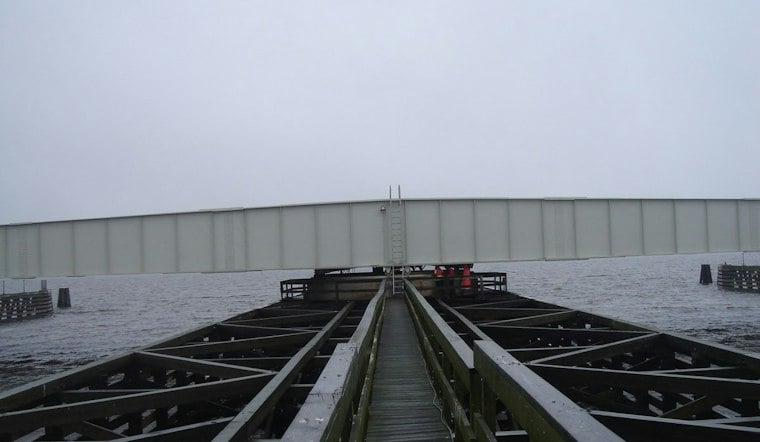
The Lindsay C. Warren Bridge has carried traffic over the Alligator River on U.S. 64 since February 1962, but once its replacement opens, big chunks of the old span won't be hauled to a scrapyard — they'll be dropped intact into Albemarle Sound. State officials say 300 bridge spans, each measuring 60 feet by 30 feet and still fitted with traffic lanes and concrete railings, are intended for use in a proposed artificial reef meant to give fish, and the anglers who chase them, a new home.
A 65-Year-Old Bridge Gets a New Purpose
The bridge, also known as the Alligator River Bridge, stretches 2.8 miles across the river in Tyrrell and Dare counties, according to the Charlotte Observer. State officials have rated it structurally deficient, meaning it's nearing the end of its lifecycle and needs more frequent monitoring, inspection and maintenance — not that it's unsafe, officials say. That upkeep has made it harder to maintain a reliable link between Columbia, Manns Harbor, Manteo and the Outer Banks, according to state officials cited in the same report.
Replacement work on the span, located roughly a 170-mile drive east of downtown Raleigh, began in early 2025. The new bridge will run about 3 miles long and sit 1,500 feet north of the existing crossing, per the same account. As reported by Coastal Review, the project is on track for a fall 2028 opening and carries an estimated price tag of $523 million — a figure that includes removing the old bridge and restoring the surrounding environment.
Why the Old Swing Span Is Going Away
The current bridge relies on a swing span to let large vessels pass, forcing drivers to stop and wait. Coastal Review reports the new bridge's 65-foot flyover will cross a 135-foot-wide channel and eliminate that wait entirely, letting drivers cross without stopping for boat traffic. NCDOT has said the old swing span needs mechanical replacement parts that aren't readily available and typically require custom fabrication, a problem first flagged back in 2021.
What happens to that roughly 12-foot-tall swing span itself remains an open question. Jordan Byrum, the state's artificial reef coordinator, said it may either be cut up and scrapped or placed at the reef site, the report notes. Dismantling of the old bridge is expected to begin once the new bridge opens in fall 2028, and after it comes down, crews plan to restore the shoreline and reforest surrounding wetlands, according to Coastal Review.
Why Albemarle Sound, Not a Dive Site
The proposed reef would cover 125 acres of barren sand about 3.5 miles northeast of the mouth of the Alligator River, where the water runs about 15 feet deep. Reef material needs six feet of water depth above it for clearance, the Observer's reporting notes. Sunken concrete sections are intended to attract sea life to areas that are otherwise largely void of fish, benefiting anglers who fish the sound.
Don't expect scuba divers to flock there, though. Byrum said the site isn't a good spot for recreational diving because Albemarle Sound's water is too cloudy for good underwater visibility, per the same report. That's a contrast with the open ocean, where North Carolina's existing artificial reefs range from a half mile to 38 miles offshore.
Sources differ on just how many reefs the state already maintains. The Observer's report attributes figures of 43 ocean reefs and 29 estuarine reefs, along with a total of 72 artificial reefs statewide, to the North Carolina Division of Marine Fisheries. But Coastwatch, North Carolina Sea Grant describes the state's artificial reef program as including 40 ocean reefs and eight in estuarine waters. Coastwatch notes the state has focused in recent years on building fishery habitat specifically in estuarine waters, where freshwater mixes with seawater, and has previously used bridge pilings and concrete rubble for that purpose.
A Public Meeting Is Coming Next Month
Residents will get a chance to weigh in before any of this moves forward. The North Carolina Department of Environmental Quality's Division of Marine Fisheries will hold a public informational meeting on establishing the new estuarine reef in Albemarle Sound at 6 p.m. Thursday, Dec. 3, in Room 110 at the College of the Albemarle, per a notice from the department.
North Carolina wouldn't be the first state to turn a retired bridge into fish habitat. When New York demolished the old Tappan Zee Bridge, officials sank pieces of it at six artificial reefs off Long Island, transporting the remains in roughly 30 barge loads, according to The New York Times. New York officials said at the time that reusing the bridge material would expand marine habitat and support recreational fishing, diving and economic development — the same kind of payoff North Carolina is now betting on for Albemarle Sound.





