

























































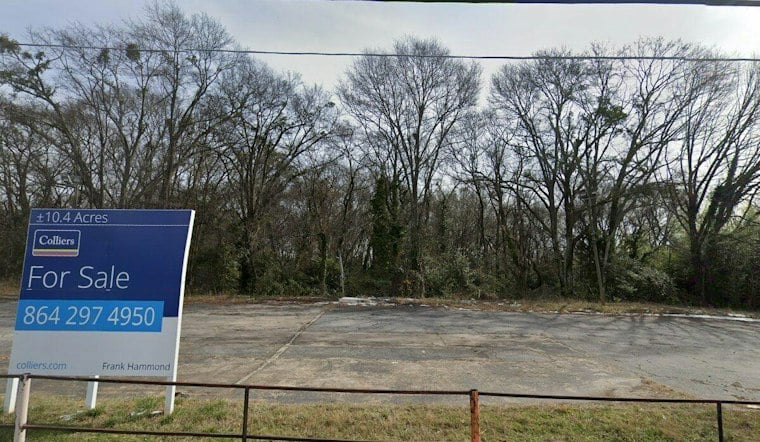
A five-acre property at 432 N. Pleasantburg Drive, right at the corner with Lowndes Hill Road, could soon be home to a 40-bed inpatient physical rehabilitation center. Plans for the facility were presented at the city of Greenville's monthly planning preview meeting on Tuesday, putting the project on the city's radar even as it still awaits key approvals.
The project is being developed by Texas-based Astrea Development in partnership with Exalt Health, a company that specializes in inpatient physical rehabilitation, according to Upstate Business Journal. Exalt Health currently operates facilities in Texas, Arizona and Florida, and the North Pleasantburg project would mark the company's first South Carolina operation, per Astrea Development founder and CEO Erik De Vries.
Who the Facility Would Serve
If built, the center would focus on inpatient physical rehabilitation for patients recovering from a range of conditions, including stroke, bone fractures, and head and spinal cord injuries. De Vries said the typical patient has an average age of around 65. The arrangement between Astrea Development and Exalt Health would involve an initial 20-year lease, with the facility projected to employ about 125 medical and support personnel.
The proposal would enter a market that already has several inpatient rehabilitation providers in Greenville. South Carolina’s 2024 health-facility report lists 152 beds across Encompass Health Rehabilitation Hospital of Greenville, Prisma Health Greenville Memorial Hospital and St. Francis Downtown. The report gives those facilities occupancy rates of 47.4%, 69.4% and 52.8%, respectively. If added to that listed capacity, Exalt’s proposed 40 beds would increase the total by about one-quarter; the figures describe beds and occupancy, not whether patients are waiting for placement. The state’s 2024 rehabilitation-program data provides the comparison.
The scale lines up with Exalt's other projects. The company's facility in Conroe, Texas is described on its own website as “a 40-bed, single-purpose inpatient rehabilitation hospital.” Last year, Exalt Health and its partner Catamount|Freese Johnson broke ground on three additional 40-bed hospitals in Florida — in Wellen Park, Daytona Beach and Orange Park — each designed to deliver neurological, orthopedic and cardiac recovery programs, the company said in its own announcement.
An inpatient rehabilitation hospital is a more intensive setting than many forms of post-acute care. To qualify for Medicare-covered inpatient rehabilitation, a patient generally must need coordinated therapy from multiple disciplines, be able to participate, and receive physician supervision; the usual therapy standard is at least three hours a day on five days a week, with a limited alternative for some patients. Those requirements mean a facility’s bed count alone does not determine who can be admitted. CMS’s inpatient rehabilitation guidance outlines the program and its coverage framework.
Rezoning Still Has to Clear City Review
Before any construction can start, Astrea Development is asking the city to rezone two parcels from mixed use and commercial corridor to campus medical. The request now moves to Greenville's planning commission for evaluation, the next formal step in a process that has not yet concluded.
The rezoning request is not the city’s final decision. Greenville’s Planning Commission reviews rezoning requests, holds a public hearing and makes a recommendation to City Council, which is the next decision-making body in the process. That distinction matters for the project’s proposed construction schedule: presentation at a planning preview meeting does not itself approve the zoning change or authorize construction. The city’s description of the Planning Commission’s role sets out those steps.
Assuming the project clears that planning and development process, De Vries said construction could begin in the summer of 2027 and take about 14 months to complete. Under that timeline, the rehabilitation center could admit its first patients in the fall of 2028 — though both dates remain projections tied to approvals that haven't happened yet.





