

























































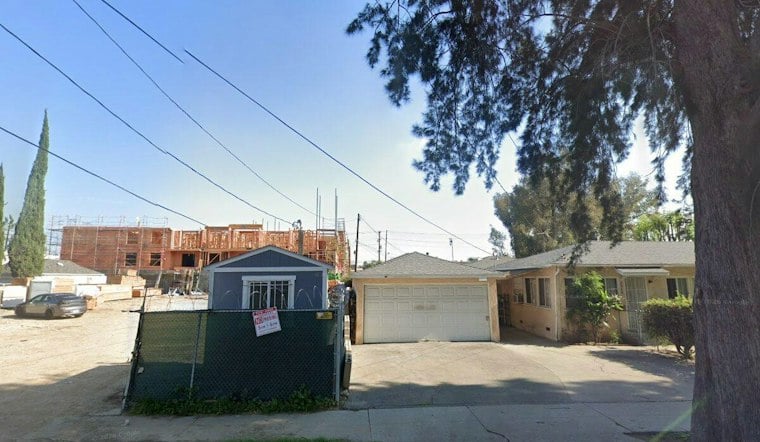
A stretch of N. Baird Avenue in Reseda is slated for a four-story affordable housing complex with 48 apartments and not a single on-site parking space. The project at 6908-6916 N. Baird Avenue will include 47 low- and moderate-income units plus one mandatory manager's unit, on a parcel where a small-lot subdivision was never built.
From Stalled Subdivision to Streamlined Approval
According to Urbanize LA, the Baird Avenue site was previously slated for a small-lot subdivision that was never built, leaving the parcel undeveloped before the current project moved forward. The property owner, associated with JB Builders, secured approvals for the complex in 2023, and those approvals relied on density-bonus incentives along with Executive Directive 1 streamlining provisions, the outlet reports. The project is designed by GA Engineering and is depicted as a contemporary stucco-clad apartment building, per the same report.
The city later made the streamlining policy permanent: the Affordable Housing Streamlining Ordinance took effect Dec. 19, 2025, codifying a revised version of ED1. The ordinance also added protections related to existing tenants, historic resources, labor, the environment and design. The Baird project’s approvals date to 2023, before that ordinance took effect; the city’s account of the policy’s evolution is in its 2025 housing progress report.
Permits Issued, But ED1's Track Record Is Mixed
Permits for the Reseda project were issued by the Los Angeles Department of Building and Safety, according to permits cited in the Urbanize LA report. Citywide, Crosstown reported that only 4,993 of 32,838 units approved under the directive through the end of the prior year had actually been issued building permits for new construction, and that just 26 percent of units entitled during ED1's first year in 2023 had reached that stage.
The gap between entitlements and permits has drawn scrutiny of the mayor's office's public claims about the program's progress. Crosstown's reporting notes that the mayor's press office said 6,000 affordable housing units were under construction citywide, but did not provide a clear explanation of how that figure was calculated.
More recent city figures show both the scale of ED1 approvals and the distinction between approval and construction milestones. Los Angeles reported that 11,055 100-percent affordable units were ministerially approved through ED1 in 2025, while 5,230 affordable units were permitted citywide that year, a 46 percent increase from 2024. Those figures measure different stages and programs, so they do not establish how many ED1-approved units entered construction. The city’s annual progress report also says average City Planning review time for ED1 projects fell to 45 days.
More Density Coming to the Same Block
The same project team behind the Baird Avenue complex is also attached to a mixed-use project taking shape on an abutting property fronting Reseda Boulevard, Urbanize LA reports. The pairing suggests the stretch near Reseda Boulevard is seeing a broader push toward denser housing.
That push extends beyond this one block. The Real Deal reported that AMG Land Development has filed plans for a 166,110-square-foot, six-story affordable complex with 272 apartments at 6650 Reseda Boulevard, with all of the units restricted to low- and moderate-income households. Construction on that separate proposal is expected to cost $8.2 million, according to the outlet, though its exact filing date and current status beyond the plan submission were not detailed.
The Baird Avenue project will have no on-site parking; its approvals also used density-bonus incentives. For the neighborhood, the project represents a planned addition of affordable housing.
California’s density-bonus law sets limits on parking local governments may require from qualifying projects, but it does not impose a blanket zero-parking rule on every affordable development. The state housing department says a project with all units affordable to lower-income households can qualify for no required parking if it is within a half-mile of a major transit stop; other qualifying projects may receive reduced ratios tied to income mix and transit access. The law’s parking provisions make those details relevant to understanding a no-parking plan.



