

























































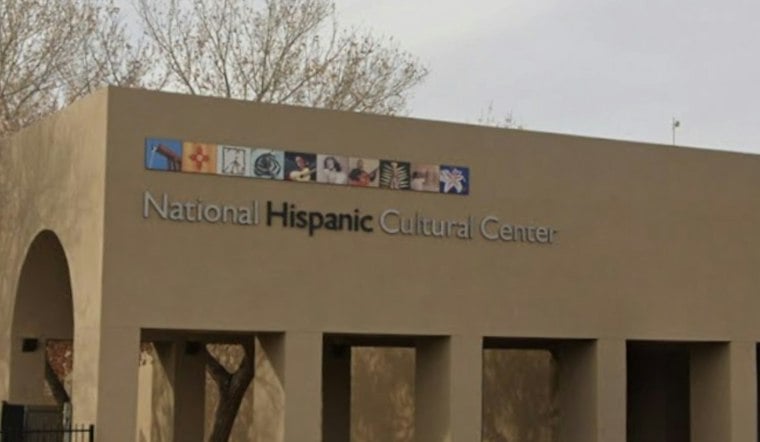
A labor-board ruling over union rights and benefits for executive-other employees has brought the National Hispanic Cultural Center workers’ dispute into court. For Jacob Saavedra, the stakes are personal: he returned to work in a wheelchair and on oxygen after acute respiratory distress syndrome and organ failure nearly killed him, leaving permanent lung damage and partial paralysis in one leg. As a temporary executive-other employee of the state, he says he had no annual or sick leave available.
In May, the Public Employee Labor Relations Board issued a unanimous order allowing eligible workers at the Albuquerque cultural center to unionize and receive compensatory damages for what it found was an improper denial of classified benefits, according to the Santa Fe New Mexican. The state is appealing the decision to state district court, Communications Workers of America Local 7076 President Megan Green told the paper. Workers have sought union representation and full state benefits since 2024.
How the classification affects workers
Saavedra worked as a customer service representative at the center for four years before he woke from a five-week coma in February 2025. He relied on donations from co-workers and friends to get by, the New Mexican reports. He says he returned to work despite the difficulties and felt the state did not value that effort.
He was not alone in facing gaps in coverage. Adri de la Cruz, who has worked at the center since 2023, sustained a concussion on the job in 2025 but did not qualify for workers' compensation because of executive-other status, according to the same account. De la Cruz told the paper that workers are fighting for their legal rights and to remain in their jobs.
Colleagues Describe Years Without a Safety Net
Rosemary Gallegos, a front-of-house representative who has worked at the center for nearly 22 years, said her temporary contracts provide no retirement benefits, health care, annual leave or sick leave, the New Mexican reports. Randy Gomez, a certified rigger at the center since 2020, could not work for almost five months after suffering a stroke two and a half years before publication. He later lost Medicaid coverage after returning to work more than 40 hours a week because his salary was deemed too high, and he still lacks health insurance, per the same report.
Executive-other employees typically work under one-year terms renewed at the end of each cycle and do not receive health insurance or retirement benefits, the New Mexican reported. The workers’ contracts lost sick leave and annual leave in 2024. In a press release, CWA Local 7076 said eleven workers joined the union in March 2025, citing the state’s revocation of benefits. The union also said workers were sometimes “hired for one-year contracts, let go for one day, then rehired for another year,” and that some who generally worked full-time hours had to reduce them to qualify for Medicaid.
The Numbers Behind the Dispute
The National Hispanic Cultural Center has 12 executive-other employees, according to the New Mexican. About 20 additional management or human-resources staff are not in the union, while 19 employees outside the executive-other classification are already covered by the CWA union. Under the labor board’s remedy, newer executive-other employees would be covered after completing one year of work.
Workers submitted signed union membership cards to the Public Employee Labor Relations Board, and the State Personnel Office approved coverage under CWA 7076’s union contract, the New Mexican reported. The office has not processed the cards, prompting the union to file a prohibited-practice complaint. Green told the paper that the state considers executive-other staff outside the definition of public employees under the Public Employees Bargaining Act. She argued that state employees who have worked for more than a year should be treated as regular employees with union rights.
Earlier precedent and recent board activity
The New Mexico Public Employee Labor Relations Board Practice Manual describes a separate 1989 case, AFSCME v. Stratton, in which a court upheld the State Personnel Office’s authority to enter a collective bargaining agreement under agency rules, provided it did not conflict with or enlarge merit-system rights. That case concerned the authority to enter an agreement, not executive-other employees’ eligibility for bargaining or benefits. The PELRB’s 2025 annual report recorded 78 new filings—43 prohibited-practice complaints and 35 representation petitions—up from 60 filings in 2024, including 35 complaints and 25 petitions. Those counts cover agency filings, not court appeals or reversal rates.
State Response and What Comes Next
Greg Gurulé, a spokesperson for the state Department of Cultural Affairs, said the department had no comment on matters under pending litigation, according to the New Mexican. Leah March, a spokesperson for the governor's office, said the office respects the judicial process and will let it run its course, per the same report. Statewide, labor board judicial appeals resulted in reversals in just one out of ten appeals in fiscal year 2026, the paper noted.
Executive-other employees and organizers held a rally in Albuquerque on Oct. 11, and workers say they hope for action over the next two months. The National Hispanic Cultural Center, which opened in 2000 and sits on 20 acres along the Rio Grande in Albuquerque, includes an art museum, a library and a theater, and falls under the state Department of Cultural Affairs. The dispute comes as New Mexico voters prepare to elect either Democrat Deb Haaland or Republican Gregg Hull as governor on Nov. 3, a decision that will determine who oversees the state agencies now fighting the workers in court.




