

























































Four Eaton Fire survivors stood on a Los Angeles stage and spoke for roughly 20 people who lived through the disaster with them, voicing neighbors, a grieving brother, and a business owner determined to rebuild. The piece, called “From Ashes We Gather,” drew on hours of interviews collected from people displaced by the fire that killed 19 people in the Altadena area.
The production traces back to Gayle Nicholls-Ali and Rasheed Ali, who had lived in Altadena for 30 years and began gathering stories from displaced neighbors after the fire, according to LAist. The two collected more than 20 hours of interviews, LAist reports, though a project page from Altadena Photographers describes the work as drawn from more than 14 hours of interviews with Eaton Fire survivors. They met Sunder Ganglani, artistic director of Cornerstone Theater Company, during mutual aid efforts after the fire, and with his help turned the interview transcripts into the play's script.
On stage, the four speakers — all fire survivors themselves — ended up voicing around 20 different people from every walk of life, representing a cross-section of a community upended overnight. The work-in-progress premiere was scheduled for October 22 at the David Henry Hwang Theater in downtown Los Angeles, according to a listing from Colorado Boulevard, with a free show beginning at 7:30 pm.
A Portrait Made of Portraits
Among the stories woven into the piece was that of Evelyn McClendon, a retired Pasadena school bus driver who was the first victim found in the Eaton Fire rubble in Altadena, per LAist's reporting. Her brother, Zaire Calvin, performed a rap he wrote with his cousin as part of the production. Artist Austin Scott described creating a memorial portrait of McClendon built from smaller portraits of other people lost in the fire — “It's going to be a portrait of her face made up of little portraits of all the other faces of the people we lost in the fire,” he said, according to the same account.
Rasheed Ali also composed a piano piece reflecting on Altadena before, during and after the fire, and he described the performance as a breakthrough. Nicholls-Ali said the experience helped her regain her creativity. Medusa, who grew up in Altadena and has collaborated with Tupac Shakur, Erykah Badu and Common, also took part in the project, the outlet notes.
A Theater With Its Own History of Survival
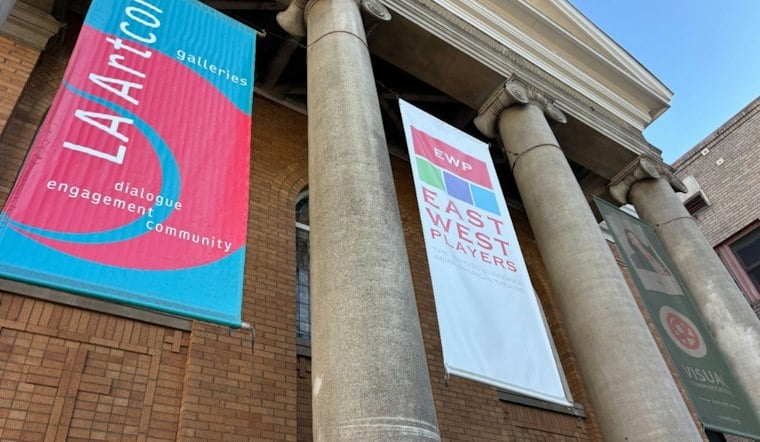
The performance took place at Union Center for the Arts, the theater home of East West Players, described as the nation's first Asian Pacific American theater company. The building previously served as a church for Japanese Americans before their World War II mass incarceration and later became a community center for Black Americans during the Great Migration, according to LAist's reporting. It was also damaged by the Northridge earthquake — a space with its own layered history of displacement and recovery hosting a new one.
The play became part of a national tour of similar events hosted by disaster survivors across the country ahead of the midterms, the outlet reports, connecting people who have lived through extreme weather with one another across different communities.
Rebuilding Businesses Alongside Memories
The production also carried the story of Rhythms of the Village, an Altadena business lost in the fire that sold goods sourced from countries across Africa and hosted drum, dance and Nigerian language classes. The Chukwurah family established the shop in Altadena in 2013 as a retail hub and learning space for African culture and art, according to PBS SoCal. Emeka Chukwurah said the store was about to reopen in a temporary space, and that turning trauma into triumphant moments and new memories made him grateful, LAist reports.
That kind of rebuilding has been slow across Altadena. About half of the town's businesses were destroyed in the fire, and Los Angeles County had received roughly 2,700 rebuilding-permit applications while issuing about 1,200 permits, with 560 homes under construction at the time of a report from CalMatters.
Art as Part of Disaster Recovery
The idea that cultural work belongs in the earliest stages of disaster recovery, not as an afterthought, has gained traction among recovery leaders elsewhere. Patricia McIlreavy has argued that recovery planning must include artists and cultural organizations from the outset, as detailed in The Art Newspaper. In Asheville's River Arts District, home to more than 700 artists before floodwater damaged an estimated 80% of its buildings, philanthropists, business leaders and local government offered grants and temporary studio space and developed a long-term Arts Recovery Framework. Two years later, the outlet reported, the district was once again filled with artists, students and visitors — an example of the kind of long arc Altadena's own creative community is still only beginning to travel.



