

























































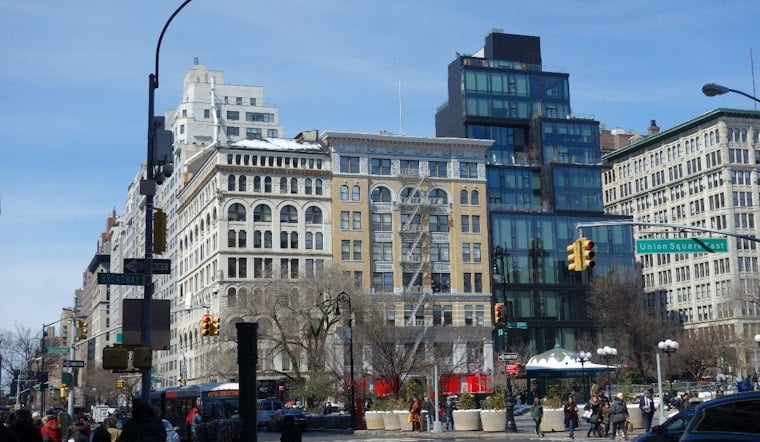
A 1905 factory building at 13 East 16th Street that most recently housed an Agnès B. boutique is being transformed into Ditto, the first restaurant from cookbook author and YouTube personality Andy Baraghani. The space sits between Union Square West and Fifth Avenue, and according to the available reporting it is designed around three distinct zones meant to carry customers from a grab-and-go market up front to a sit-down dining room in back.
The project traces back to an approach from restaurant investor Michael Silber, who is behind Borgo, Penny, and Bistrot Ha, and who pitched Baraghani on the idea of a laid-back café serving breakfast, lunch, and dinner, according to Architectural Digest. Baraghani has said he had no interest in opening a restaurant, per the same outlet, which also notes he has been obsessed with design since childhood. The pairing eventually produced Ditto, described elsewhere as an all-day café opening in the Flatiron neighborhood.
Baraghani built his reputation well before picking up a chef's jacket for his own place. He worked at Chez Panisse in Berkeley as a teenager and later at Estela in New York, and his debut cookbook, The Cook You Want to Be, won him a James Beard Award for which he's also known, per the Architectural Digest account. That same book landed on the New York Times best-seller list, as reported by The New York Times, which also confirmed that Ditto occupies the space formerly home to Agnès B.
Three Zones, One Converted Factory
Walking in, customers first hit a market area selling hand-picked groceries, the report notes. From there, a middle section features a glossy white Bauhaus-curved counter where patrons take a number before carrying food out or sitting down at laminate-topped tables beneath three oversized custom fabric pendants. The layout lets Ditto function as either a quick counter stop or a slower sit-down meal depending on which zone a visitor lands in.
The rear holds the restaurant's third zone, a blue-painted dining area with an open kitchen, patinated stainless-steel walls, and café tables set beside a full-length banquette. Architectural Digest reports that the room's Venetian plaster walls are tinted to match Benjamin Moore's Buckland Blue. Baraghani has described this back room as a calmer moment compared to the busier middle section, per the outlet's account.
Despite the transformation, the building's bones remain visible: Ditto preserves industrial structural arches and polished concrete floors original to the 1905 structure. Vintage glass-prism Holophane pendant lights hang in the front window, adding a period touch to the renovated factory shell.
Design Team Built Around Baraghani's Circle
The project drew on a mix of professional designers and personal connections. Architect Alta Indelman, who has worked with New York restaurateurs including Andrew Tarlow and Gabe Stulman, handled the build, while interior designer Eric Wink, a close friend of Baraghani's, contributed restroom fixtures including Neo-Metro's wall-mounted Miniloo stainless-steel toilet, to which he added a custom wood top.
Baraghani and Silber reportedly considered roughly 50 chair options before settling on 1960s Dutch industrial Model S22 chairs by Galvanitas, sourced from Amsterdam Modern in Los Angeles. Silber also picked up midcentury ceramic bud vases on eBay for under $20 each, and the dining room displays two midcentury French ceramic faces on loan from Baraghani's own home. Baraghani chose Maharam's Stripe It fabric for custom stools, rounding out a décor mix that Silber has said ranged across Bauhaus, De Stijl, and classic modernism as well as 1970s and 1980s Italian and French aesthetics.
Branding fell to Chandelier Creative, which also created the restaurant's in-house playlists through Michael Scanlon, while sound artist Tom Bloxam contributed white wall speakers built into the space. Keith Pollock, Baraghani's husband and a former Architectural Digest editor who now works as a West Elm executive, rounds out the circle of collaborators named in the design coverage.
A Menu Written Fresh Each Day
Ditto's menu is handwritten on butcher's paper and updated daily, according to Architectural Digest, with dishes reported so far including a pomegranate spoon salad and granola served with tahini, maple syrup, yogurt, and fig-leaf oil. Flaky biscuits are expected to become a signature item. The restaurant's concept was partly inspired by City Bakery, the longtime New York institution located two blocks uptown from Ditto's 16th Street address.
Exactly when diners will get to try that menu remains unsettled. The New York Times reported in September that Ditto was scheduled to open on September 30, while Architectural Digest's more recent reporting lists an opening date of November 19. The available reporting does not resolve which date is accurate or confirm that the restaurant has opened.





