

























































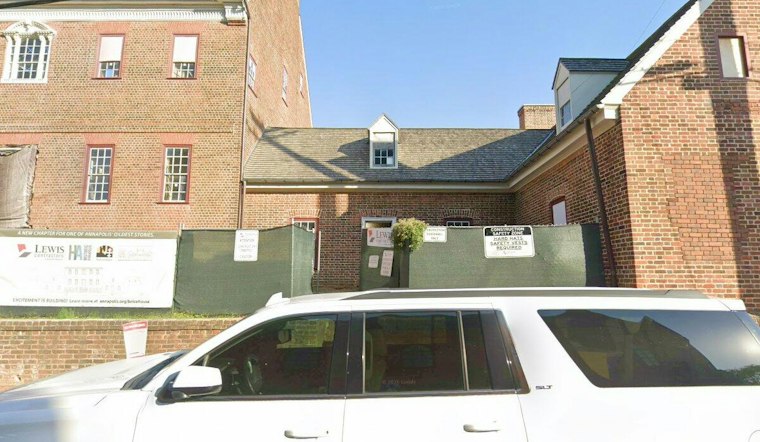
Historic Annapolis has received the Decorative Arts Trust’s 2026 Prize for Excellence and Innovation for its restoration of the James Brice House, a National Historic Landmark in downtown Annapolis. Built between 1767 and 1774, the colonial home is entering a new phase of a project that began a decade ago.
The prize, awarded by the Decorative Arts Trust, recognizes projects that contribute to the study, preservation, and understanding of decorative arts and historic craftsmanship. As Eye On Annapolis reports, the house is considered one of the nation's significant examples of colonial architecture and craftsmanship, and Historic Annapolis has partnered with the State of Maryland on the extensive restoration effort now entering its tenth year.
The work combines research and hands-on conservation, with contributions from Historic Annapolis Executive Vice President Michael Day, Lewis Contractors President Tyler Tate, preservation architect Bill Neudorfer, and Willie Graham, former curator of architecture at Colonial Williamsburg, according to Eye On Annapolis.
What a Decade of Restoration Has Uncovered
Since the full-scale restoration began in 2016, close examination has revealed evidence of the house’s changing finishes, including textured plaster, fragile distemper coatings, and 18th-century woodgraining, according to the Decorative Arts Trust. Specialists have also uncovered plaster ornaments beneath later paint and repaired deteriorated masonry with materials suited to the original construction, per Eye On Annapolis.
The building also records later changes in its fabric: a 19th-century floor was laid over an 18th-century floor, and a large opening was cut through a masonry wall when the cellar was used by the neighboring Carvel Hall Hotel, according to the National Trust for Historic Preservation’s Saving Places. Historic Annapolis says its eventual aim is to restore the house to its completed 1774 appearance.
The wider group of contributors includes paint analyst Dr. Susan Buck, materials scientist Dr. Kirsten Travers Moffitt, conservator Christopher Mills, master mason Ray Cannetti, Marcia Miller, former chief of research, survey, and registration at the Maryland Historical Trust, and Matt Webster, vice president of operations at Colonial Williamsburg, according to Eye On Annapolis.
Prize Money Will Fund the Next Phase: Hardware and Fireplace Cranes
The prize funding will support the next stage: assessing surviving architectural hardware and making replacements where pieces are missing, the Decorative Arts Trust says. The work is to draw on physical evidence from the house as well as documentary research.
The funded work also includes the fabrication of fireplace cranes. Surviving features being studied include different types of hinges, hand-built mortise locks, decorative handles, and brass fittings, as well as cast-iron butt hinges, according to the Decorative Arts Trust.
Researchers will examine how the hardware was made, fitted, and used, per Eye On Annapolis. To guide work on elements that no longer survive at the Brice House, they are also looking at comparable properties, including the Ridout House, built around 1765.
A Model Project With a Complicated Past
The Decorative Arts Trust says the project’s combination of traditional building skills and modern conservation methods is intended to inform future preservation work. Eye On Annapolis reports that the research and practices developed at the house may also be useful to similar projects elsewhere.
The State of Maryland bought the James Brice House in 2014 and arranged for Historic Annapolis to maintain and manage the National Historic Landmark, according to the organization’s historical account. That account estimates that as many as 28 people were enslaved at the house or forced to labor in its construction by the Brice family, a history the restoration research has sought to document alongside the building’s architecture.
History Beyond the Architecture
The Maryland State Archives records that James Brice served as acting governor of Maryland from February 10 to April 5, 1792, adding a public-service chapter to the builder’s biography. Historic Annapolis’s estimate of the enslaved people at the house and those compelled to work on its construction is an important part of the site’s documented history. At the separate Hammond-Harwood House in Annapolis, public tours address the social histories of the families and enslaved people who lived there, as well as architecture and decorative arts, according to the Hammond-Harwood House.
Conservation and research work has continued steadily; throughout August 2025, the restoration team carried out additional conservation and research intended to support stabilization and future interpretation of the house, Historic Annapolis noted at the time. A separate $500,000 federal grant from the National Park Service is also set to support restoration of all 74 of the house's original windows, according to Historic Annapolis.
Historic Annapolis joins a short list of past honorees for the Decorative Arts Trust's Prize for Excellence and Innovation, which recognized the Cooper Hewitt, Smithsonian Design Museum in 2022 and the Black Craftspeople Digital Archive in 2021.





