

























































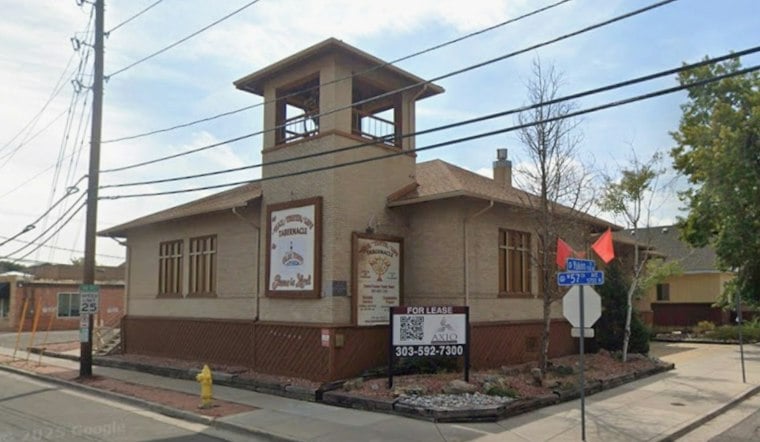
A vacant church just a block off Olde Town Arvada's main drag could soon be reborn as community space and a second location for the beloved Denver pizza chain Hops & Pie, but first two developers need the city to cut them a check for $1 million. The Arvada Urban Renewal Authority was scheduled to vote Wednesday on whether to award the public funds to transform the former church property at 5690 Yukon St.
The proposal, first reported by BusinessDen, calls for renovating the vacant 9,000-square-foot church into a mixed-use space that would include a new outpost of Hops & Pie, which has served up pies and craft beer on Tennyson Street in Denver since 2010. The site sits just one block off Olde Town Arvada's main strip, putting it squarely in the heart of the city's historic commercial core.
This isn't the first time the church property has been eyed for a major overhaul. Meeting materials from the Arvada Urban Renewal Authority show that back in December 2022, the agency's board considered a very different redevelopment agreement for the same building, then referred to as the former Tabernacle Church, with a development group called 5690 Olde Town LLC. That 2022 proposal identified Brandon Young and Nicole Brant-Zawadzki as the individuals behind the LLC.
A Food Hall That Never Materialized
The 2022 pitch described in AURA's board packet envisioned something quite different from today's pizza-and-community-space concept: a food hall and gathering spot with six vendors, including a bar, three food vendors, a local grocery and a coffee stand. Developers at the time proposed investing nearly $6.6 million to remodel the church and surrounding site while preserving its historic character, according to the agency's own meeting packet. That earlier agreement would have capped AURA's contribution at $1.5 million, split between an upfront $300,000 payment and up to $1.2 million in sales-tax-increment reimbursements, and it reportedly gave the authority the right to terminate the deal if construction hadn't begun by the end of October 2023.
Whether that earlier agreement ever moved forward, and how it connects to this week's $1 million request, isn't addressed in the available records. What is clear is that the building has sat vacant for years, with AURA's own December 2022 materials flatly noting, “The building is now vacant.”
How Arvada's Renewal Authority Operates
AURA was established by Arvada's City Council back in 1981 to remediate and prevent blight throughout the city, and it has since grown into Arvada's primary redevelopment engine. The agency relies heavily on tax-increment financing, a tool that lets it capture tax revenue generated above an existing baseline to help fund qualifying projects. According to the authority's own economic-impact report, that financing model has paid dividends in other parts of town: City Center, described as AURA's oldest urban-renewal project, now generates 27 percent of all sales-tax dollars collected citywide. The same report found that every dollar AURA invested in the Ralston Fields urban-renewal area leveraged $5.98 in private investment, while dollars put into Village Commons and City Center leveraged $4.88 and $2.02, respectively.
A separate Arvada project offers a useful comparison for how the authority has supported redevelopment elsewhere. As Denverite reported, AURA contributed $1.6 million toward the outdoor area of the Arvada Beer Garden, after buying that site for $3 million in 2020 and later selling a corner lot to City Street Investors for just $270,000 in 2024. Denverite also reported that, per AURA's executive director, no competitive bid process was used to select the beer garden's developer. Some of the authority's funding capacity traces back to property and sales taxes generated by newer retail developments in the area, a temporary allocation that is scheduled to revert to other taxing entities in 2028.




