

























































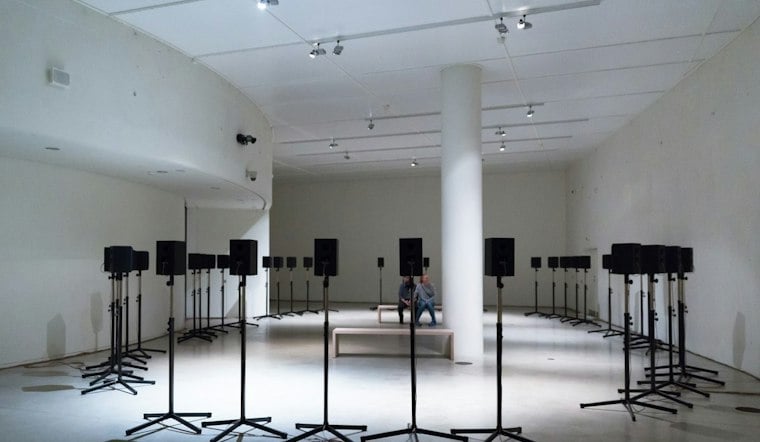
Visitors to the Parrish Art Museum in Water Mill can move among forty speakers arranged in an oval as they hear Janet Cardiff’s The Forty Part Motet, an installation built around Thomas Tallis’s sixteenth-century choral work Spem in Alium. The Parrish calls this the work’s first exhibition on Long Island’s East End; the installation is scheduled to run through February 14, 2027, with a member opening reception set for November 21, according to the museum.
The arrangement makes listening a matter of where a visitor stands: each speaker presents a singer’s part, rather than only a blended choral sound. The work runs on a fourteen-minute loop, with eleven minutes of music and a three-minute intermission, according to Cardiff and George Bures Miller’s studio. The Parrish and James Lane Post identify the work as a 2001 reworking of Tallis’s composition, which is scored for forty singers.
Why the voice count varies
The number of recorded voices is not described consistently. The Parrish says fifty-nine individually recorded voices are heard through forty speakers, while Cardiff and Miller’s site describes forty separately recorded voices. The Clark Art Institute offers a technical explanation: fifty-nine tracks were recorded, then soprano parts were mixed together to produce forty playback tracks. The descriptions differ, so the count depends on whether one means the initial recordings or the parts played through the speakers.
A local partnership in a changing museum landscape
The Cardiff installation is also the first project in a planned Parrish-FLAG collaboration. The museum says the organizations intend to present three exhibitions annually across two adjoining galleries from 2026 through 2030. FLAG says its own exhibitions and programs are free and open to the public; that policy does not by itself establish admission terms for this Parrish presentation.
The partnership arrives amid a broader decline in U.S. art-museum attendance, though that national measure says nothing about expected turnout in Water Mill. In its Survey of Public Participation in the Arts, the National Endowment for the Arts reported that the share of U.S. adults who attended an art museum fell from 23.7% in 2017 to 17.7% in 2022. The NEA figures provide national context, not evidence about the Parrish or this exhibition.
The Parrish moved from Southampton Village to a purpose-built Water Mill facility in 2012. The museum says its building draws on the region’s light, water and sky, and evokes sheds and potato barns that served as artists’ work spaces. Those details describe the institution’s local setting, not a claim that the building was designed specifically for Cardiff’s installation, according to the museum’s accounts of its history and architecture.
Cardiff’s gallery work also has a useful, but distinct, New York sound-art precedent. MTA Arts & Design says Max Neuhaus’s unmarked sound artwork occupied a Times Square pedestrian island from 1977 until 1992, then was reinstated in 2002. Neuhaus’s piece is embedded in public space, unlike Cardiff’s time-limited installation inside a museum; the comparison shows different settings for sound art, not a shared history or evidence of a trend.



