

























































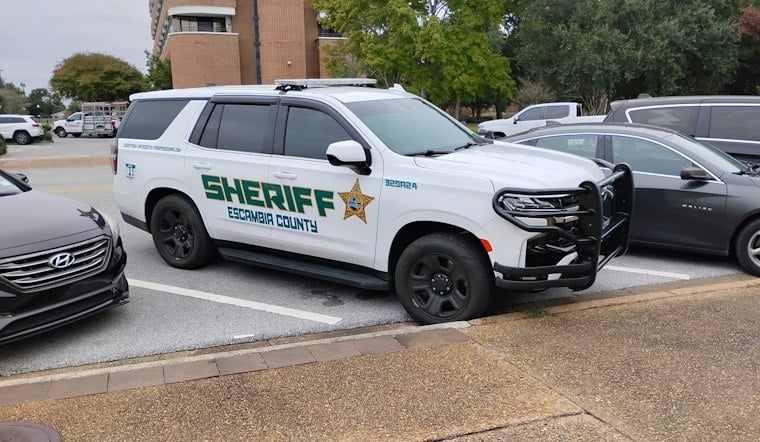
Bones discovered along Interstate 65 near Atmore, Alabama nearly three decades ago finally have a name. The Escambia County Sheriff’s Office says the remains, found on May 18, 1997, belong to Jimmy Monroe Pitts, a man who had been reported missing out of West Point, Georgia.
For years, investigators could not determine who the man was, hampered by the condition of the remains and by forensic technology that simply wasn’t capable of the job at the time, according to fox10tv.com. Pitts, born February 21, 1953, remained an unidentified John Doe for 29 years before new science finally caught up with the case.
The break came in 2020, when Escambia County Sheriff’s Office Crime Scene Investigator Lindsey Miles began coordinating with multiple forensic organizations to pursue advanced DNA testing on the remains, according to northescambia.com. It took several more years and multiple unsuccessful attempts before DNA Labs International finally managed to extract and sequence usable DNA from the remains in 2025, opening the door to forensic genetic genealogy research.
A Match Surfaces, Then a Confirmation
That genetic groundwork paid off in August 2026, when Moxxy Forensic Investigations identified Pitts as a potential match, the same report states. From there, investigators traveled to Georgia to collect a DNA reference sample from Pitts’s sister, and DNA Labs International compared that sample against DNA from the remains, providing the scientific evidence that confirmed his identity.
Authorities said the investigation turned up no evidence of foul play in Pitts’s death. As reported by CNAW2, Sheriff Heath Jackson credited a long list of partners in closing the case, including Olivia McCarter, the Cold Case Coalition, Dr. Kenneth Woodward of Brewton Dental, DNA Labs International and Moxxy Forensic Investigations.
“Most importantly, after nearly three decades, Jimmy Monroe Pitts has his name back, and his family can finally receive answers,” Jackson said, according to northescambia.com. The sheriff also said that persistence in cold cases, paired with advancing forensic technology, can ultimately bring answers to families who have waited years for them.
Part of a Wider Pattern of Cold Cases Cracking Open
Pitts’s case is one of a growing number of long-dormant identifications being solved through forensic genetic genealogy, a technique that cross-references DNA against genealogical databases to trace family lines. A study on the method notes that the National Missing and Unidentified Persons System has observed roughly a 50 percent success rate among its first 200 unidentified-remains cases processed this way, per a study published on pmc.ncbi.nlm.nih.gov, which describes that figure as a conservative estimate.
Similar breakthroughs have surfaced elsewhere recently. In Nashville, Tennessee, a woman found dead in the basement of a home in 1987 was identified through forensic genetic genealogy as Toni L. Gordon, while the other woman found at the same scene, Shelia Cummings, was identified in 2025, according to fox5atlanta.com. And in Summit, Illinois, investigators are still working to identify a man whose body was recovered from the Illinois and Michigan Canal on January 3, 2005, with Moxxy Forensic Investigations now applying the same investigative genetic genealogy approach, as reported by fox32chicago.com.
For the Escambia County Sheriff’s Office, the identification closes out a file that sat open for nearly 30 years and finally gives a family in West Point, Georgia the answers they had been missing since Pitts disappeared. The investigation into his case has now been concluded.




