

























































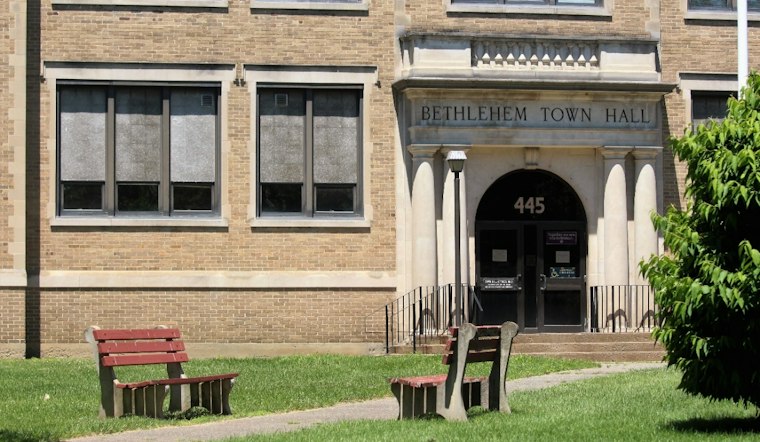
Traffic, development intensity and infrastructure capacity remained central to Bethlehem’s zoning debate at the Town Board’s Oct. 29 meeting, though only seven residents spoke during public comment. The proposed amendments were not on that night’s agenda, and the turnout was notably smaller than at the packed sessions that marked the fight over the summer and fall. Speakers raised familiar questions about traffic safety, school crowding and the pressures of growth.
A Quiet Night Before a Pivotal Hearing
The relatively sparse comment period comes as Bethlehem barrels toward a public hearing on the zoning update scheduled for Tuesday, November 10, at 6 p.m. at Town Hall, according to the Town of Bethlehem. The town says the update remains subject to State Environmental Quality Review. At its Oct. 14 meeting, the Town Board was not scheduled to vote on final approval or disapproval of the modified code, the town's website notes, and that same meeting drew sparse attendance with just one person speaking on zoning during public comment, as reported by the Daily Gazette.
Traffic safety and the need for more evidence were among the concerns residents brought to the board. Chris Dempf said at least three car accidents had occurred in Glenmont near Route 9W and Feura Bush Road. Phil Stevens argued that the town should assess traffic and infrastructure capacity and complete critical studies before choosing among zoning options; he also objected to what he described as arbitrary time limits for advancing the amendments.
Density Caps, Incentive Bonuses Still at Issue
Colleen Scott and Karen Harmon welcomed the board's earlier reversion to the existing Residential A and B zoning districts, a shift Town Board Supervisor David VanLuven first announced at the Sept. 23 meeting, when about a dozen residents raised concerns about density, traffic safety and infrastructure capacity, the Daily Gazette's earlier reporting on the board's reversal shows. But Scott and Harmon said the proposed Mixed-Density Residential district still permits up to 17 dwelling units per acre, and the Commercial Multi-Use district up to 22 units per acre, with available incentive bonuses capable of boosting density by more than 400 percent. The two residents called for caps on unit counts and building heights across the affected zoning districts.
Harmon cited a senior apartment building approved for Rockefeller Road as an example of her concerns. The three-story, 90-unit project was approved by the Zoning Board of Appeals despite exceeding the area’s regular zoning allowance of 60 units and two stories. Harmon said the project showed how high-density development could proceed despite community opposition, and asked VanLuven to follow through on the zoning changes residents had sought. She added that she hoped he would support further amendments she considers necessary.
Affordability and Everyday Traffic Fixes
Becky Hathaway raised housing affordability as another part of the debate, questioning whether Bethlehem’s high costs make it difficult for people to move into town or downsize within it. On traffic, she suggested improving management at street entrances and exits, while saying she was unsure whether officials could address drivers who ignore stop signs. Another resident cited nearly 1,000 new homes built in Bethlehem since he moved there in 2000, as context for the scale of growth.
School Enrollment and Building Capacity
The school-capacity debate has more than one measure: Bethlehem Central School District’s May 7, 2025 presentation reported that districtwide enrollment had declined 21.3% since its 2006-07 peak, while identifying Eagle and Glenmont elementary schools as nearing capacity, according to the Bethlehem Central School District.
VanLuven had supported a separate change at a previous board meeting concerning how constrained versus unconstrained land is treated in conservation districts, part of the broader recalibration that followed the September reversal. In September, the Town Board directed the Planning Department to leave the existing Residential A and Residential B districts unchanged under their current rules, according to the town's zoning update page. At the Oct. 14 meeting, the board formally voted to revert the proposed Residential A and B amendments to current zoning regulations and, in a second vote, set the Nov. 10 public hearing date, the Daily Gazette reported.
The $65,000 Traffic Study Looming in the Background
Much of the anxiety over density traces back to traffic data that has shadowed the zoning debate for years. The Town Board approved spending $65,000 at its Aug. 26 meeting on a study examining 19 intersections along Feura Bush, Beacon and Wemple roads in Glenmont, the Daily Gazette reported separately. Planning Director Robert Leslie said that study does not need to be completed before the town updates its zoning code, even though board members David DeCancio and Tom Schnurr both said they wanted the results in hand before the public hearing.
A 2018 traffic assessment found that peak-hour demand at the study intersections had not changed between 2005 and 2017, and that average daily traffic on Route 9W north of Feura Bush Road had actually dropped modestly, from a 2008 peak of 21,500 vehicles per day to 19,750 in 2014, per the town's own corridor analysis. Still, that same assessment projected that four intersections — including Route 9W at Feura Bush Road/Glenmont Road and at Wemple Road — could see failing level-of-service conditions by 2026 without improvements, and estimated that potential development through 2026 could generate 4,425 new vehicle and transit trips during the PM peak hour alone. Those projections help explain why residents keep circling back to traffic even as the zoning conversation itself grows quieter at the podium.



