

























































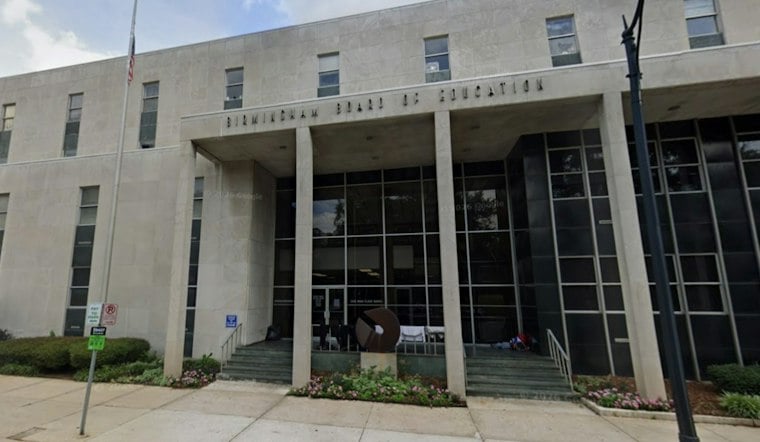
Birmingham City Schools is weighing a plan that would spend $606,495.60 in state funds to place remotely teaching certified instructors into eight vacant classroom positions spread across five schools. The proposal pairs live online teachers with long-term substitutes who would stay physically present in the classroom to help students day to day.
According to ABC 33/40, a separate account from Citizen Portal put the cost at $668,495.60, also described as paid from state funds — a discrepancy that has not been resolved in public reporting. Under the plan, the company Proximity Learning would deliver live online instruction while classroom substitutes act as facilitators, receiving training from the company to support students during lessons.
The proposed assignments would cover a second-grade class at Oliver Elementary, English language arts teachers at Hudson and Washington K-8 schools, a French teacher at Phillips, and Spanish, social studies and science teachers at Huffman High School. District administrators reportedly selected the schools after meeting with principals about the program, and principals had asked for Proximity Learning to be used to address those specific vacancies, per a BCS administrator.
Even the Company Says In-Person Is Better
At an Oct. 27 work session, Proximity Learning’s senior vice president of strategy, Michael Robinson, told the school board that in-person teaching remains the stronger option. “The best solution is if I can get a highly qualified teacher to come to Birmingham City Schools,” he said, framing the remote option as a stopgap rather than a preference.
Robinson pointed to comparisons from other districts, including Memphis-Shelby County Schools, saying the data suggested students performed better when paired with certified remote teachers and in-classroom facilitators. He also cautioned that some teachers in the comparison district held emergency licenses, which he said made the comparison harder to assess cleanly. The company’s presentation did not include results specific to Birmingham City Schools, the outlet’s report noted.
A Pilot Program With No Public Scores
BCS has already tested the approach once, piloting Proximity Learning in a single classroom at W.E. Putnam Middle School last year after a teacher was out sick for an extended period, leaving students without their regular instructor. Dr. Dadron Ham, the principal, told the board that students remained engaged, could get extra help after class, and showed growth in math and English language arts, along with what he described as significant growth in critical standards and key objectives covered by the program.
Ham did not cite specific pilot scores during the work session, and the discussion included no numerical results from the Putnam trial. A board member requested pilot data before voting, in order to help evaluate the program before committing district money to the broader five-school rollout.
Teacher Shortages Keep Mounting Districtwide
The proposal comes as Birmingham City Schools works a separate track to fill roughly eight additional positions through Teach for America, with a district administrator saying that recruitment effort is not yet at capacity. The same administrator agreed that teacher recruitment remains the core struggle, and said additional Teach for America teachers would reduce some of the district’s open positions. Those vacancies sit inside a larger staffing crunch: BCS has said it was working to fill around 160 open positions across the district, according to WVTM 13, and the district has said it expects more openings in coming months as retirements continue, per WBRC. Earlier this year the district rolled out $7,000 sign-on bonuses for certified teachers in subjects like ESL, math, science and foreign languages, with $10,000 bonuses for special education hires, funded through the district’s general fund, WBRC reported.
Statewide, the pressure is building too. Birmingham City Schools reported 191 educator shortage positions entering the 2025-26 school year, a roughly 46% jump from 131 the year before, according to NBC 15. Across Alabama, districts reported 3,413 shortage positions entering that same school year, up about 23% from 2,771 the prior year, with elementary education remaining the state’s largest gap. NBC 15 has cautioned that those figures describe conditions entering 2025-26 and should not be read as a current count for 2026-27.
What Happened Elsewhere With Proximity Learning
Memphis-Shelby County Schools offers a longer track record with the same vendor, having used Proximity Learning virtual instructors since the 2018-19 school year and paying more than $12 million for online teachers over the past three school years, according to Chalkbeat. That district’s board approved a six-month, $4.6 million contract for 100 live online teachers, but a 2022-23 evaluation there found students in Proximity Learning classes performed significantly worse on end-of-course assessments than peers in traditional classes, even though they earned higher rates of A, B and C grades in those same subjects. A fall 2023 evaluation also found students reported less positive attitudes toward their virtual instructors than toward teachers physically in the room.
Proximity Learning’s own materials paint a different picture: the company has reported that nearly 4,400 students took part in its courses with assessments during the 2025-26 school year, with average growth of 18.58% in ELA and 14.86% in math, and has cited a peer-reviewed Chicago State University study showing higher average test scores in 2021 and 2022 among students with access to its live instruction compared with similar students without it.
Birmingham City Schools had not announced when the board would vote on the proposal, and the district did not make a representative available for an interview Tuesday, per ABC 33/40’s reporting.




