

























































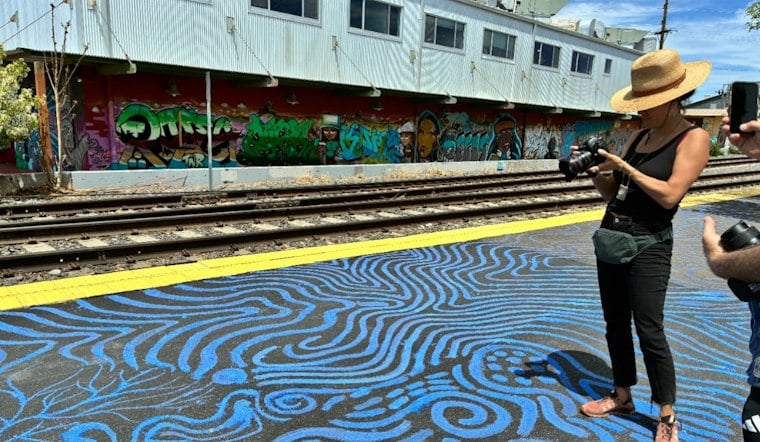
A line of blue chalk mixed with water wound its way from Japhet Creek Park toward Finnigan Park this week, tracing a Fifth Ward stream that disappeared from the surface long ago. The chalk route marked Missing Waters, a community art project led by environmental artist Stacy Levy that retraced historic streams once feeding into Buffalo Bayou. By design, the drawings will not last: the next hard rain will wash them away.
The project unfolded at Japhet Creek Park in Houston's Fifth Ward, organized by the Buffalo Bayou Partnership as part of its broader Buffalo Bayou East effort. According to the Houston Chronicle, participants used the blue chalk mixture to trace streams along a route between the park and Finnigan Park, aiming to reveal forgotten neighborhood waterways and raise awareness of how urban development has reshaped the landscape and worsened flooding. Levy described Missing Waters as a temporary way to make hidden waterways visible again.
To find the routes, Levy studies historic maps overlaid with modern satellite imagery to locate former streams, then looks for physical clues on the ground — large drains, steep banks and patches of vegetation that hint at water once flowing through. Houston's historic waterways continue to shape the city's landscape today, particularly during heavy rainfall, since paved surfaces make it harder for rainwater to soak into the ground and follow the natural pathways those streams once carved.
A Park Built Around a Hidden Stream
Japhet Creek Park itself was designed with that buried history in mind. The park features walking paths, native plants, wildflower meadows and stormwater-management landscaping, and includes a large grated pipe that lets visitors hear water flowing beneath their feet. Buffalo Bayou Partnership describes Japhet Creek as a historic bayou tributary that will be transformed into a key connector between the Fifth Ward, the waterfront and the Greater East End.
One longtime neighborhood resident recalled picking berries along Japhet Creek decades ago, a memory that speaks to how much the landscape has changed since the stream ran closer to the surface. Levy said the project helps people recognize the stream bed beneath them and argued that waterways need to be factored into how cities are designed going forward.
Neighbors Drawn In by Chalk and Curiosity
Among those who showed up was Alyssa Ladd, 38, who attended with her friend Robert Wichmann, 58. Wichmann said he found out about the event through Buffalo Bayou Partnership's website and had his own history with sidewalk chalk — he began making chalk drawings in his driveway at the start of the COVID-19 pandemic. He said the practice helped him get to know his neighbors, and he brought that same spirit to tracing Houston's buried creek.
Levy has been orchestrating these kinds of ghost-waterway projects since 2020, with earlier installations in New York, Brooklyn, Philadelphia, Akron and Charlotte, according to the Railyard Park Conservancy. A similar effort unfolded in April 2025 at the Santa Fe Railyard, where Levy worked with local artists and students from New Mexico School for the Arts over three days to paint a water map onto existing hardscape — a nod to the more than 40 acequias that once snaked through Santa Fe in the early 1900s. That painting, too, was built to disappear, wearing away under foot traffic or washing off in the next rainstorm, as Southwest Contemporary reported ahead of the April 25-29 installation.
Levy's first Missing Waters project, in 2020, used ephemeral chalk lines to trace the edge of a historic wetland at Flushing Bay in New York, presented alongside NYC H2O and Guardians of Flushing Bay, according to her project page. That Flushing Bay site, now paved and raised above the tide range, was once a living tidal wetland — much like the quiet drainage line now running beneath Houston's Fifth Ward.
What Comes Next for Buffalo Bayou East
Japhet Creek Park is just one piece of a larger vision. Buffalo Bayou Partnership says the next phase calls for a trail following the creek to provide public access to the waterfront, eventually leading to Kinder Bridge — described as the first bayou-crossing pedestrian bridge in Buffalo Bayou East — which would connect the bayou's north bank to Tony Marron Park on the south side. The Partnership currently lists early 2028 as the target completion for that trail and bridge, though a 2024 Houston Chronicle report had previously cited a September 2027 target for the pedestrian trail reaching Tony Marron Park.
The park's size has also been described differently across sources: Buffalo Bayou Partnership President Anne Olson told Houston Public Media it is about a four-acre park, while the Houston Chronicle's 2024 report put it at 3.2 acres. Either way, the goal behind it is the same — Buffalo Bayou Partnership says it aims to expand public access to the bayou and connect neighborhoods that have historically been cut off from the waterfront. The Partnership has said it and its partners plan to realize the full Buffalo Bayou East 10-Year Plan by 2032, an effort made possible by a $100 million catalyst gift from the Kinder Foundation along with public support from Harris County and the City of Houston.
For now, though, the visible trace of Japhet Creek is the blue chalk line left behind this week — a marking that Levy has said will last only until the next rainstorm washes it from the pavement.





