

























































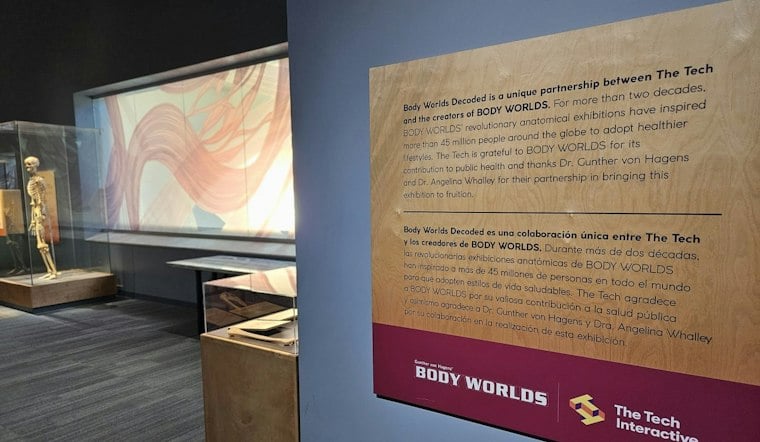
A touring exhibition of preserved human cadavers, posed mid-stride, mid-swing and mid-stretch, is set to open at the Del Mar Fairgrounds on Dec. 22, marking the show's first appearance in San Diego. Body Worlds: The Anatomy of Happiness will fill the fairgrounds' Activity Center at 2260 Jimmy Durante Blvd. through April 21, 2027, with tickets already on sale.
What Visitors Will See
As reported by the San Diego Union-Tribune, the exhibition features posed specimens depicting physical activities and everyday experiences associated with happiness, including figures nicknamed The Archer, Wave Runner and a soccer players duo. Visitors will also encounter side-by-side displays of healthy and diseased organs, an anatomical mirror showing the position of vital organs in the human body, and exhibits focused on spine and brain health. A healthy-aging photo documentary series featuring people who lived to 100 or more rounds out the educational material, according to the same report.
The official San Diego ticketing site, sandiego.bodyworlds.com, describes the show as using real human specimens preserved through Dr. Gunther von Hagens' plastination process, and says it explores how emotions, lifestyle and social relationships can influence physical health and well-being. The site estimates a typical visit takes around 60 to 90 minutes. Fever, a ticketing partner for the show, notes the Del Mar venue is wheelchair accessible and calls this the exhibition's first stop in San Diego.
The Science Behind the Specimens
Plastination, invented by German anatomist Gunther von Hagens in 1977, replaces bodily fluids and soluble fats in a cadaver with reactive plastics, according to the Union-Tribune's reporting. Von Hagens created Body Worlds alongside physician Angelina Whalley, sharing a goal of making human anatomy accessible to the public for science and health education. Von Hagens died from a cerebral hemorrhage at age 81 in July 2026, and had donated his own body to the Institute for Plastination for display, the paper reported.
Whalley, per the same report, has said plastination presents the human body memorably and beautifully to support learning about anatomy, disease and health, and that the exhibition aims to show how experiences, emotions and choices leave traces in the body. She has also said many visitors leave with greater body awareness and motivation to live more consciously. Body Worlds held its first public exhibition in Tokyo in 1995 and has since appeared in more than 175 cities worldwide, drawing more than 58 million visitors according to the company — though the company's own FAQ page separately cites over 170 cities in 42 countries, a discrepancy the bodyworlds.com FAQ does not reconcile with other company figures.
Where the Bodies Come From
Body Worlds has said all cadavers used in its exhibitions were obtained through donation with verifiable written consent, and the company's FAQ states that all whole-body plastinates and most other specimens come from people who registered to donate their bodies for educational use, with more than 21,000 donors registered worldwide. The Union-Tribune separately reports that more than 24,000 people worldwide have registered to donate their bodies to the program.
That sourcing question has drawn scrutiny before. NPR reported in 2006 that von Hagens said every whole body exhibited in North America came from fully informed European and American donors who gave permission in writing, but the network also found no clear paper trail linking willing donors to the specific bodies on display. An ethics investigator cited by NPR matched more than 200 Body Worlds donation forms to death certificates but did not match that paperwork to specific displayed bodies. NPR drew a sharper contrast with the rival Bodies… The Exhibition, whose spokesman said its cadavers all came from China and were unclaimed rather than donated by willing participants; a Florida anatomical board chair told the network the documentation for that show amounted to only the Chinese plastinator's word, with no supporting documents.
A later ethics review by the California Science Center's Ethics Advisory Committee examined records for 1,606 Body Worlds donors who died between 2004 and 2016, finding that 1,408 of those donors had agreed to public display. The committee concluded the exhibit had considerable educational value and was appropriate for the Science Center, which had previously hosted Body Worlds exhibitions in 2004, 2005 and 2008 — each of which broke box-office records, according to the report. Religious leaders and ethicists have nonetheless questioned the practice of selling tickets for displays of human corpses, while copycat companies have faced legal questions over specimens allegedly sourced from prisons where consent could not be confirmed, the Union-Tribune noted.
Hours, Tickets and Logistics
The exhibition will open daily at noon Monday through Thursday, closing at 8 p.m.; Fridays it opens at 10 a.m. and closes at 8 p.m.; Saturdays it opens at 10 a.m. and closes at 9 p.m.; and Sundays it opens at 10 a.m. and closes at 6 p.m., according to the Union-Tribune. Tickets range from $29 to $35, with discounts offered to seniors, students and others.
Under California's Health and Safety Code Section 7150.15, a donor may make an anatomical gift of their body or body part during their life for transplantation, therapy, research or education, subject to Section 7150.35 and in the manner provided by Section 7150.20. That statutory language governs how such gifts are legally made but does not by itself establish whether any particular specimen in the Del Mar exhibition complies with those provisions.




