

























































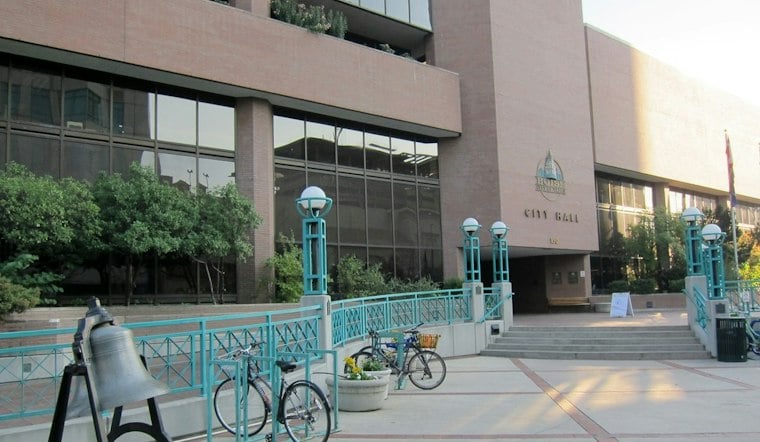
Boise Mayor Lauren McLean wants to immediately stop mega data centers from being built within city limits, pushing a moratorium that would take effect the moment it passes. The proposal heads to the Boise City Council for a public hearing at its regular meeting Tuesday, November 10.
According to KBOI, McLean's proposal would halt mega data center development within Boise city limits and is designed to kick in right away if the council signs off. The City of Boise has scheduled the council meeting for 6 p.m. Tuesday, and the meeting notice says members of the public may speak on the item once everyone on the advance sign-up list has had a turn.
McLean has framed the move as an emergency step to protect Boise's water, power grid and neighborhoods from facilities she says do not belong anywhere in the state at this scale. She said she has an obligation to protect Boise for future generations and will not allow mega data centers to drain water, raise energy costs or leave residents with the bill, according to the KBOI report. She also said outsiders have historically sought to profit from Idaho's land and natural resources at the expense of residents and the environment, per the same report.
No Applications Yet, But a Statewide Fight Looms
Per the KBOI report, the city currently has no applications for mega data centers on file, and McLean has said Boise's growth must align with the city's values rather than accommodate unchecked mega data center development. That stance echoes a statement her office issued in September, when she argued that no data center of this size should be considered anywhere until a statewide framework is in place, according to the City of Boise.
That September statement came amid scrutiny of a separate, much larger proposal southeast of the city. The Idaho Statesman reported that Rhea Data has proposed a facility spanning more than 3,700 acres of Bureau of Land Management property near Blacks Creek Reservoir, with multiple buildings, electrical infrastructure and a natural gas power plant. BoiseDev, however, reported that the BLM would not confirm reported design figures — including a 3,226-acre footprint — saying those details may still change. The Idaho Statesman also reported that the BLM described the application, first received in 2025 and updated this past spring, as being in very early stages, with no timeline yet set for public comment.
Idaho Communities Already Hitting Pause
Boise would join what the KBOI report describes as a growing number of Idaho communities that have issued their own moratoria on data center development. Bannock County, for instance, stopped accepting or processing data-center applications in unincorporated areas for 180 days while officials write the county's first ordinance specifically governing the facilities, according to KMVT. That pause does not apply inside incorporated cities such as Pocatello, and KMVT reported it remains in effect through January 26, 2027.
The concerns driving these moves are not just local. University of Idaho Energy Institute executive director John Kumm told KMVT that some data centers carry electric loads on the scale of a small town, adding that concentrated demand can strain an already constrained grid — technically, regulatorily and financially. A Taxpayers Protection Alliance report cited by the station estimated that data centers accounted for just 0.01% of Idaho's water consumption and 1.5% of its electricity use in 2025, a split that underscores the twofold opportunity-and-challenge framing local officials have used.
Idaho Law Sets Limits on How Long a Freeze Can Last
State statute offers a window into what tools cities have available, though it does not establish which mechanism Boise's council is using. Under Idaho Code § 67-6523, an emergency ordinance or moratorium may be effective for no longer than 182 days, and a governing board may act without a commission recommendation after whatever abbreviated hearing notice it finds practical. A separate provision, Idaho Code § 67-6524, says an interim ordinance or moratorium must state a definite period and cannot remain in force for more than one calendar year, with a regular ordinance required to sustain its restrictions afterward.
Nationally, the debate McLean is tapping into has intensified. A Gallup poll in May found that seven in 10 Americans would oppose construction of a data center in their area, the Idaho Statesman reported. CNBC reported that voters have passed 40 of 41 proposed ballot measures placing restrictions on some of the more than 2,000 new data center facilities planned nationwide, and that a one-gigawatt AI data center can consume up to 10 million gallons of water a day, according to UC Riverside researcher Shaolei Ren. CNBC also noted that dry cooling systems use far less water than evaporative cooling but can demand significantly more power, especially in hot climates — a tradeoff utilities and developers are already wrestling with elsewhere.
Idaho already has one large facility running: the Idaho Statesman reported that Meta's 750,000-square-foot data center in Kuna began operations on September 3, 2026. CNBC reported separately that Meta spent $100 million on a new water and wastewater system near that facility. BoiseDev has also reported that a separate hyperscale project from Diode Ventures nearby in Kuna has not yet started construction and remains the focus of legal action.
Maine has seen a similar wave of local action: Data Center Dynamics reported that voters in Peru, Wells and Eliot approved 180-day data-center moratoria, Wiscasset approved a six-month moratorium, and Sabattus voters backed a moratorium on data centers of at least 10,000 square feet or 20 megawatts that runs until May 2027. Whether Boise's council follows through with McLean's proposal — and in what form — will become clearer after Tuesday's hearing.



