

























































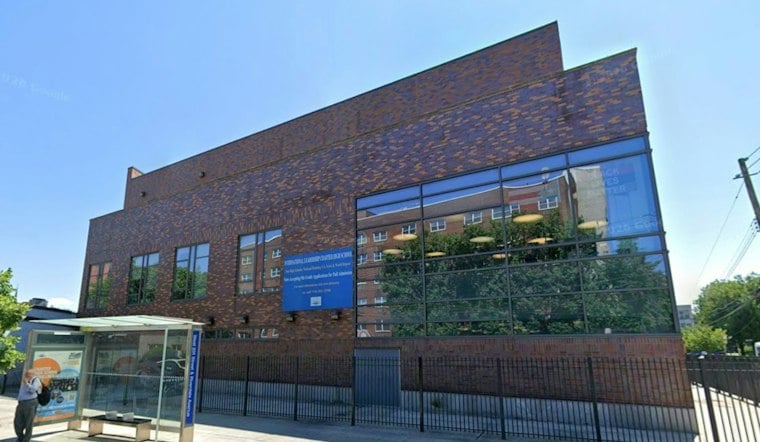
Javier Piña walks through a metal detector and submits his backpack for inspection every morning before class at International Leadership Charter High School in the Bronx, a routine he says leaves him anxious and feels intrusive to his privacy. The daily search is standard procedure at his school, but Piña, who moved to New York from the Dominican Republic, says it has shaped how he sees the adults stationed in his hallways.
Piña said school safety officers patrol the hallways with walkie-talkies, and when a metal detector signals red, those officers may wand students for a closer check. He told the Bronx Times that he often felt watched, as if officers were looking for reasons to suspend students rather than keep them safe. The officers who staff those posts are hired and trained by the NYPD, though they are not fully sworn-in members of the department, per the department's own description of the role.
Piña's experience lines up with borough-wide patterns documented nearly a decade ago. According to data compiled by WNYC, 62% of Bronx high school students passed through metal detectors in the 2014-15 school year, the highest share of any borough measured at the time, and the station reported that more than 91,000 New York City high school students went through detectors each morning that year — about a third of the citywide high school population. The same WNYC analysis found 48% of Black high school students and 38% of Hispanic students went through detectors, compared with 14% of both Asian and white students, meaning Black students were more than three times as likely as white students to pass through the machines.
Searches That Follow Students Outside the Building
Piña said school safety patrols made it difficult for him and his friends to simply enjoy being teenagers, and that he noticed more school safety vehicles circulating through his neighborhood around the end of the school day. He said officers could view teenagers playing in the street as suspicious, extending the scrutiny he felt inside the building out into the block where he lives. Students who are stopped and searched by school safety may end up with a suspension or a custodial sentence over whatever is found on them, a consequence that advocates say can follow a student for years.
That dynamic is what the American Civil Liberties Union has labeled the school-to-prison pipeline — policies and practices that push schoolchildren out of classrooms and into the juvenile and criminal justice systems, by the organization's own definition. Separately, the NYCLU says school safety officers' deployment is supposed to be public information under a 2005 law, but the group has said the NYPD has not fully complied, suing the department for data on metal detector use. In a statement to the Bronx Times, Johanna Miller said there is no evidence that metal detectors make schools any safer, arguing instead that they provoke unnecessary police confrontations, worsen absenteeism, subject youth to invasive searches, and disproportionately affect students of color.
From Searches to Statehouse Advocacy
Piña's pushback against the system started with a summer program. He participated in the Bronx Civic Scholars Institute, a six-week program hosted by Hostos Community College that pairs rising seniors with local organizations, organized through the Bronx Leadership and Organizing Center. Through the program's BLOC track, Piña interned with the Bronx Defenders, a nonprofit that provides holistic public defense across the borough along with community support and outreach.
During the internship, Piña learned about the school-to-prison pipeline and began teaching other community members about it, according to the Bronx Times account. Aleciah Anthony, the Bronx Defenders' director of community engagement, said the people most affected by an issue should be central to its solutions — acting as decision-makers and strategists rather than passive subjects of policy. Piña has proposed reducing the number of school safety officers while increasing the number of counselors, arguing that schools should employ substantially more mental-health, rape-crisis and homelessness-crisis professionals than safety officers.
The Bronx Defenders is now working with a statewide coalition pushing for passage of the Solutions Not Suspensions bill, which Anthony said aims to reduce the number of children excluded from school. Anthony said suspensions are not a solution to behavior problems in schools and can leave children without a plan while exposing them to risks in their neighborhoods. Piña has continued his advocacy since returning to high school, encouraging other young people to contact their elected representatives about issues that affect them and recommending they use the website Who Represents Me to identify local officials. He said young people should not have to make hundreds of phone calls just to get basic counseling support.
Citywide Numbers Show a Mixed Picture
The discipline landscape Piña is organizing against has shifted over the past two decades, even if current Bronx-specific figures on detectors or officer deployment are not publicly broken out. New York City public schools issued nearly 9,200 suspensions from July through December 2025, 8% fewer than the same stretch in 2024, according to Chalkbeat. That total was also 27% lower than the same period before the pandemic forced school buildings to close. Chalkbeat reported that the reasons behind the decline are unclear, though advocates point to mental-health supports and restorative-justice efforts as possible factors.
Still, the decline has not been even. Advocates for Children of New York found that Black students, who make up about a fifth of the student population, received 47% of superintendent's suspensions — the lengthiest punishments available — an increase of 2.4 percentage points from the year before. Over a longer stretch, the Data Collaborative for Justice found that citywide suspensions fell 39.4% between the 2006-07 and 2016-17 school years, though the numbers fluctuated throughout that period. The city Department of Education says it reports disciplinary responses broken down by race, gender, grade level, IEP status, English-language-learner status and housing status, as required under Local Law 93 of 2015.
What Restorative Justice Has — and Hasn't — Proven
Restorative-justice programming, the kind of alternative Piña and the Bronx Defenders are pushing for, has a mixed record in the city's own trials. From fall 2017 until the pandemic hit in 2020, restorative-justice programming was implemented in five Brooklyn high schools in a district with some of the city's highest suspension rates, according to a Center for Justice Innovation evaluation. That assessment found no significant difference in incidents or suspensions between schools that got the programming and those that didn't, even as students and teachers reported improved relationships.
Other Bronx-based efforts have run longer. Bronx Lab High School has incorporated restorative justice into its programming for a decade, partnering with the DREAM! organization through the Community-Based Restorative Justice Program, according to the CUNY Institute for State & Local Governance. Since 2024, 16 organizations, including the Kingsbridge Heights Community Center, have joined that citywide program. Separately, NYU's Research Alliance for New York City Schools identified 106 middle and high schools that met its criteria for inclusive discipline practices for at least one year between 2011-12 and 2018-19 — but only 10 schools sustained those practices across the entire study period, underscoring how difficult consistent reform has proven citywide.




