

























































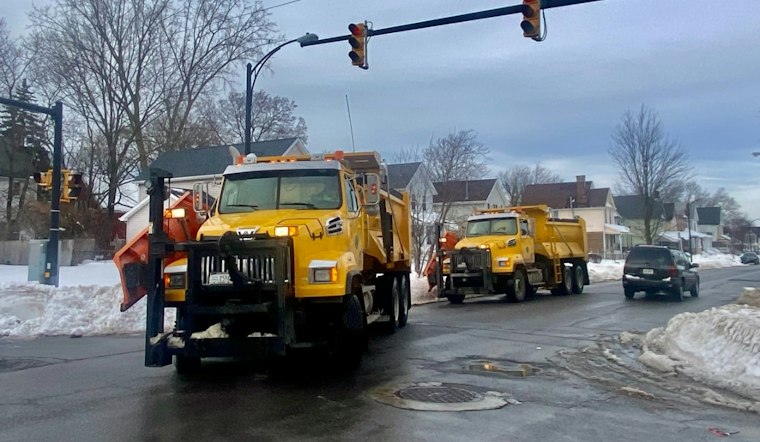
Buffalo officials told the Common Council this week that the city's winter arsenal is ready to roll: 44 pieces of snow-fighting equipment, more than 3,000 tons of salt on hand, and a new three-zone coordination plan designed to avoid the breakdowns that plagued the region during the deadly 2022 Christmas blizzard. DPW Commissioner Nolan Skipper told council members the equipment and salt supply were prepped and ready to go, while Deputy Mayor Benjamin Swanekamp laid out how the city, Erie County and New York State would divide responsibilities if forecasters declare an extreme storm.
Equipment, Salt and a Bigger Contractor Budget
The Ryan Administration rolled out new equipment for the upcoming winter season on October 30, part of a broader push that also increased the contracted snow-removal budget from $580,000 to $2.7 million, according to Buffalo Toronto Public Media. Skipper said the larger contractor budget would support the city's response to major weather events. Buffalo's fleet now includes 22 full-size plows, 12 high lifts fitted with plow attachments, and pickup and small dump trucks equipped with plows and spreaders, plus more than 3,000 tons of salt already on hand and contracts in place to bring in another 25,000 tons if the winter demands it.
The city has also purchased smaller John Deere tractors equipped with snowblowers meant for the roughly 200 miles of roadway made up of narrow streets, dead ends and roads with medians, per Buffalo Toronto Public Media. That outlet and newyorkupstate.com both reported the city added seven of the tractors, while a city website preview describes the plan as including five smaller tractors — a discrepancy that remains unresolved in public materials. The committee's seed facts, drawn from the Common Council presentation, list seven tractors with snowblower attachments as part of the DPW's fleet.
Three Zones If an Extreme Storm Hits
Niagara District Councilman David Rivera pressed officials on who actually coordinates with the county and state once a severe storm arrives, a question that traces directly back to criticism of the city's response during the 2022 Christmas blizzard. Swanekamp said he coordinates that response alongside Buffalo Emergency Coordinator Thomas Luby, and that the city now divides into three zones if the National Weather Service declares an extreme storm. Under that plan, New York State would be responsible for the area north of Broadway and west of Main Street, Erie County would handle the area south of Broadway, and Buffalo itself would cover the area north of Broadway and east of Main Street.
Swanekamp told the committee the city was in strong shape for coordination this winter, and pointed to a recent exercise in which Buffalo rehearsed its extreme-storm response plan. The National Weather Service brought together nearly all regional emergency managers for that training and planning session, according to the presentation reported by WGRZ. The scrutiny isn't new: a May 2023 analysis commissioned by then-Mayor Byron Brown and conducted by the NYU Wagner School found that coordination between the city, county and state was challenging during the blizzard that killed 31 city residents in December 2022.
Pushing Residents to Sign Up for Alerts
Swanekamp said the administration is focused on getting more people to sign up for Buff-Alert, the city's notification system, noting that Buffalo issued many Buff-Alerts last winter season. For the most serious storms, the city also relies on IPAWS, the Integrated Public Alert and Warning System, which works like an Amber Alert and reaches people through cell phones, television and radio, Swanekamp explained to the council.
That emphasis on alerts echoes a recommendation from the NYU Wagner report, which found that too few residents had enrolled in text-message alert systems during the 2022 storm and recommended leaning on the Wireless Emergency Alert system to reach the majority of Buffalonians. New York State's Division of Homeland Security and Emergency Services separately completed its own independent after-action review of the state's response to that blizzard, though the review's specific findings were not detailed in the committee presentation.
With forecasters tracking weather for the coming week, the administration's pitch to the council comes as the city tries to show it has absorbed the lessons of 2022. Buffalo's stated goal remains making at least one plow pass on every residential street within 24 hours after snowfall ends, though officials acknowledge that ongoing snow, extreme weather or blocked streets could push that timeline back.




