

























































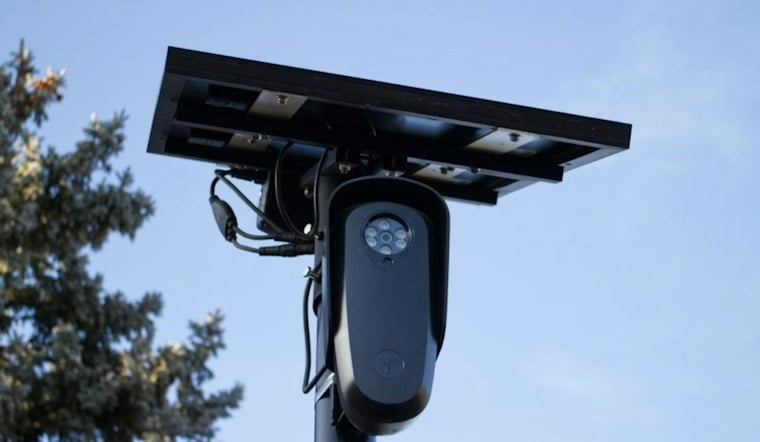
Calistoga's police chief stood before the city council this week and defended the town's network of license plate reader cameras, pointing to a fatal hit-and-run case near St. Helena that he said would have gone unsolved without them. Chief Matt McCaffrey told councilmembers the cameras helped investigators identify a white pickup truck connected to the 2024 death of Jackie Rhodes, an 81-year-old Napa resident struck by a vehicle after getting off a bus near the Culinary Institute of America on Highway 29.
A Fatal Crash Becomes the Chief's Central Argument
According to The Napa Valley Register, investigators used the cameras to locate the pickup truck on Silverado Trail, and McCaffrey said the case would have gone unsolved without that investigative tool. He told the council that Flock is a force multiplier for a small town such as Calistoga, noting the department has no dedicated detective to chase down leads the old-fashioned way. Calistoga installed six automated license plate reader cameras in 2022 and now pays Flock Safety $17,500 annually under a contract that runs through November 2028, per the same report.
Flock Safety, based in Atlanta, was founded in 2017 and began selling its cameras in 2020, the Register notes. The company's Calistoga transparency portal states that the department uses the technology to capture objective evidence without compromising on individual privacy and utilizes retroactive searches to solve crimes after they've occurred, though the portal snippet reviewed does not detail the underlying search records behind that claim.
Council Members Press for Details on Data Handling
The camera issue is controversial, Councilmember Lisa Gift said, according to the Register's account of the Nov. 17 meeting, which she presided over in Mayor Don Williams' absence. The council formally requested a presentation from McCaffrey about how camera information is collected, stored and shared. Resident Irais Ortega-Lopez raised concern about whether camera data could be shared with U.S. Immigration and Customs Enforcement, while McCaffrey said state law and department policy prohibit sharing camera information with ICE and that the department cannot share data outside California.
McCaffrey told the council the cameras capture vehicle characteristics including license plates in a public place and do not use facial recognition technology or continuously follow individuals. He said there are many misconceptions about the technology and maintained the department does not intend to infringe residents' rights. He attributed some of the public distrust of Flock partly to poor public relations early in the company's history, the Register reported.
A Fourth Amendment Challenge From the Audience
Resident Dan Herndon questioned whether collecting the camera information violates the Fourth Amendment, arguing the constitutional violation lies in the act of gathering the data itself. McCaffrey countered that the Fourth Amendment does not prohibit officers from observing activities openly visible in public places, saying camera photos are taken in a public setting. He told the council that public safety and individual freedom need not compete.
Flock spokesperson Andrew Smith declined to assess the company's earlier communications efforts but said Flock has worked to make product information more accessible as surveillance questions have increased, adding that the company is always available to answer product questions, the Register reported. The Calistoga Police Department deletes camera information after 60 days unless it is needed as evidence or for certain criminal investigations, according to the same report — a figure that sits alongside California Senate Bill 34, which the California Legislative Information site shows has regulated the collection, use and sharing of license plate reader data since 2015, including a provision limiting retention to no more than 60 days unless the data is evidence or tied to a felony investigation.
Privacy Advocates and a Statewide Reckoning
The American Civil Liberties Union and other privacy advocates have raised concerns about unauthorized access to camera information and warrantless tracking, worries echoed by privacy advocates nationally who point to the widespread reach of motorist-tracking systems. Pew Research Center figures cited in the Register's reporting put the number of deployed license plate readers and surveillance cameras at more than 120,000 devices across more than 6,000 communities.
Those concerns have sharpened elsewhere in California in recent days. The Santa Ana City Council voted 6-0 to terminate its contracts with Flock Group and Motorola Solutions, according to the Los Angeles Times, even though the city's camera system had helped with 55 cases between April and September, including 18 stolen-vehicle crimes and six firearm crimes. The vote came one day after San Diego's city council unanimously ended its own Flock contract, and followed Fullerton's October decision to temporarily switch off its system for six months, the Times reported.
Flock itself has moved to tighten oversight amid the backlash. The company reduced its recommended default retention period for ALPR data from 30 days to seven, though existing customers may keep the retention periods their jurisdictions already approved, according to Police1. Flock also plans to require law enforcement customers to activate its Audit Assistance feature and to require officers to enter a case code for every search by the end of 2026, with emergency exceptions automatically flagged for administrative review. Multifactor authentication became mandatory for all Flock accounts in August, Police1 reported.
The American Civil Liberties Union says Flock has announced it will now require reasons for a search and plans to universally roll out its audit assistance tool. Citing an Electronic Frontier Foundation review, the ACLU notes that within a dataset of 11.4 million Flock searches nationwide over six months, more than 14% of the search-description fields contained just the word investigation, and that 75% of Flock police customers share their data nationally.
Closer to home, the Register has reported that Napa County and the Napa Police Department have been looking at employing more cameras, even though Napa's police department does not own ALPRs itself and has instead used data from privately owned readers, NCRIC and other law enforcement agencies. For Calistoga, the debate now moves to McCaffrey's promised follow-up presentation to the council on exactly how the department collects, stores and shares the footage its six cameras capture at the city's entry points.




