

























































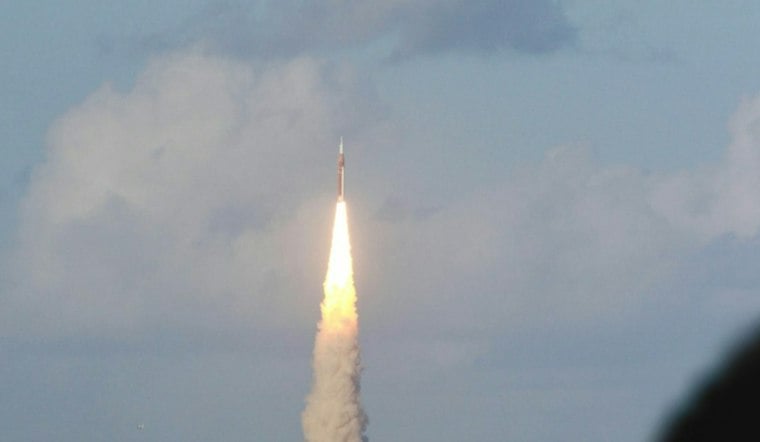
A SpaceX Falcon 9 rocket is targeting liftoff from Cape Canaveral Space Force Station Sunday morning, carrying roughly 11,000 pounds of supplies and science gear to the International Space Station aboard Northrop Grumman's Cygnus XL spacecraft. The mission could also rattle windows across nine Central Florida counties, with SpaceX warning residents that one or more sonic booms may be heard when the rocket's first-stage booster returns to land.
The spacecraft, named the S.S. James “Jim” A. Lovell after the NASA astronaut who died in 2025, is targeting a launch atop a SpaceX Falcon 9 rocket Sunday at 10:49 a.m. ET from Cape Canaveral Space Force Station, according to WUSF. The Orlando Sentinel reports the rocket is set to lift off at 10:47 a.m. from Space Launch Complex 40, with a backup launch time of 10:24 a.m. Monday if needed. Space Launch Delta 45's weather squadron forecasts a 75% chance of good launch conditions Sunday, with thick clouds the primary concern, though that outlook drops to 30% Monday and Tuesday as a front moves across Florida, per the same outlet.
Lovell commanded Apollo 13 and also flew on Apollo 8, Gemini VII and Gemini XII, a career the Sentinel's reporting ties directly to the spacecraft bearing his name. Once in orbit, NASA astronauts Jessica Watkins and Luke Delaney are expected to grapple Cygnus using the Canadarm2 robotic arm and affix it to the station's Unity module on its Earth-facing port, with the trip taking about two days after launch, per WUSF.
Nine Counties Warned of Possible Sonic Boom
SpaceX has issued a sonic boom advisory covering residents of Brevard, Orange, Osceola, Indian River, Seminole, Volusia, Polk, St. Lucie and Okeechobee counties, who may hear one or more booms during the booster's landing attempt, according to the Sentinel's reporting. The first-stage booster, flying its ninth trip to space after eight previous missions, will attempt a recovery landing at Landing Zone 40 roughly eight minutes after liftoff.
Once docked, Cygnus is expected to remain attached to the station until May, per WUSF, carrying cargo that according to the Sentinel's reporting includes holiday-season treats alongside the hardware and research payloads. Among the scientific cargo is a study intended to help predict whether a patient's cancer is likely to spread to other parts of the body — research WUSF reports could help guide future cancer treatments. Per NASA's own description of the payloads as relayed in the Sentinel's reporting, other experiments aim to improve drug delivery for cancer and osteoarthritis treatment, advance treatments for muscle loss, and improve radiation sensing while supporting food production for future long-duration missions.
A Long Run for Cygnus, Now Leaning on SpaceX
This flight marks the 25th cargo vehicle Northrop Grumman has built for the station under its NASA contract, according to WUSF, and the Sentinel's reporting identifies it as the third flight of the larger Cygnus XL variant. Cygnus was first developed by Orbital ATK and made its first mission in 2013; over the ensuing 13 years it has delivered more than 169,000 pounds of cargo to the station, per the Sentinel. When its cargo-carrying days are done, the spacecraft is disposed of by release to burn up in the atmosphere, typically packed with trash.
Northrop Grumman currently relies on SpaceX to fly Cygnus missions while its own Antares rockets sit on the shelf, with the Antares 330 — under joint development with Firefly Aerospace — not likely to be available until later in 2027, the Sentinel reports. SpaceX has set aside one more Falcon 9 to support future Cygnus flights, underscoring how central the partnership has become to keeping NASA's commercial resupply program, which also includes SpaceX's own Dragon missions, running on schedule.
A Slower Year for the Space Coast
Sunday's launch adds to what has been a comparatively quiet year along the Space Coast. The region is on pace for 62 launches in 2026, with all but eight flown by SpaceX, a steep drop from the record 109 launches in 2025 that were also led by the company, according to the Sentinel's reporting. An earlier Sentinel gallery had already counted 61 Space Coast launches through Nov. 15.
The slowdown has been driven by troubles at rival launch providers and by SpaceX's own shift in focus toward its in-development Starship program, the Sentinel reports. United Launch Alliance flew six Space Coast launches in 2026 but suffered first-stage booster issues on its Vulcan rocket earlier in November that led to the loss of an Amazon payload; ULA is still working to determine what went wrong, according to the same reporting. ULA has six Atlas V rockets left, all reserved for Boeing's Starliner, while Vulcan itself is meant to replace both Atlas V and the retired Delta IV family.
Blue Origin flew just one Space Coast launch in 2026 after its launch pad suffered major damage during a rocket test hot-fire in May, an incident Col. Brian Chatman called the largest explosion ever seen on the Space Coast, per the Sentinel. The company has since pushed its New Glenn return to flight to late January. NASA, meanwhile, flew one Space Coast launch in 2026 using the Space Launch System and Orion on Artemis II; stacking for the next SLS rocket began in September, and its short stack — made up of solid rocket boosters and a core stage — was completed Oct. 26, with NASA planning to roll it to Launch Pad 39-B for testing ahead of Artemis III, slated for summer 2027.
Other activity on the horizon includes a SpaceX Falcon Heavy launch carrying Voyager Technologies' Griffin lunar lander from Kennedy Space Center's Launch Pad 39-A, with its first launch window closing in early January 2027. Stoke Space expects to debut its Nova rocket from Space Launch Complex 14 sometime in 2027, while Relativity Space — which flew its smaller Terran 1 rocket from Cape Canaveral in 2023 — plans to return with its larger Terran R rocket from Launch Complex 16. SpaceX's own Starship and Super Heavy launch tower is also nearly complete and being prepared for a first launch in the coming months, according to the Sentinel's reporting.





