

























































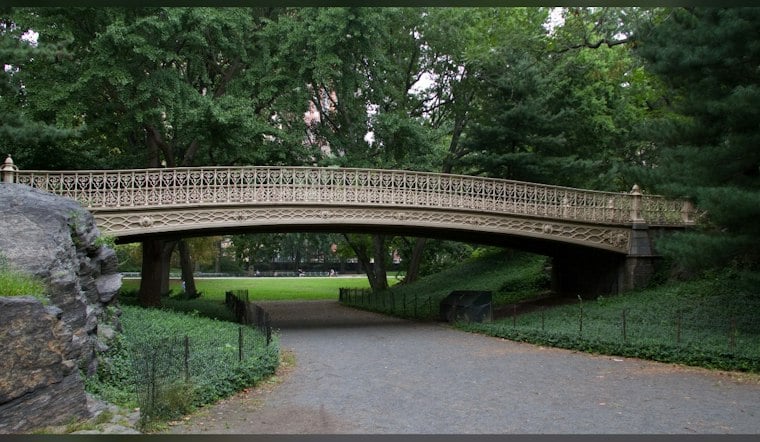
An approved project at Pinebank Arch will add a route between the bridle path and a worn crossing over nearby lawn, addressing a dead end that has sent riders and walkers back the way they came. The plan retains the bridle path’s existing terminus beneath the 1861 cast-iron bridge, while reducing the cul-de-sac and adding a way to reach the broader park network. Construction is scheduled to begin in spring 2027 and finish by spring 2028.
The Landmarks Preservation Commission has signed off on circulation and site improvements surrounding Pinebank Arch, according to New York YIMBY. The project was prepared by the Central Park Conservancy and is budgeted at $1 million to $1.5 million in private funding. At its core, the plan will eliminate the dead end where the bridle path terminates beneath the 1861 cast-iron bridge and reconnect the path to the broader park network.
The arch sits in the park's southwest corner between West Drive and Central Park West, just west of Heckscher Playground and Umpire Rock. It's one of four ornamental bridges that carry foot traffic over the bridle path, according to the Central Park Conservancy. The bridle path itself dates back to Olmsted and Vaux's 1858 Greensward Plan and originally ran from Grand Army Plaza to the 102nd Street Cross Drive, before being progressively truncated to accommodate construction of the Central Park Zoo and Heckscher Playground, per the same account.
Reworking a Stubborn Cul-de-Sac
The plan keeps the existing terminus but reduces the landscaped cul-de-sac left by a 2006 reconstruction. It calls for rustic benches and seating boulders, selective vegetation removal, new plantings, and replacement lighting beneath the bridge, according to the report. Cody Erhart said the cul-de-sac would be scaled down to what he called a “more of a human scale.”
A new asphalt path with a granite block curb will follow a worn route across the lawn north of the bridge, with a branch connecting back to the bridle path at a flush granite Belgian block threshold. The bridle path will keep its stone screenings surface.
How the new route fits the park
The project adds a way across the lawn to the wider park network without moving the bridle path’s existing endpoint beneath the arch. The Central Park Conservancy says the park’s arches and bridges separate different forms of traffic by carrying one over another. It also lists Pinebank Arch among the destinations near Umpire Rock, alongside Heckscher Playground and Heckscher Ballfields, according to the Conservancy.
Lighting upgrades round out the site work. Two DOT light fixtures beneath the bridge will be replaced in situ using existing conduit, with downlights by Cline Bettridge Bernstein Lighting Design providing the new illumination.
Restoring the Arch Itself
Alongside the circulation changes, the Conservancy's restoration of Pinebank Arch will include replacing the existing decking, recasting missing decorative cast-iron pieces, repairing ornamental elements, and scraping and painting the cast-iron and steel, according to the Conservancy. Cody Erhart described the restoration as restoring the grandeur of the archway. The bridge, designated Bridge No. 15, was erected in 1861 by J.B. and W.W. Cornell Ironworks.
Selective removal of ilex shrubs and amelanchier is planned to re-establish the historic visual connection between the arch and the surrounding landscape. A conceptual planting palette includes eastern white pine, sweet bay magnolia, American witch-hazel, winterberry, and pinxterbloom azalea, with an understory of sedges, ferns, and perennials filling in beneath the canopy.
Part of a Broader Bridge Campaign
The Conservancy’s vice president for program management said the Pinebank work follows the Conservancy’s restorations of Gothic Bridge and Bow Bridge, according to I Love the Upper West Side. West Side Rag covered the planned rerouting in September; the circulation work is now moving forward around the arch.
Readers interested in the official record can review Certificate of Appropriateness decisions dating back to March 2015 on the New York City Landmarks Preservation Commission's decisions page. Construction is scheduled to begin in spring 2027, with the new connection expected by spring 2028.





