

























































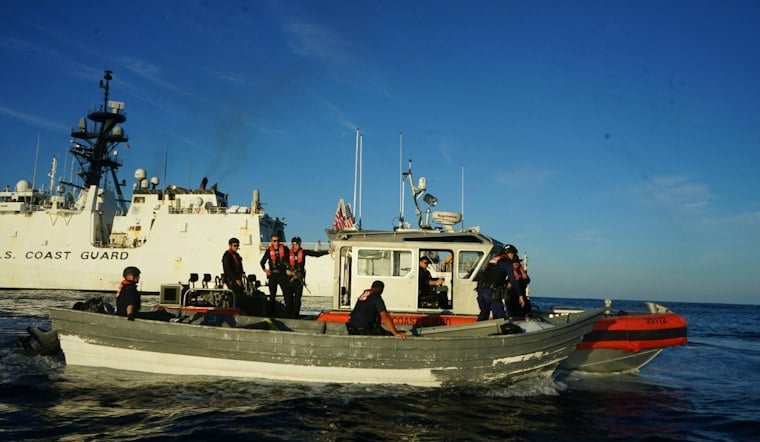
A 61-year-old Ecuadorian man is standing trial in federal court in Charleston over a cocaine-smuggling bust that unfolded near the Galapagos Islands in March 2025, and jurors this week watched video of bales being heaved overboard from the boat. Jorge Augusto Mero Figueroa faces charges tied to the interception, which also led to the arrest of a co-defendant who has since pleaded guilty.
Figueroa and Carlos Armando Cedeno were arrested by the crew of the U.S. Coast Guard Cutter Stone in March 2025 near the Galapagos Islands, according to the Post and Courier. Court records cited by the paper say the pair were indicted on charges of conspiracy to distribute more than five kilograms of cocaine — more than 11 pounds — along with possessing and intending to distribute cocaine, and jettisoning forfeitable property. Cedeno pleaded guilty in October to conspiracy to distribute more than five kilograms of cocaine, the outlet reported, while Figueroa's case went to trial.
An MH-65 Dolphin helicopter crew tried to hail the boat before firing warning shots off its bow, according to the Post and Courier. Video footage shown to jurors on Wednesday captured two men dumping large black bales overboard from the vessel, the outlet reported. When the boat tried to flee, Coast Guard Petty Officer Ryan Teal testified that he disabled it with rifle shots to the engines.
Smuggling Route Testimony and the Haul
Teal also testified that the vessel had been found along known routes used by drug smugglers from South America, per the Post and Courier's report. The Cutter Stone crew went on to recover 38 bundles containing bricks of cocaine along with a GPS device, Assistant U.S. Attorney Elle Klein said, according to the outlet. Klein said the recovered cocaine was ultimately unloaded in Charleston for analysis by the State Law Enforcement Division, the same report states.
Figueroa and Cedeno were initially detained in Fort Lauderdale, the Post and Courier reported, before the case made its way to the federal court in Charleston. An earlier Post and Courier report had described Figueroa as 60 years old, while the newspaper's current trial coverage identifies him as 61.
Defense Says Cartel Gunmen Forced the Crossing
In opening statements, defense attorney Brandon Daniels described a fishing trip gone wrong, telling jurors that masked gunmen intercepted Figueroa's fishing boat one evening, according to the Post and Courier. Daniels said Figueroa had been forced to operate the boat by cartel members. Figueroa himself said masked gunmen held him at gunpoint until he and Cedeno took control of the drug-running vessel, the outlet reported.
The case arrives against the backdrop of a broader stretch of Coast Guard interdictions tied to the Cutter Stone, which was docked on the Cooper River in Charleston as of January 2024. The Post and Courier previously reported that the Stone's crew seized thousands of pounds of illegal substances in seven of 11 missions between December 21, 2024, and March 10, 2025, with its total take accounting for more than half the weight of all drugs seized across those missions. That earlier coverage also noted more than 45,000 pounds of narcotics from several Coast Guard missions were confiscated at Port Everglades, Florida, on March 20, 2025 — a figure the U.S. Coast Guard separately put at roughly 45,600 pounds worth more than $517.5 million offloaded from the Stone at that port.
The Post and Courier's earlier reporting also noted that the Stone helped stop a suspect vessel off the Galapagos Islands on March 10, 2025, with authorities finding nearly 4,000 pounds of cocaine aboard, and that the charges against Cedeno and Figueroa could carry a maximum penalty of life in prison. A separate U.S. Department of Justice announcement said the case was being prosecuted as one of 14 major drug-smuggling operations in the District of South Carolina, describing charges of possession with intent to distribute five kilograms or more of cocaine aboard a vessel subject to U.S. jurisdiction and jettisoning property subject to forfeiture.




