

























































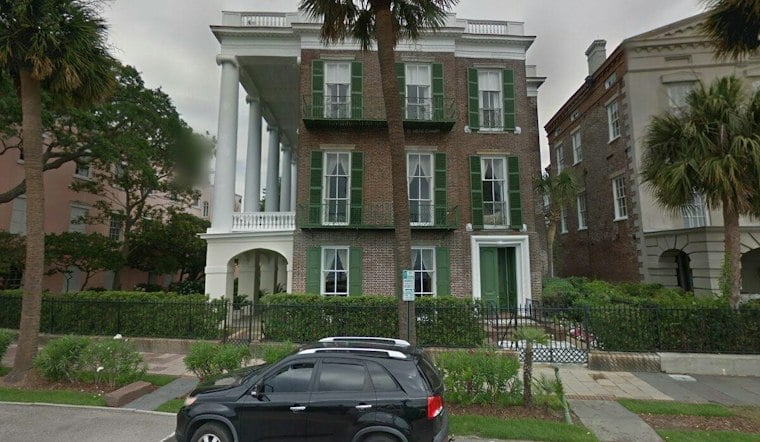
The Roper House at 9 East Battery, the Greek Revival mansion that once welcomed a sitting U.S. president and a future king through its doors, has new owners. The storied Charleston property sold for $13.3 million in an all-cash deal, according to public real estate records filed Nov. 17.
The buyer is identified in those records as The Glass Key LLC, as reported by the Post and Courier. The sale closes a chapter for the Richard Hampton Jenrette Foundation, which had listed the property about two years earlier and spent that time looking for a buyer willing to shoulder the demands of owning one of the city's most monumental homes.
Built in 1838-39, the Roper House has long stood among the first mansions to rise along East Battery after completion of the High Battery, per the Post and Courier. It was constructed in the 1830s by cotton planter William Roper, whose father helped finance Roper Hospital, and the home is recognized by the Historic Charleston Foundation as one of the city's most monumental Greek Revival houses, known for its large piazza and towering columns. Historic Charleston Foundation records note the house was later restored in 1982-83 after a late-19th-century addition.
A Financier's Charleston Showpiece
Richard “Dick” Jenrette, a co-founder and chairman of a global investment firm, bought the Roper House in 1968, the Post and Courier reports. Under his ownership, the home became, per Jenrette's own book, a stopping-off point for notables visiting Charleston, with guests including Rockefellers and Rothschilds alongside President Gerald Ford, President George W. Bush and Britain's King Charles, then Prince of Wales.
Jenrette, who was born in North Carolina and became known as a self-described house-aholic and antiques collector, wrote about his properties in his book, Adventures With Old Houses. He purchased and preserved six historic homes over his lifetime and led a tour of the Roper House in 2010. He died in 2018, leaving his properties and an endowment to what is now the Richard Hampton Jenrette Foundation, based in New York.
Why The Foundation Chose To Sell
The foundation decided to part with the Roper House after determining it would not be practical or economically feasible to convert it into a museum, a decision attributed to foundation president Benjamin Prosky. Jenrette, according to the same account, never required that his homes be preserved as monuments to himself or his collecting, and he hoped instead that the properties would advance education. He left the board discretion to sell properties it deemed cumbersome in order to further the foundation's broader aims.
That discretion did not mean an easy sale. The foundation rigorously and selectively vetted prospective buyers for 9 East Battery, turning away multiple offers over two years because, in Prosky's account, those buyers did not understand what it takes to preserve a Charleston house of this stature. Prosky has said a buyer should love Charleston and want to be part of the community, not simply acquire a trophy address.
The foundation has used similar discretion elsewhere. It has already found buyers for Cane Garden on St. Croix and the Baker House, a 1931 brick townhome on 93rd Street in Manhattan. It still owns three other properties tied to Jenrette's legacy: Millford, a Greek Revival mansion in Sumter County that Jenrette considered the finest home in South Carolina; Ayr Mount in Hillsborough, North Carolina; and Edgewater, in New York's Hudson River Valley.
A Legacy Beyond One Mansion
Jenrette's imprint on Charleston preservation extended well past the Battery. In the late 1960s he led a group that financed the $5 million reconstruction of the historic Mills House Hotel at Meeting and Queen streets. He also restored the William Blacklock House at 18 Bull St. and donated it to the College of Charleston, a gift that was the college's largest at the time, according to the Post and Courier.
The Roper House sale lands amid a run of eye-catching figures in Charleston's high-end real estate market. Just blocks away, the historic Drayton House at 25 East Battery had been listed for $28 million after selling for $7.1 million in 2022, the newspaper reported. Elsewhere, a sale on 51 East Bay Street closed for more than $21 million on Nov. 4, with a separate furnishings bill of sale pushing the total contract to $21.575 million, while a home on Sullivan's Island sold for $13 million in October.




