

























































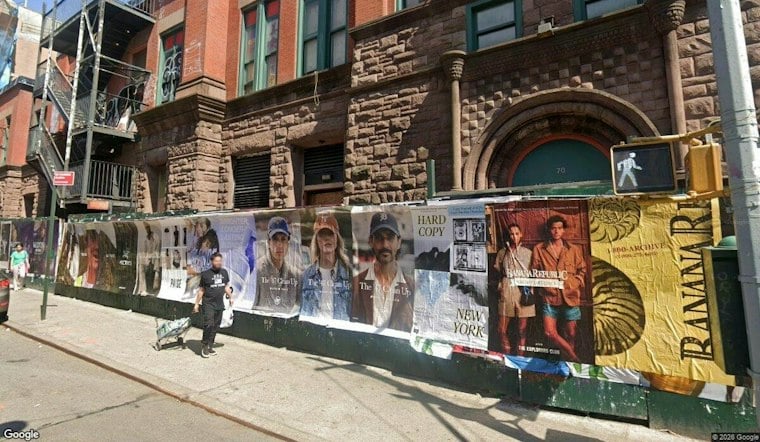
City officials broke ground this week on the long-awaited reconstruction of 70 Mulberry Street, the former public school turned Chinatown community center that was gutted by a five-alarm fire nearly seven years ago. The rebuild will turn the historic structure into an eight-story cultural hub, restoring roughly 51,000 square feet to the five nonprofit organizations that once called it home and adding another 16,500 square feet of new community space.
The building was severely damaged by a five-alarm fire that broke out on its top floor in January 2020, according to 6sqft. The blaze forced demolition of the building's top three floors, while the two lower floors were retained, according to Buro Happold, the engineering firm working on the project. Before the fire, the building housed five community organizations: HT Chen Dance Center, the Chinatown Manpower Project, the United East Athletics Association, the CPC Chinatown Senior Center, and the Museum of Chinese in America's archives, per the same account.
New York City Mayor Zohran Mamdani said the organizations and people who depended on the building were forced to carry on elsewhere after the fire, and that 70 Mulberry Street captures Chinatown's history and hopes, according to 6sqft's reporting. Designed by Grimshaw Architects, the rebuilt facility will create an eight-story cultural hub, the outlet notes, with construction expected to wrap up in 2030 — though a 2025 press release from the city's Department of Design and Construction had put the completion target at 2029, a discrepancy the dossier does not resolve.
A School Building's Long Second Life
70 Mulberry Street was built as a 19th-century public school, though sources differ on the exact year: 6sqft reports it opened in 1893 as Public School No. 23, while Think!Chinatown states the city constructed the building in 1892. The original five-story structure was designed by C.B.J. Snyder in Romanesque and Renaissance Revival style, featuring a pressed brick masonry facade with a brownstone base, per 6sqft's account. The school was decommissioned in the middle of the 1970s and converted into the Chinatown community center that would serve the neighborhood for decades afterward.
The reconstruction project aims to preserve what remains of the building's roughly 130-year architecture, integrating the two-story historic facade into the new structure and keeping the corner stair tower with its spiral staircase intact, the outlet reports. Architect Stephen Pitman described the design as balancing heritage and innovation for a new community center, per the same account, with the preserved facades meant to anchor the building in its past even as the rest of the structure is rebuilt from the ground up.
What the Museum of Chinese in America Nearly Lost
Among the hardest-hit tenants was the Museum of Chinese in America, which initially thought most of its 85,000-item collection stored in the building had been destroyed in the fire. Much of the collection was ultimately salvaged, 6sqft's reporting states, though the scare underscored how much irreplaceable Chinatown history was riding on the building's fate.
The project is being overseen by the city's Department of Design and Construction and the Department of Citywide Administrative Services, and marks the first time DDC has used the Construction Manager-Build method outside of library projects or emergencies — the agency previously relied on that method during COVID-19 field hospital, testing, and vaccination site construction in 2020, according to the outlet.
Funding Figures and a Stalled Timeline
Then-Mayor Bill de Blasio pledged $170 million in 2021 to rebuild 70 Mulberry Street, according to Think!Chinatown. That figure has since grown: the project's price tag is now reported at $184 million, attributed to the mayor's office, per 6sqft's account.
The timeline has also shifted. NYC Databook Capital Projects shows the city's forecast completion date moved to February 4, 2030, as of its May 2026 schedule publication — 22.2 months later than the project's first forecast. A schedule-history entry from that same May 2026 publication attributed the delay to pending approval of necessary permits.
Sustainable Systems and New Shared Spaces
The rebuilt facility will include renewable energy and natural ventilation, creating accessible, flexible spaces for the five returning organizations and the wider neighborhood, 6sqft reports. All new building systems will run on electricity, and the structure will include three new elevators and ADA upgrades. The restored building is required to meet LEED Gold standards but is tracking toward LEED Platinum certification, according to Buro Happold.
The new community space represents about 30 percent more square footage than the original building offered, per 6sqft's reporting. Planned amenities include six community rooms, a kitchen serving the senior center, and a sixth-floor multipurpose room overlooking Columbus Park that can be used for sports and events. The building will also connect to landscaped outdoor terraces facing Mulberry and Bayard streets.
A Memorial Artwork Built From the Fire's Remains
The reconstruction will include a new public art installation by artist Jennifer Wen Ma, titled Wings of Everchange 易之翼, commissioned through the Department of Cultural Affairs' Percent for Art program. The three-part installation includes a suspended sculpture about 33 feet long, made of metal, glass, and objects salvaged from the 2020 fire, according to 6sqft.
The artwork also features amber glass orbs that will serve as time capsules dedicated to memories and stories tied to the building, an ink painting on glass panels along the stairwell, and an oral history component developed with the community, the outlet reports. Ma said the groundbreaking moves the project closer to reopening 70 Mulberry Street, and described Everchange as a three-part public artwork co-created with the community, per 6sqft's reporting.





