

























































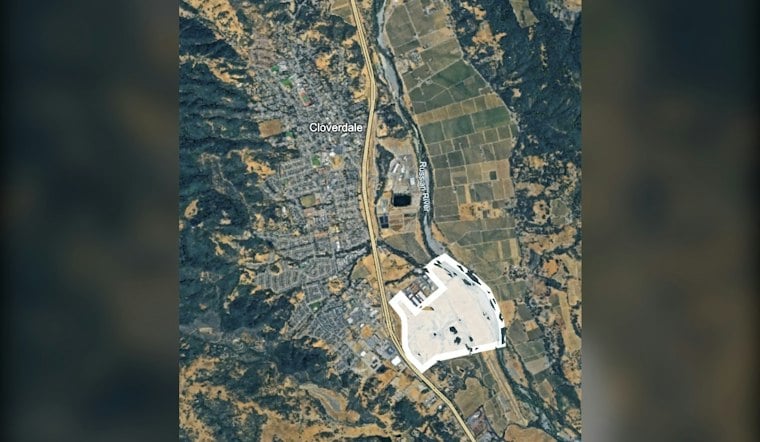
Cloverdale's City Council capped a 3½-hour hearing late Wednesday night by approving the long-debated Esmeralda development, a sprawling plan for housing, a resort hotel and more on the south end of town that sits atop land once used for wood treatment and sawmill operations. The vote sends one of the North Bay's biggest housing proposals in years toward its next phase, even as questions about the site's industrial past and the council's own vote tally linger.
A Late-Night Vote, With Some Confusion Over the Count
According to The Press Democrat, the council approved the Esmeralda proposal by a 4-0 vote on Wednesday night, with Councilwoman Marjorie Morgenstern absent from the meeting. That tally differs from earlier reporting by KQED, which had described a 3-2 council vote to approve the project's overall plan; available records do not make clear how that earlier vote relates to Wednesday's outcome. The council's actions that night, per the Press Democrat's reporting, included adopting the city's Esmeralda Specific Plan, adopting an addendum to a previously certified environmental impact report, and amending the Cloverdale General Plan. City project records separately list a resolution adopting the Specific Plan and Objective Design Standards as formally adopted on Nov. 11, 2026, according to the City of Cloverdale.
Vice Mayor Todd Lands framed the moment as the culmination of a long slog, saying the process involved two years of discussion, negotiations and recommendations, per the Press Democrat's account of the meeting. Tensions ran high enough in the room that Mayor Brian Wheeler had to admonish attendees not to shout over speakers at the podium or the council dais, the newspaper reported.
What's Actually Being Built
As described in the seed reporting, the Esmeralda project would add 605 housing units along with a 160-room resort hotel, a spa and fitness center, restaurants, office space, daycare, athletic fields and a K-6 school. KQED's earlier coverage of the plan put the housing figure at roughly 600 homes and added that the project would include an event center and a preschool, alongside more than 160 acres of parks and open space — a figure that differs from the Press Democrat's reported total of 123 acres of preserved undeveloped open space. The project's design team has said the development would deliver more than $4 million a year to Cloverdale, a city of about 9,000 people that saw its downtown core lose traffic after the Highway 101 bypass diverted cars away in 1994, according to the Press Democrat.
Site-size estimates also vary across sources: the Press Democrat describes the property as 261 acres, KQED has put it at roughly 260 acres, and the city's own FAQ page, along with The Advocate-News, has cited a 266-acre site. The city's FAQ notes that Esmeralda Land Company began community outreach more than three years ago, before it was even under contract to purchase the property.
A Site With a Toxic Past
The land's industrial history is central to why the project has drawn scrutiny. Masonite once operated a wood-preserving facility there, and Louisiana-Pacific ran a sawmill on the same site, per the Press Democrat's reporting. Those past operations left behind hydrocarbons, including petroleum, and wood preservatives including pentachlorophenol, the paper reported. KQED's earlier coverage similarly noted that the site once housed a wood treatment plant known to discharge hazardous waste into the soil and groundwater before it shut down in 1976, adding that state agencies verified the site had been decontaminated by 2012.
The North Coast Regional Water Quality Control Board has declared that the development poses little risk to human health or the environment, attributing that low-risk assessment to soil removal and remaining pentachlorophenol trapped in underground bedrock, according to the Press Democrat. Esmeralda Land Company separately agreed on Nov. 4 to perform a sitewide human health risk assessment, and per KQED's reporting, the company agreed more broadly to conduct additional studies to ensure the site is safe for people to live there before construction begins, with a city-hired environmental consultant reviewing the results. The Cloverdale Planning Commission had earlier voted 4-1 to recommend the council approve Esmeralda's plan with conditions, including environmental mitigation monitoring, KQED reported.
One Councilman's Last-Minute Fight Over Soil Language
Councilman Andrés Marquez had opposed the Esmeralda project for months, and the Press Democrat reported he said the project was being rushed and that decisions were being made on the spot. Wednesday afternoon, the day of the vote, Marquez spoke by phone with Don McEnhill, deputy director of Russian Riverkeeper, and pushed for specific geographic areas of concern to be added to the plan's soil-sampling language.
Esmeralda Land Company's director of development, Michael Yarne, pushed back, saying the existing language already covered all areas of potential contamination, according to the paper's account. Marquez ultimately got the edit he wanted to the soil-sampling language. City Attorney Alex Mog advised that the change could be handled as an administrative edit rather than a substantive amendment — a distinction that mattered because a substantive amendment would have required the resolutions to return to the council in December for an additional reading, per the Press Democrat. Esmeralda Land Company also made concessions on water tanks, evacuation planning, playing fields and other points of contention raised during the broader review process, the paper reported.
An Unfinished Political Backdrop
The vote landed amid a council election that, per the Press Democrat's reporting, was apparently expected to send three new members to the municipal body — with Marquez himself running fifth in that race. The entitlement application the council acted on includes a Specific Plan, Objective Design Standards, a Development Agreement, CEQA environmental documentation and a Tentative Subdivision Map, according to the city's project page, and the city says review of the application draws on its Planning, Engineering, Legal, Fire and Police departments. The city's FAQ also makes clear that approval of the plan is a framework rather than sign-off on individual buildings, and that construction cannot begin until later permitting steps are complete.
Opposition to Esmeralda grew as the project moved closer to approval, KQED reported, with critics in The Advocate-News's reporting citing concerns over water, environmental contamination and the project's financial backers, while supporters pointed to potential tax revenue and benefits for local businesses. A 2009 proposal for the Alexander Valley Resort, which would have included a hotel resort, homes and a golf course, was also once planned for the site but fell through in 2017.





