

























































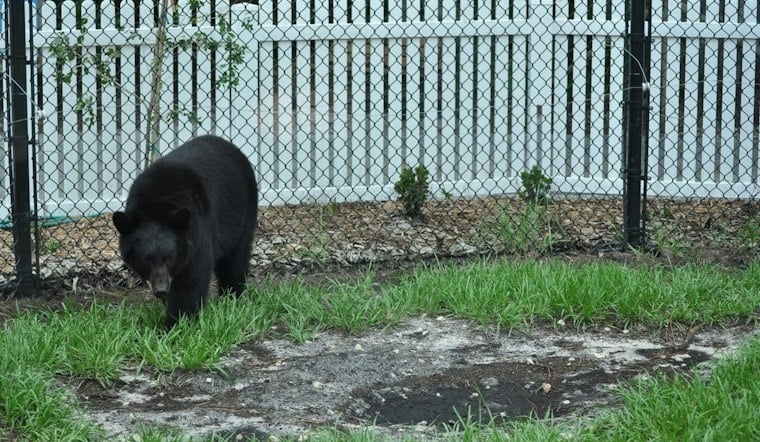
Reporting has documented black bears in three very different Collier County settings: crossing Immokalee Road beneath the Interstate 75 overpass, stuck in a Naples tree, and inside the Naples Zoo.
A driver's video caught the Immokalee Road crossing on a Saturday morning, Gulf Coast News Now reported, while WINK News followed a juvenile from a tree into nearby woods. A separate WINK News account put another juvenile inside the Naples Zoo, where visitors and staff had to leave. The useful question is what a person nearby is supposed to do before any of those endings.
Under the Overpass and Out of a Tree
The Immokalee Road bear crossed beneath the I-75 overpass on a Saturday morning, in video shot by a driver. Gulf Coast News Now reported the scene as a Collier County road, the interstate overhead, and a black bear on the pavement.
The tree bear had a longer exit. WINK News reported that a juvenile got stuck in a Naples tree, then lowered itself and ran into nearby woods. Florida Fish and Wildlife Conservation Commission officers watched it descend, cross the street, enter a retention pond, and work its way into the woods away from people.
Officers watched that bear leave. The zoo encounter moved people instead. A juvenile entered the Naples Zoo on a Saturday afternoon and prompted an evacuation of visitors and staff. Zoo officials said everyone was safely evacuated. FWC arrived to develop a capture plan, and bear biologists might set a trap for relocation if the bear did not leave the area on its own.
Do Not Race a 35-Mph Bear
FWC's encounter guidance is written for the person still standing there. Do not run. Running can trigger a chase instinct, and bears can sprint up to 35 mph. At that speed, the bear wins.
The Florida Fish and Wildlife Conservation Commission tells people to back up slowly toward a secure area and to leave the bear a clear escape route. The tree bear, with officers watching, took an exit of that kind on its own: across the street, into a retention pond, then into the woods and away from people.
Injuries remain uncommon, and the agency says so without treating them as impossible. It is rare for bears to injure people in Florida, but people have been bitten and scratched by bears defending themselves, cubs, or food sources.
The call has a narrower test. If a bear threatens the safety of humans, pets, or livestock, or causes property damage, contact FWC. A crossing under I-75, or a young bear leaving a tree, is not the situation that instruction describes.
Fall Calories and a Long Call Log
Fall is when a bear on the move can be easier to notice. WINK News reported that bears may be more visible as they pass through areas looking for food. An adult, the station reported, needs approximately 20,000 calories a day during the fall.
The phone record is on another scale. Naples Press reported an annual figure of about 6,300 bear-related calls, and 99,582 calls from 2005 through 2024. Calls peaked at 7,311 in 2023 and fell to 5,689 in 2024, when 37% involved conflicts.
Even the lower year was thousands of calls, not a rarity. Encounters are a separate tally. Naples Press reported that statewide bear encounters have increased since 2006, when FWC began keeping records, especially when dogs accompanied humans. Over 19 years, the paper reported 42 encounters, 28 of them involving dogs.
Copeland's Count and a Garage Door
The paper also reported a local radius. Between May 5, 2024, and May 4, 2025, FWC received 16 bear-related calls within 10 miles of Copeland. Three bears were relocated and hazed. One was humanely killed.
Those are not the next step after every sighting. Officers watched the Naples tree bear leave on its own. At the zoo, a trap and relocation were the option if the bear stayed. The Copeland count is the paper's record of bears moved, hazed, or humanely killed in connection with that year's calls inside the 10-mile radius.
A visitor told Gulf Coast News Now that the wildlife comes with the address, bears included, along with coyotes and cane toads. "It is part of living here. It is. You have to look before you open your garage door for bears."
FWC's line is narrower than a glance down the driveway. Back away slowly, and leave the bear a way out. Call if it threatens people, pets, or livestock, or if it damages property. In the encounters this reporting actually describes, the difference between a bear in a retention pond and a bear the agency may have to move is whether it still has that exit.





