

























































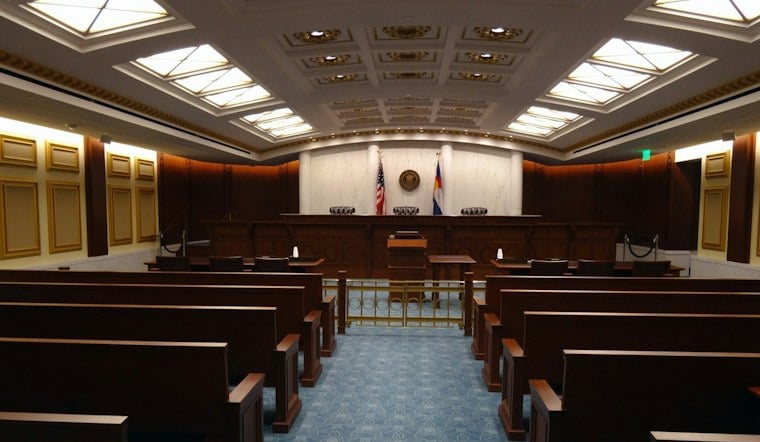
A Colorado appeals court has ruled that mental health officials cannot force medication into a patient through a nasogastric tube without separately proving that method is justified, overturning part of a court order tied to a patient held at the state hospital in Pueblo. The three-judge panel found that the government had failed to show why a tube, rather than a less invasive option, was necessary to medicate the man.
The Case Behind the Ruling
The decision, issued Thursday in In the Interest of Babb, centered on Dean Perry Babb, who entered the Colorado Mental Health Hospital in Pueblo in 2025 after he was found not competent to proceed in a criminal case, according to Colorado Politics. By mid-2026, the hospital had begun administering psychiatric medication, including valproic acid, based on Babb's behavior, the outlet reported.
The hospital later petitioned for authorization to administer the valproic acid to Babb either by nasogastric tube or by mouth, but the Colorado Politics report notes it never explained why the nose-to-stomach tube was warranted in the first place. Babb's treating psychiatrist testified there was no less-intrusive method of “treating” Babb, but according to the same account, the psychiatrist did not address whether medication itself could be administered through a method less intrusive than the tube.
What the Appeals Court Found
A Pueblo County judge had found that the government satisfied the criteria for forcible medication and authorized valproic acid for Babb by tube or by mouth. On appeal, the panel noted that Colorado's existing multifactor test requires proof that a person is not competent to make their own treatment decisions, among other elements, but the question of whether tube administration specifically needed its own justification had not previously been analyzed by the Colorado Court of Appeals.
Writing for the panel, Judge Lino S. Lipinsky de Orlov concluded that medication administration by tube is a bodily intrusion distinct in kind from the intrusion caused by the drug itself, and that evidence supporting involuntary administration of a medication alone does not automatically justify administering it by tube. “We hold that it does” require separate proof, the court wrote, holding that a court may not approve involuntary medication by nasogastric tube absent a showing by clear and convincing evidence that such means of administration satisfies the no-less-intrusive-method element.
The three-judge panel issued the ruling. The panel overturned the portion of the involuntary medication order authorizing tube administration of Babb's medication, basing its reversal on the government's lack of evidence and the trial judge's lack of findings on the need to medicate Babb specifically by tube.
How the Test Normally Works
Colorado's standard for forcing medication on a patient requires proof on several fronts: that the person cannot make their own treatment decisions, that the medication will prevent further decline or danger, that forcible medication is sufficiently compelling, and that no less-intrusive treatment is available. This week's ruling adds a layer specific to the method of delivery, requiring courts to examine not just whether medication is necessary but whether the particular way it's administered meets that same bar.
The framework echoes limits the U.S. Supreme Court has placed on forced medication more broadly. In Sell v. United States, the justices held that the Constitution allows the government to administer antipsychotic drugs against a defendant's will only in limited circumstances meeting specified conditions, a principle aimed at restoring a defendant's competence to stand trial. A separate account in Psychiatric Services describes an earlier case in which an appeals court approved administering clozapine to an unwilling patient by nasogastric tube, reasoning that if a medication is medically necessary, the means used to administer it must be medically necessary as well — a standard that tracks the reasoning Colorado's appellate panel applied this week.
The ruling leaves open what happens next for Babb's underlying medication order or his broader case, details not addressed in the available record. For now, the decision stands as a reminder to Colorado hospitals and courts that forcing a drug on someone and forcing it through a tube are, in the court's words, two separate intrusions requiring two separate justifications.





