

























































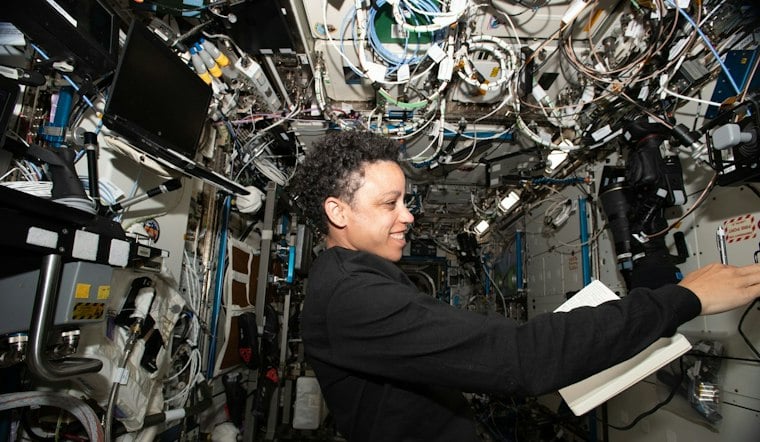
Jessica Watkins, a Colorado astronaut and Lafayette native, cast her ballot in the 2026 midterm election this week from 250 miles above Earth, aboard the International Space Station. She posted a photo of her “I Voted” sticker from inside the orbiting lab, joining fellow NASA astronauts Anil Menon and Luke Delaney in taking part in the election without ever touching down on the planet.
How the Vote Travels From Orbit to Earth
Menon described the process in a video, saying he and his crewmates “voted in the U.S. midterm elections from the International Space Station,” according to Space.com. “We filled out an electronic ballot and sent it securely to the election officials,” Menon said. He added more detail about his own ballot, telling the outlet, “Inside of it is my computer, where I was able to fill out an electronic form and send it to Harris County so I could vote today.” Most NASA astronauts register to vote in Harris County, Texas, since it is home to Johnson Space Center in Houston, per the same report.
Watkins arrived at the station on October 1 as part of the SpaceX Crew-13 mission, which launched alongside Delaney, the station's report notes. It is her second NASA mission; she previously served as crew commander when she returned to the ISS aboard a SpaceX Dragon capsule, according to KFOR.com. In 2022, Watkins became the first Black woman to serve a long-duration mission aboard the space station. Crew-13 is studying life on Earth and in space, according to NASA.
The Encryption Behind an Astronaut's Ballot
Before Election Day, Mission Control at Johnson Space Center uplinks an encrypted electronic ballot to each crew member, according to the National Air and Space Museum. Astronauts then enter specific credentials sent to them by email, fill out the ballot, and downlink their completed vote back to Earth. The museum notes that the county clerk's office on the receiving end collects and counts the astronaut ballots, and that the ballot itself is encrypted and accessible only by the astronaut and the clerk.
This system is not new. The museum traces the practice back to 1997, when NASA astronaut David Wolf became the first person to vote from space, casting his ballot aboard the Russian space station Mir. That voting process took root after Texas lawmakers passed a measure allowing astronauts to vote remotely from orbit. A more recent example came in March 2024, when a pair of astronauts filled out electronic absentee ballots and downlinked them to Johnson Space Center, which relayed the votes to a county clerk's office, according to NASA.
The Legal Framework That Makes It Possible
The arrangement rests on a narrow provision of state law. Texas Election Code Chapter 106 applies only to a person who is unable to vote because they are on a space flight, as defined by the secretary of state, on Election Day or during the early-voting period, according to the Texas Constitution and Statutes. NASA confirms the process traces back to 1997, after Texas passed the bill that first allowed astronauts to vote from space.
Back on the ground, Colorado Governor Jared Polis encouraged residents to vote this week, as the state's own election got underway. For most people on Earth, that still means a ballot box, a polling center, or the mail. For Watkins and her two ISS crewmates, it meant an encrypted file traveling between a laptop in orbit and a county clerk's office back on the planet they left behind in October.




