

























































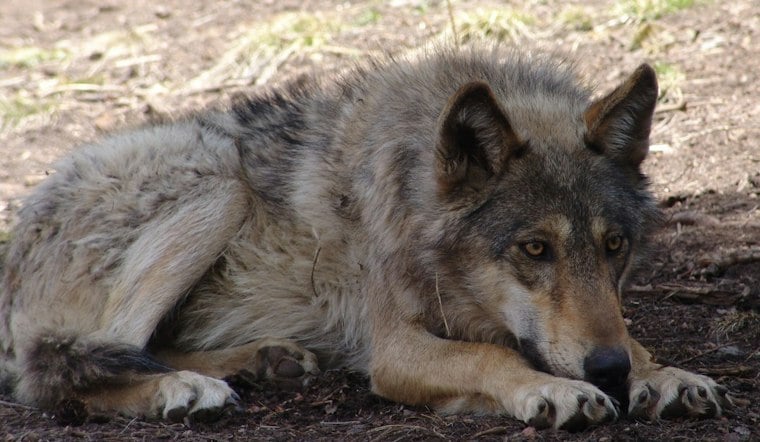
A female gray wolf brought to Colorado from British Columbia in January 2025 has died in Utah, the 20th wolf to die under Colorado Parks and Wildlife’s watch since reintroduction began in December 2023.
Colorado Parks and Wildlife confirmed a mortality alert from the collar on wolf 2516 on Nov. 7, The Colorado Sun reported. The U.S. Fish and Wildlife Service, CPW, the Utah Department of Natural Resources and local law enforcement are investigating. None of the agencies described the cause of death or other details.
Nine Thousand Miles, Then a Line
Wolf 2516 did not stay put. In the roughly 22 months after she was brought from British Columbia, she traveled more than 9,000 miles across Colorado and into neighboring states, Summit Daily reported.
Colorado has an agreement with Utah, New Mexico and Arizona under which gray wolves from Colorado that enter those states can be captured and returned. The collar alert came from Utah. Capture and return never got that far.
Summit Daily also counted this as the ninth death among Colorado’s wolves in 2026. That is a calendar-year tally, separate from the longer count of 20 deaths under CPW’s watch since December 2023.
From 45 Wolves to a Reported 44
As of Sept. 24, Colorado’s gray wolf population totaled 45, counting breeding adults, yearlings and 20 pups. The Sun reported that the Utah death brought the number to 44. That is an adjustment from the September figure, not a new full census.
Twenty-five wolves were transplanted in two rounds. By mid-2026, 14 of the original transplanted wolves had died after vehicle strikes, capture-related complications, legal traps, other predators and shooting deaths.
An earlier snapshot, from Colorado Newsline in 2025, found that eight of the state’s first 25 relocated wolves had died, including three deaths confirmed in 2024, a mortality rate of 32%. The mid-2026 count of 14 original transplants is a later and larger loss from that same introduced group.
Pups Ahead of the Usual Odds
The young wolves have been the brighter number. CPW reported that 82% of detected pups survived their first year in 2025–2026. Typical survival for pups in Western wolf populations runs 50% to 60%. The agency also said that 82% figure will likely fall by the end of the biological year in March 2027.
Adults have not matched that pace. In its 2025–2026 wolf year report, CPW estimated survival at 61% among adult wolves present in Colorado during that biological year. Outside highly protected areas in the Rocky Mountains, adult survival can be 75% a year or lower, with an expected lifespan of 2 1/2 years, The Colorado Sun reported in January.
The British Columbia cohort that included 2516 started below a state benchmark. The 15 wolves brought from British Columbia in January 2025 had a 67% survival rate in the first six months after translocation, under the state’s 70% threshold, Outdoor Life reported.
CPW’s wolf program manager put the stakes in one sentence: “if mortality remains high, as observed in 2025, the risk of failing to achieve a self-sustaining wolf population in Colorado increases.”
A Pause After Lethal Control
Not every death in the program was an accident or an unknown. CPW and state agents killed six wolves after they preyed on livestock multiple times. Some were offspring of the introduced animals. Three were shot in three days in early September.
On Sept. 30, CPW announced it would temporarily suspend the directive that allows gray wolves that harass or kill livestock to be killed. The agency cited concern that population growth may not occur this biological year, and possible evidence of an infectious parasite that could affect future survival.
Utah has its own recent lethal record, and it is a different case. State agricultural officials killed three gray wolves in north-central Utah on Jan. 9, a removal Outdoor Life described as the region’s first since 2010. That account does not identify those animals as wolf 2516, and the agencies investigating her death have not said how she died.
A Harder Start Than Yellowstone’s
Colorado Newsline set the early Colorado losses against the Yellowstone reintroduction. There, 24 of 31 relocated wolves survived the program’s first two calendar years, along with 19 of 23 pups, for a reported total mortality rate of 20%. Colorado’s 32% mortality among the first 25 relocated wolves, measured by 2025, was already higher, and the transplanted animals kept dying into 2026.
The investigation into wolf 2516 is still with federal, Colorado and Utah agencies and local law enforcement. The livestock-killing directive remains under the September suspension, and CPW has already warned that the strong pup-survival number is likely to slip before the biological year ends in March 2027.





