

























































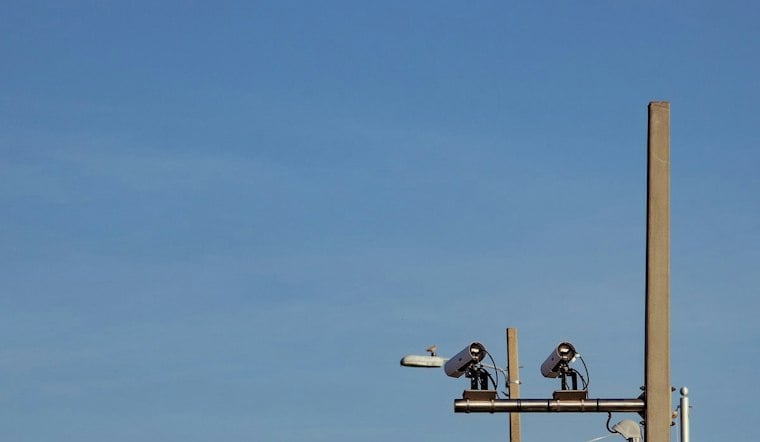
Columbia County's Board of Supervisors unanimously approved a three-month moratorium on license-plate-reading cameras Tuesday night, ordering the sheriff's office to cover the lenses of its eight Flock cameras unless the company agrees to switch them off first. Residents packed the meeting and cheered when the vote came down, capping months of tension over how the cameras ended up in the county in the first place.
According to the Times Union, the Board of Supervisors learned about the Flock deal only after it surfaced at a county committee meeting in August, months after then-Sheriff Don Krapf had already approved a contract for 10 of the cameras. The county's sheriff's office signed the agreement while current Sheriff Jackie Salvatore was still undersheriff, the paper reports. County officials now plan to ask Flock directly to power down the cameras during the pause, and will physically hood the devices if the company does not comply, per the same account.
Supervisor Tistrya Houghtling had pushed for a tougher, six-month pause at a public safety committee meeting the month before, with a plan to form a task force and hold public town halls on the cameras, according to Daily Gazette reporting — but the committee rejected her proposal at the time. Supervisor Robert Lagonia had opposed that version, the Daily Gazette notes, but he's the one who introduced Tuesday's shorter moratorium measure, telling the Times Union that Sheriff Salvatore's support for a pause was what changed the board's willingness to act.
A Contract Dispute Over Who Owns the Data
Sheriff Salvatore has said she wants to change language in the Flock contract stating that the company, not the county, owns the data its cameras collect — a provision Houghtling has also questioned. Houghtling has argued the county shouldn't be gathering information on Flock's behalf at all, and has said the moratorium should become an outright ban if that contract language can't be fixed, per the Times Union.
The dispute got personal at one Valatie farm. Salvatore sought information from Flock about a camera installed at Golden Harvest Farm, the Times Union reports, after someone cut the camera down — only for Flock to reinstall it, according to the sheriff, without her office's permission or knowledge. Her office later hooded that camera itself. A local anti-Flock activist filmed an unmarked white van with Connecticut plates idling near the reinstalled camera on Nov. 4; the van's driver refused to answer the activist's questions and began filming back, the Times Union says. Separately, Lagonia has said Flock has been difficult to reach and has not answered the county's questions, including whether the company has signed contracts with the landowners where it installs cameras — Flock has said it does have such agreements but, per Lagonia's account, has not produced documents proving it.
An Albany County Scandal Looms Over the Debate
The moratorium debate unfolded against the backdrop of a scandal in neighboring Albany County, where an investigator was accused of searching Flock's database roughly 4,000 times, including about 3,000 searches allegedly targeting an ex-girlfriend and four former acquaintances, according to the Times Union. The Albany County Sheriff's Office suspended the investigator, who was charged with misdemeanor counts of second-degree falsifying business records and official misconduct. That office has since rewritten its Flock search policy, which Salvatore has praised, the Times Union reports.
In Columbia County itself, a local activist group has said that 81 percent of the sheriff's office's Flock database searches over the previous two years carried no case number, citing a log obtained through a public-records request, according to the Daily Gazette. Board Chair Matt Murrell told that outlet the pause was meant to give the county time to get more information. Sources differ on when Columbia County bought its 10 cameras: the Times Union has reported the purchase came the year after a tabled 2023 request to sign a memorandum of understanding, while the Daily Gazette has reported the purchase happened in 2025 using a state law enforcement technology grant, without supervisors' knowledge.
Columbia County Joins a Growing Statewide Pushback
Columbia County is far from alone. The New Lebanon Town Board banned Flock cameras from town resources on Sept. 8, though that ban does not extend to cameras set up by the sheriff's office. Dutchess County pledged in September to remove 65 county-operated Flock cameras after its district attorney and sheriff withdrew their support for the technology, and Newburgh ended its Flock contract in October. Ulster County Executive Jen Metzger signed an executive order banning Flock cameras in her county last month even though Ulster had none installed, making her the first official in New York to ban the cameras by executive order, according to Spectrum News.
The retreat extends well beyond the Hudson Valley. At least 10 local governments and police departments have moved since summer to curb, restrict, or end their use of Flock technology, including Newburgh, Richmond, Virginia, and South Windsor, Connecticut — where cameras reportedly went live the previous year without public warning or a vote before the town voted in October to remove them — according to TechCrunch. Flock has responded by shortening its default data-retention period for new customers from 30 days to seven and requiring a case code before any database search, the outlet reports.
State lawmakers are weighing in too. New York legislators are considering new restrictions on automated license-plate-reader technology, with Assemblymember Nily Rozic noting the state currently lacks universal minimum standards for how the systems collect, retain, and share information, according to WKBW. A bill from Assemblymember Pamela Hunter would limit how government agencies can use the systems and require audit logs and public reporting, the station reports.
Back in Columbia County, the moratorium could still extend beyond its initial three months, Lagonia has said, calling the pause a chance to see whether the county can work through its issues with Flock. Elliott Matos, managing director of the Hudson Catskill Housing Association, called the vote an important step toward a permanent countywide Flock surveillance ban and urged transparency, accountability, and an end to surveillance practices he said threaten community privacy and safety.




