

























































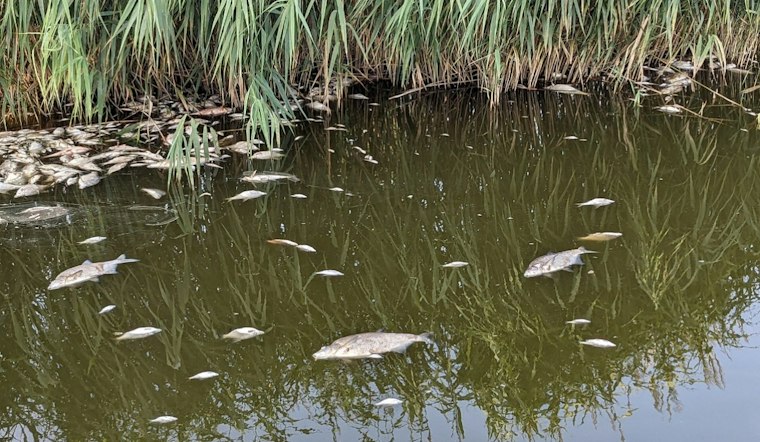
More than 200 dead fish turned up in Smith Branch Creek near Page Ellington Park on Oct. 30, along with a light oil sheen and a distinct petroleum odor that investigators have not yet traced to a source. South Carolina environmental staff were called in after a concerned citizen reported the die-off, and the cause, including whether a suspected petroleum spill is actually responsible, remains unconfirmed.
Yahoo News reported that staff inspected the creek on Oct. 30 after receiving reports of a fish kill near Page Ellington Park. The Post and Courier reported that a citizen called the Congaree Riverkeeper's pollution hotline, prompting Riverkeeper Bill Stangler's office to call in South Carolina's Departments of Environmental Services and Natural Resources that same day. Investigators found dead small sunfish, including bluegill and perch, along the waterway, with the oily sheen and petroleum smell detected behind the Central Energy venue in the BullStreet District, downstream from underground storm drains.
Conflicting Counts on the Scale of the Die-Off
Just how many animals died depends on which count you look at. Yahoo's report, citing the inspection, put the number at more than 200 dead fish, primarily small sunfish species. The state Department of Natural Resources, however, estimated well over 1,000 fish, frogs and tadpoles were killed, with dead fish found extending downstream to Earlewood Park, according to the Post and Courier. The two figures describe different scopes of the same event, and the dossier does not reconcile them.
The potential fuel spill appeared to cover pockets over approximately 100 feet of the creek, the Post and Courier reported, though investigators found no obvious source for the sheen or the chemical smell. Stangler said the cause and source of the suspected petroleum spill, along with the amount of oil in the waterway, remain unknown. He added that the spill appeared to have occurred a couple of days before the fish kill was discovered, and that Smith Branch Creek's water level had spiked a few days earlier, based on water-quality data and a USGS gauge reviewed by investigators.
Ruling Out — and Not Ruling In — Other Causes
Fish kills commonly result from low dissolved oxygen, large temperature swings or pollution, Stangler said, but investigators discounted all three as causes in this case. Columbia had a water-main break on Oct. 25, but it was unclear whether it caused or contributed to the fish kill. A DES spokesperson said the cause of the fish kill has not been confirmed and that investigators cannot determine whether the suspected spill contributed to the deaths, while Benjamin Wildt, Columbia Water's communications manager, said the source of the petroleum spill has not been pinpointed and DNR has taken the lead in the investigation.
Elsewhere in South Carolina this year, low dissolved oxygen has been the culprit in similar-looking die-offs. Thousands of dead fish were found floating in Turkey Creek and washing ashore in Hanahan in August, with officials eyeing extreme heat and low oxygen, according to ABC News 4. More than a thousand dead fish were found floating in Smythe Lake on Daniel Island in October, a kill that the state attributed to low dissolved oxygen, per Live 5 News. Warm water holds less dissolved oxygen than cooler water, and levels can fall further overnight, a dynamic cited in the Turkey Creek case — but investigators in the Smith Branch case have specifically discounted low dissolved oxygen as a cause.
Is Columbia's Drinking Water at Risk?
Smith Branch Creek flows into the Broad River above the Columbia Canal, which is one of the primary drinking-water sources for Columbia, West Columbia and Cayce, according to the Post and Courier. That geography is what has residents asking questions. Columbia officials told the paper that the city's drinking-water quality and safety are not a concern, with one official stating that Columbia's water is safe and faces no threat.
Columbia Water says the city's water comes from the Broad River Diversion Canal and Lake Murray, is treated at one of two water treatment plants, and is delivered to homes through underground pipes, according to Columbia Water. Treated drinking water contains chlorine or chloramine, which is safe for humans to drink but can harm fish by burning their gills.
An Urbanized Watershed Prone to Runoff
Smith Branch's watershed is highly urbanized, with 37% impervious cover, according to a City of Columbia watershed plan from 2017. That same plan identifies oils, greases and metals among the contaminants that can reach the creek from roadways and other sources. Development, including roads, buildings and parking lots, can replace natural vegetation and change how water flows into nearby creeks, Yahoo reported, citing Bailey Parker. Columbia's storm drains lead directly to the city's creeks and rivers rather than to sewer treatment plants, which is why officials are urging residents not to dump chemicals or cleaning supplies down storm drains and to report any such dumping so agencies can remediate potential problems.
The pattern of murky causation is not unique to Smith Branch. In a 2021 diesel spill near Columbia, state regulators initially said 800 gallons leaked onto the ground and into a storm drain, while a contractor's project manager put the figure that actually reached the creek at about 200 gallons, according to The State. Emergency crews in that case found that stormwater pipes and drainage conduits connected the release site directly to the creek, much like the storm-drain network implicated in the current Smith Branch investigation.
Stangler noted that fish are more susceptible to pollution issues than people because they live in the water full time, and that the Congaree Riverkeeper's office investigates about one or two fish-kill incidents per year, though some years bring none at all. For now, he said, the cause of the Smith Branch kill remains unresolved. Residents who spot large numbers of dead fish are asked to report them to the Congaree Riverkeeper at 803-760-3357, the Department of Environmental Services at 888-481-0125 or the Department of Natural Resources at 800-922-5431.




