

























































Tricia Sheldon was told she had three to five years to live. On Sunday, more than two years after a stranger's stem cells helped pull her back from that prognosis, the Council Bluffs woman was scheduled to meet her donor face to face for the first time.
Sheldon was diagnosed with polycythemia vera in 2012, which later progressed into myelofibrosis, the paper reported. Doctors considered about 17 potential stem-cell matches before narrowing the search to three and selecting Trace Passmore, an Illinois resident who had registered as a potential donor after seeing a high-school advertisement, according to the Journal Star.
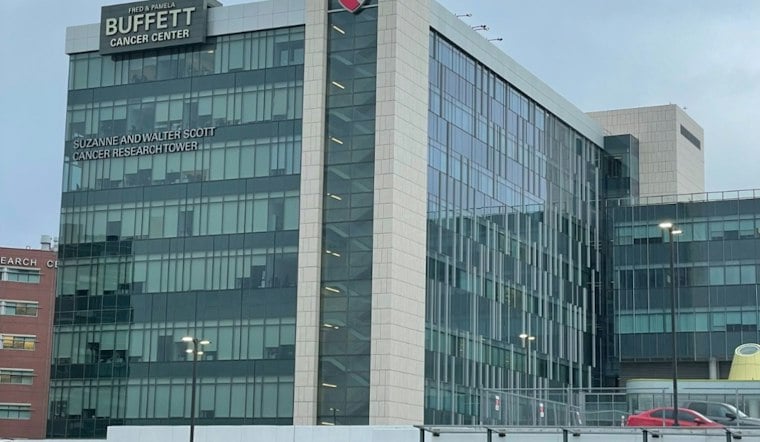
Passmore traveled to Chicago for the stem-cell collection, and Sheldon received the transplant at Omaha's Buffett Cancer Center on Oct. 30, 2024. She had been admitted on Oct. 23 for intensive chemotherapy. During treatment, she lost her hair, needed a feeding tube and received several blood transfusions, according to the Journal Star.
A Rough Recovery and a 'Rebirth Day'
Sheldon calls Oct. 30, 2024, her rebirth day, the Journal Star reported. Her husband took 100 days off work without pay to care for her, and her daughters organized a GoFundMe to help with expenses. Sheldon also received grants from cancer organizations during her recovery.
After the transplant, Sheldon's blood type changed from A positive to O positive, according to the newspaper. She also developed pneumonia and graft-versus-host disease.
In September 2025, Sheldon was hospitalized with respiratory infections and pneumonia. Her heart stopped beating for nine seconds during that hospitalization, the Journal Star reported. She has continued monthly IVIG treatments and had to repeat childhood vaccinations after chemotherapy wiped out her immune system.
Remission Since January 2025
Sheldon has been in remission since January 2025, according to the paper. Before Passmore was selected, her brother was tested as a potential donor, while one of her three sisters declined testing. Sheldon has three sisters and one brother in total, the Journal Star reported.
Finding any match at all is not guaranteed for every patient. A 2022 registry model from NMDP found that the likelihood of a closely matched 8/8 donor ranged from 74% down to as low as 16% depending on a patient's race and ethnicity, with Black and African American patients facing only a 29% chance of finding an available match on the registry. The same modeling found that broadening the search to include donors with matches as low as 5/8 pushed availability above 99% for every group studied, even when limited to donors age 35 or younger.
Messages, a Phone Call, Then a Meeting
Before the planned meeting, Sheldon and Passmore had exchanged messages, photographs and information about the donation process, as well as having a brief phone conversation, according to the Journal Star.
The pair had planned to discuss their experiences during a 5 p.m. Sunday TikTok Live. Sheldon told the paper she hoped their stories would encourage people to learn about stem-cell donation and consider joining the donor registry.
Donor-recipient reunions like the one Sheldon anticipated have played out elsewhere in recent months. University of Houston football coach Donn Landholm received his own stem cell transplant on Feb. 4, 2025, for chronic myelomonocytic leukemia, and finally met his donor, Morgan Chalup, in person at the university this past September after the waiting period for donor-recipient contact had passed, according to People. In a similar case detailed by City of Hope, lymphoma patient Crystal Cornelius received donor Cody Duge's cells through a transplant on May 8, 2024, and the two did not meet in person until Sept. 14, 2026.
On the donor side, the process itself can be demanding. The University of Wisconsin System detailed how donor Cadence Cordova spent six hours donating peripheral blood stem cells for a cancer patient in Kansas City, lying covered in warm blankets as a machine separated the stem cells from her blood. Passmore donated in Chicago, and Sheldon received her transplant in Omaha.
Safeguards for Donor Cells
For unrelated-donor transplants, donor eligibility is governed by regulations that include screening and testing requirements. The FDA says regulations under 21 CFR part 1271, subpart C set those requirements for donors of covered human cell, tissue and cellular and tissue-based products.



