

























































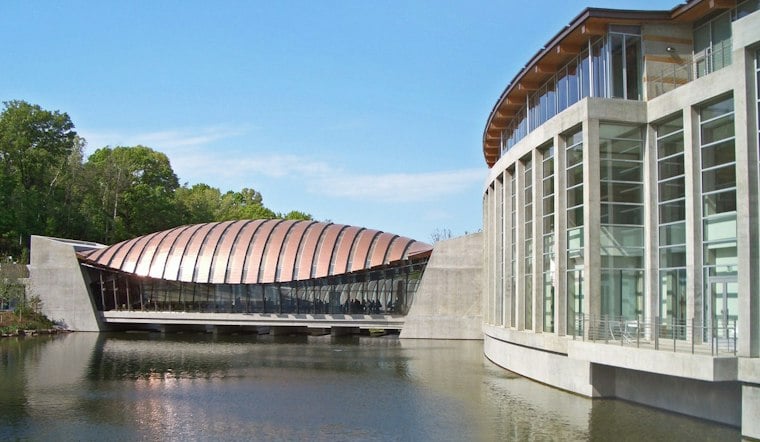
Crystal Bridges Museum of American Art got noticeably bigger when its 114,000-square-foot expansion designed by Moshe Safdie opened to the public on June 6 and 7, 2026, boosting its total footprint by 50 percent and drawing nearly 10,000 visitors over the two-day celebration. The free, admission-free institution in Bentonville, Arkansas, welcomed visitors for the opening.
The addition includes a glass-bridge gallery, a new contemporary art gallery and a cafe, according to Crystal Bridges. Since the museum first opened in 2011, funded by Walmart heir Alice Walton, it has welcomed more than 15 million visitors without ever charging admission, the museum says. That kind of sustained draw has made Crystal Bridges a singular cultural force in a part of the country rarely associated with architectural ambition.
The museum sits at the center of a broader campus transformation. According to the Alice Walton Foundation, the 134-acre Crystal Bridges Campus now features three landmark buildings connected by trails. In 2025, the Heartland Whole Health Institute and the Alice L. Walton School of Medicine opened on the same grounds, with the medical school building alone spanning 154,000 square feet, according to Architectural Record. The Heartland Whole Health Institute was designed by Marlon Blackwell Architects of Fayetteville, Arkansas, the foundation notes.
A Museum That Reshaped Its City
Crystal Bridges' impact on Bentonville itself has been dramatic by the numbers. As reported by The New York Times, Bentonville had a population of about 37,000 when the museum opened in 2011, and that figure has nearly doubled since. The Times also reports that a single-family home in Bentonville sold for about $175,000 on average in 2011 and now costs around $490,000, while average rent has nearly tripled to about $2,000 a month from roughly $800.
The city has added award-winning restaurants, shopping, boutique hotels, condominiums, offices and a highly sophisticated bike-trail network since the museum's debut, per the same Times report. Architect Moshe Safdie recalled that when he first encountered the area, it was mostly empty land, and there were no restaurants on the town square, the Times reports. The Walton family describes its civic investments across the region as giving back, according to the same account.
Why Architects From Dublin to Denmark Are Arriving
Crystal Bridges' expansion is only one piece of a design boom spreading across Northwest Arkansas, which ranks among the 10 fastest-expanding metro areas in the United States, according to census figures cited by the Times. The region has attracted architects from New Orleans, New York, Chicago, Denmark and Switzerland, the paper reports.
Twenty-five miles away in Fayetteville, Dublin-based Grafton Architects — winner of the 2020 Pritzker Prize — built the Anthony Timberlands Center for the University of Arkansas's Fay Jones School of Architecture and Design, according to the Times. The nearly 45,000-square-foot educational building, designed with local practice Modus Studio, opened at the end of August and was conceived to showcase construction using timber and wood products sourced primarily from Arkansas forests and mills, Architectural Record reports. It marks Grafton's first completed building in the United States, the outlet notes, and the Times adds that the project was underwritten by a major timber supplier.
Tod Williams + Billie Tsien Architects, the firm behind the new Obama Presidential Center, is also designing an art center currently underway in Northwest Arkansas, according to the Times. That project received funding from a former Walmart employee, the paper reports. Together with Crystal Bridges' own expansion — which Metropolis notes now serves roughly 800,000 annual visitors — the projects reflect a concentrated bet that world-class design can remake a rural corner of the Ozarks into a cultural destination.




